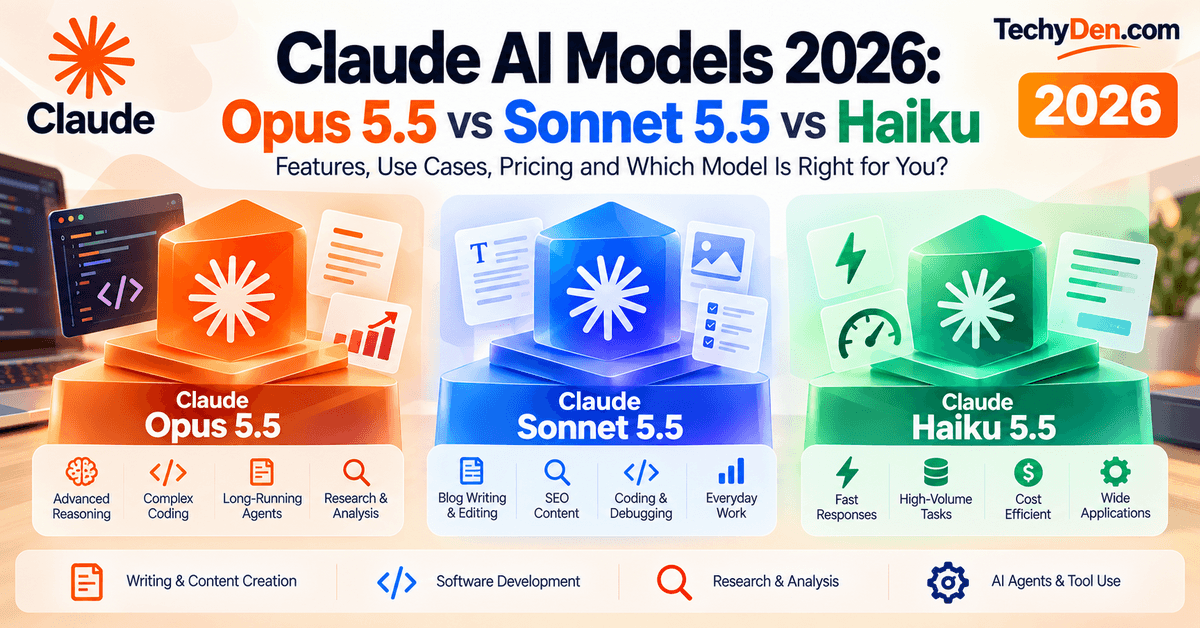
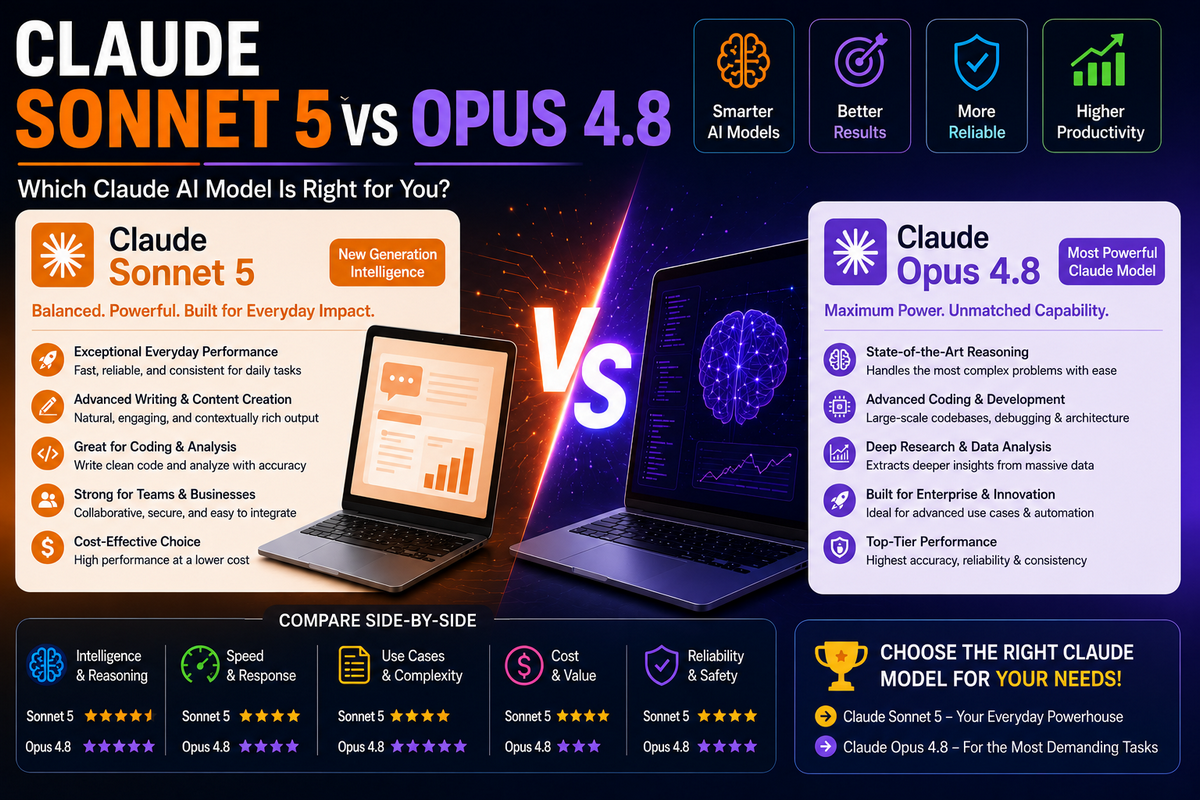
Anthropic’s Claude lineup has moved beyond the original Claude Sonnet 5 and Opus 4. In 2026, the most important models for everyday work are Claude Sonnet 5 (the new default Sonnet) and Claude Opus 4.8 (the latest Opus revision). Choosing between them still isn’t just about raw intelligence—it’s about matching the right model to your workload, budget, and speed requirements.
Choosing between them isn’t just about raw intelligence—it’s about matching the right model to your workload, budget, and speed requirements. This guide breaks down every key difference so you can make the best decision.
When comparing Claude Sonnet 5 vs Opus 4.8, most users will find Sonnet 5 offers a better balance of speed, cost, and quality for everyday workloads, while Opus 4.8 remains the precision tool for the hardest tasks.
What Are Claude Sonnet 5 and Opus 4.8?
Both models are part of Anthropic’s latest Claude family, but they serve different purposes. Claude Opus 4.8 is Anthropic’s flagship Opus‑class model, engineered for deep analytical reasoning, complex coding, and demanding agentic workflows.
Claude Sonnet 5 is the newest mid‑tier Sonnet model, built for speed, cost‑efficiency, and strong agentic performance, making it ideal for high‑volume, production‑grade applications.
In simple terms: Opus 4.8 = maximum precision, Sonnet 5 = best cost‑performance balance.
Claude Sonnet 5 vs Opus 4.8: Key Differences at a Glance
| Feature | Claude Opus 4.8 | Claude Sonnet 5 |
|---|---|---|
| Release Date | May 28, 2026 | June 30, 2026 |
| API Input Price | $5 per 1M tokens on the platform. | Intro: $2 per 1M (to Aug 31, 2026), then $3 per 1M |
| API Output Price | $25 per 1M tokens on the platform. | Intro: $10 per 1M, then $15 per 1M |
| SWE‑bench / coding | Opus 4.8 leads on the hardest coding tasks; higher verified scores | Very close to Opus 4.8 on many coding + agent benchmarks at lower cost |
| Agentic benchmarks | Strongest overall for the hardest agent workloads | Near‑Opus performance on many BrowseComp and OSWorld tests |
| Context Window | Up to 1M tokens platform. | Up to 1M tokens (similar to Sonnet 4.6, with improved behavior) |
| Max Output Tokens | Up to ~128K in some configs | Large outputs (tens of thousands of tokens) suitable for long documents |
| Speed / Effort | Higher effort modes for maximum accuracy | Wider range of cost‑performance options; efficient at medium effort |
| Best For | Hardest reasoning, enterprise‑grade coding, high‑stakes tasks | Daily driver for most apps: chat, content, coding, agents |
| Cost Efficiency | Premium (more expensive per token) platform. | Best value for near‑Opus performance |
In real-world projects, the Claude Sonnet 5 vs Claude Opus 4.8decision usually comes down to whether you prioritize budget-friendly scalability or maximum reasoning depth.
Performance & Benchmarks
Claude Opus 4.8 leads on the most demanding technical and agentic benchmarks, especially at higher effort levels. It is positioned as Anthropic’s top choice when you need maximum accuracy on complex coding, multi‑step reasoning, and long‑running agent workflows.
Claude Sonnet 5, however, is a strict improvement over Claude Sonnet 5.6 on every benchmark Anthropic has published and narrows the gap with Opus 4.8 while costing significantly less.
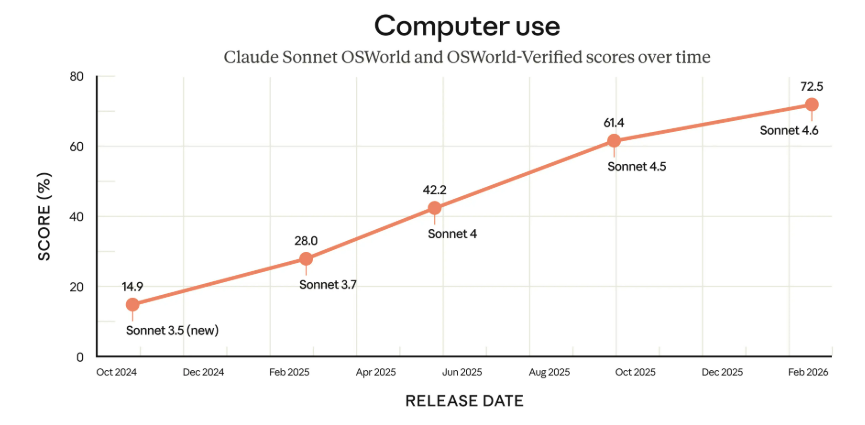
Independent summaries show Sonnet 5 beating Claude Sonnet 5.6 across all tested agentic and computer-use evaluations, while often landing just a few points behind Opus 4.8.
Key takeaway: For absolute peak performance on the hardest tasks, Opus 4.8 still wins. For most real‑world workloads, Sonnet 5 delivers near‑Opus performance at a much better price.
Pricing: Opus 4.8 vs Sonnet 5
Pricing is still where the two models diverge most sharply.
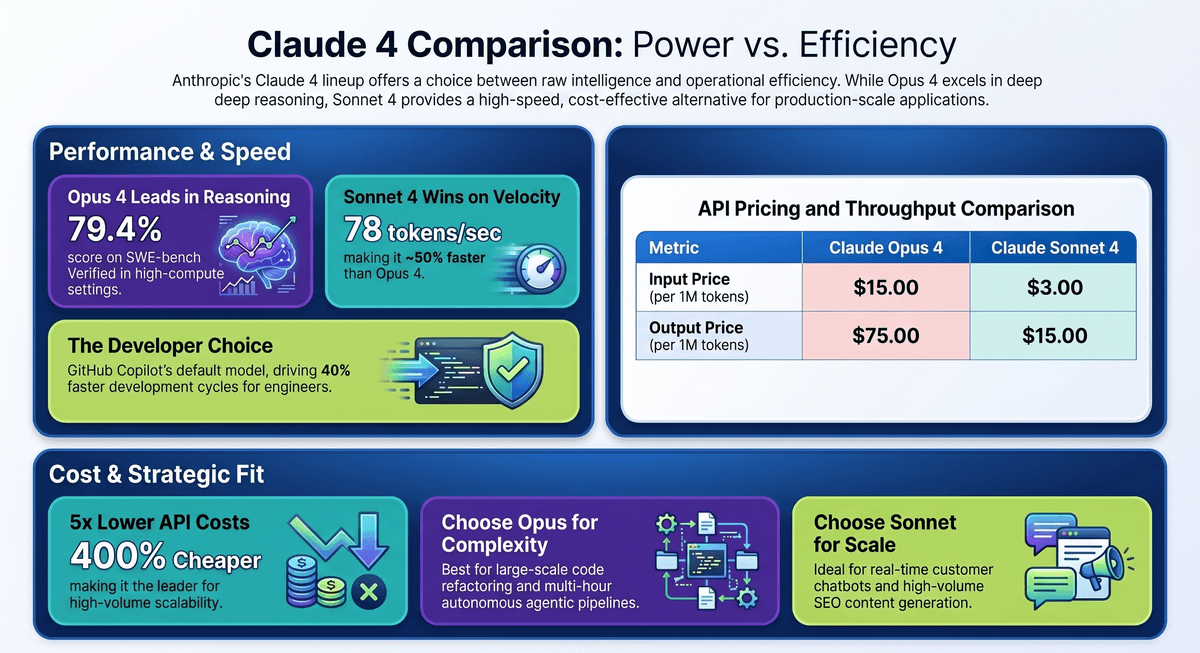
- Claude Opus 4.8 costs $5 per 1M input tokens and $25 per 1M output tokens, with an optional Fast mode at $10 / $50 that is about three times cheaper than previous Opus fast tiers.
- Claude Sonnet 5 launches with introductory pricing through August 31, 2026 at $2 per 1M input and $10 per 1M output, then moves to $3 / $15 from September 1, 2026 — the same standard rates Claude Sonnet 5.6 used.platform.
For a developer processing 10 million tokens per month, choosing Sonnet 5 instead of Opus 4.8 can save a meaningful amount of money while only giving up a small margin of peak performance. For startups or high‑volume SaaS products, this cost difference remains a crucial factor.
Speed & Latency
With Sonnet 5 and Opus 4.8, the core trade‑off stays the same: Sonnet 5 is the best default for most users, while Opus 4.8 is reserved for the hardest, highest‑value tasks.
In practice, Sonnet 5 is designed to offer a better cost‑performance curve than Opus 4.8, especially at medium effort settings, while Opus 4.8 keeps higher‑effort modes for maximum accuracy.
Sonnet 5’s design makes it an excellent default for interactive apps where latency and cost matter, while Opus 4.8’s higher‑effort modes are better suited to batch and high‑stakes jobs.
Use Cases: Who Should Use What?
Choose Claude Opus 4.8 If you need:
- Deep code analysis, refactoring large codebases, or debugging complex logic
- Long-running agentic tasks that span hours with multiple tool calls
- Advanced mathematical reasoning or scientific research synthesis
- High-stakes enterprise workflows where accuracy outweighs cost
- Multi-document research where cross-source thematic continuity matters
Choose Claude Sonnet 5 If You Need:
- Fast, high-volume content generation for blogs, emails, or product descriptions
- General-purpose coding assistance, pair programming, or everyday dev tasks
- Customer-facing chatbots and AI-powered support systems
- Cost-effective API integration for startups or production apps
- Creative brainstorming, marketing copy, and ideation
- For content creators, the Claude Sonnet 5 vs Claude Opus 4.8question is simple: Claude Sonnet 5 is ideal for high-volume SEO writing, while Claude Opus 4.8fits premium, research-heavy pieces.
Agentic & Coding Capabilities
Both models support extended thinking and agentic workflows, but Claude Opus 4.8was specifically engineered to handle longer, more complex chains of agent actions with fewer dead ends.
In head-to-head agentic evaluations, Claude Opus 4.8demonstrates stronger performance on multi-hour autonomous coding and reasoning pipelines, where maintaining contextual consistency over thousands of lines of code is critical.
From a developer’s perspective, Claude Sonnet 5 vs Claude Opus 4.8is a trade-off between lightning-fast feedback loops in Sonnet and deeper, more deliberate reasoning in Opus.
For everyday coding, Claude Sonnet 5 remains the dominant choice in the developer community. GitHub chose Claude Sonnet 5 as the default model for GitHub Copilot because of its edge in productivity-focused, agentic coding scenarios. Cursor users have called it a “cheat code for coding speed.”
Context Window: Are They the Same?
Both Claude Sonnet 5 and Claude Opus 4.8share a 200K token context window. This is sufficient for most use cases, including analyzing long documents, processing large codebases, or handling extended conversations.
It’s worth noting that later versions of both models have expanded context capabilities—Claude Sonnet 5.6 now supports a 1M token context window, giving the Sonnet line a significant edge for large document processing going forward.
Claude 4 vs Later Versions: Where Does the Family Stand?
Since the original Claude 4 launch, Anthropic has released multiple upgrades, including Opus 4.5, Opus 4.6, Opus 4.8, Sonnet 4.5, Sonnet 4.6, and now Sonnet 5. Claude Sonnet 4.6 was an important step with a 1M‑token context window, but Sonnet 5 is now the default model on claude.ai for Free and Pro users.
The Opus line has also evolved. Opus 4.8 keeps the $5 / $25 per 1M token pricing from earlier Opus versions but adds improved performance and cheaper Fast mode, making it a more attractive option for enterprise‑grade workloads.
Frequently Asked Questions on Claude Sonnet 5 vs Opus 4
Is Claude Opus 4.8worth the extra cost?
Claude Opus 4.8 is worth the extra cost only when your tasks genuinely demand elite-level reasoning—such as complex multi-step code refactoring, in-depth scientific research, or high-stakes agentic pipelines. For everyday writing, coding assistance, and content generation, Claude Sonnet 5 delivers nearly identical results at one-fifth the price, making it the smarter default for most users and businesses.
Which model is faster—Claude Sonnet 5 or Opus 4?
Claude Sonnet 5 is significantly faster than Opus 4. Claude Sonnet 5 generates output at approximately 78 tokens per second with a time-to-first-token of just 320ms, whereas Claude Opus 4.8 averages around 50 tokens per second with a 500ms TTFT. For real-time applications, customer chat interfaces, and interactive coding environments, Claude Sonnet 5’s speed advantage translates directly into a better user experience.
Can I use Claude Sonnet 5 for free?
Yes, you can access Claude Sonnet 5 for free through Anthropic’s Free plan on claude.ai, though it comes with daily usage limits. For heavier usage, the Pro plan starts at $20 per month and unlocks higher message limits. Developers can also access Claude Sonnet 5 via the API, where it is priced at $3 per million input tokens and $15 per million output tokens.
What is Claude Opus 4.8best at?
Claude Opus 4.8shines at tasks requiring deep, sustained reasoning over long sessions. It is best suited for complex software engineering, large codebase analysis, multi-hour agentic workflows, and advanced research synthesis. In head-to-head tests, Claude Opus 4.8 also demonstrated superior performance on document analysis, extracting deeper thematic insights from dense technical or scientific materials compared to Claude Sonnet 5.
Are there newer versions than Claude Sonnet 5 and Opus 4?
Yes. Anthropic has released several iterative upgrades since the original Claude 4 launch, including Sonnet 4.5, Sonnet 4.6, Opus 4.5, Opus 4.6, Opus 4.8, and Sonnet 5. As of mid‑2026, Claude Sonnet 5 is the default model on claude.ai and offers improved agentic performance, while Opus 4.8 is the latest Opus‑class model for users who need maximum accuracy.
Is Claude Sonnet 5 good enough for professional coding?
Absolutely. Claude Sonnet 5 scores 72.7% on SWE-bench. Verified—just 0.2 points below Opus 4’s original 72.5% score—making it highly competitive for professional development tasks. GitHub integrated Claude Sonnet 5 as the default model for GitHub Copilot, and platforms like Replit and Cursor rely on it heavily. Developers consistently report 40% faster development cycles using Claude Sonnet 5 over previous-generation models.
Final Verdict: Claude Sonnet 5 vs Opus 4
After comparing every dimension — performance, speed, pricing, and real-world use cases — it is clear that Claude Sonnet 5 and Claude Opus 4.8 both have a well-defined place in Anthropic’s lineup.
Claude Sonnet 5 is the best choice for the majority of users. Whether you are a blogger generating SEO content at scale, a developer building AI-powered apps, or a startup integrating LLMs into a product, Claude Sonnet 5 delivers exceptional quality at a price that doesn’t break your budget.
It is 5x cheaper than Opus 4.8, generates responses faster, and has been trusted by industry giants like GitHub and Replit as their default model—a testament to its real-world reliability.
Claude Opus 4.8, however, remains unmatched when the stakes are high.
If your workflow involves complex, multi-hour agentic pipelines, advanced scientific reasoning, or mission-critical enterprise tasks where even a 1–2% gain in accuracy has a significant downstream impact, Claude Opus 4.8 justifies every penny of its premium price tag.
The smartest strategy is a tiered approach:
- Use Claude Sonnet 5 as your everyday workhorse for content generation, routine coding, customer support, and general tasks
- Reserve Opus 4 for your most demanding, high-value workflows where depth of reasoning is non-negotiable
- As your needs evolve, consider using Sonnet 5 as your daily driver and Opus 4.8 for your highest‑value workflows.
Ultimately, the “best” Claude model isn’t the most powerful one—it’s the one that perfectly aligns with your goals, workflow, and budget. For most content creators, developers, and marketers, Claude Sonnet 5 will be more than enough.
For researchers, enterprise AI engineers, and power users chasing peak performance, Claude Opus 4.8 is worth every dollar.
Ultimately, the Claude Sonnet 5 vs Claude Opus 4.8 choice should align with your business model, traffic volume, and tolerance for higher API costs in exchange for top-tier performance.
Start with Claude Sonnet 5, push its limits—and you may never need to upgrade.