Best Residential Proxies of 2026: Top 10 Residential Proxy Services Compared
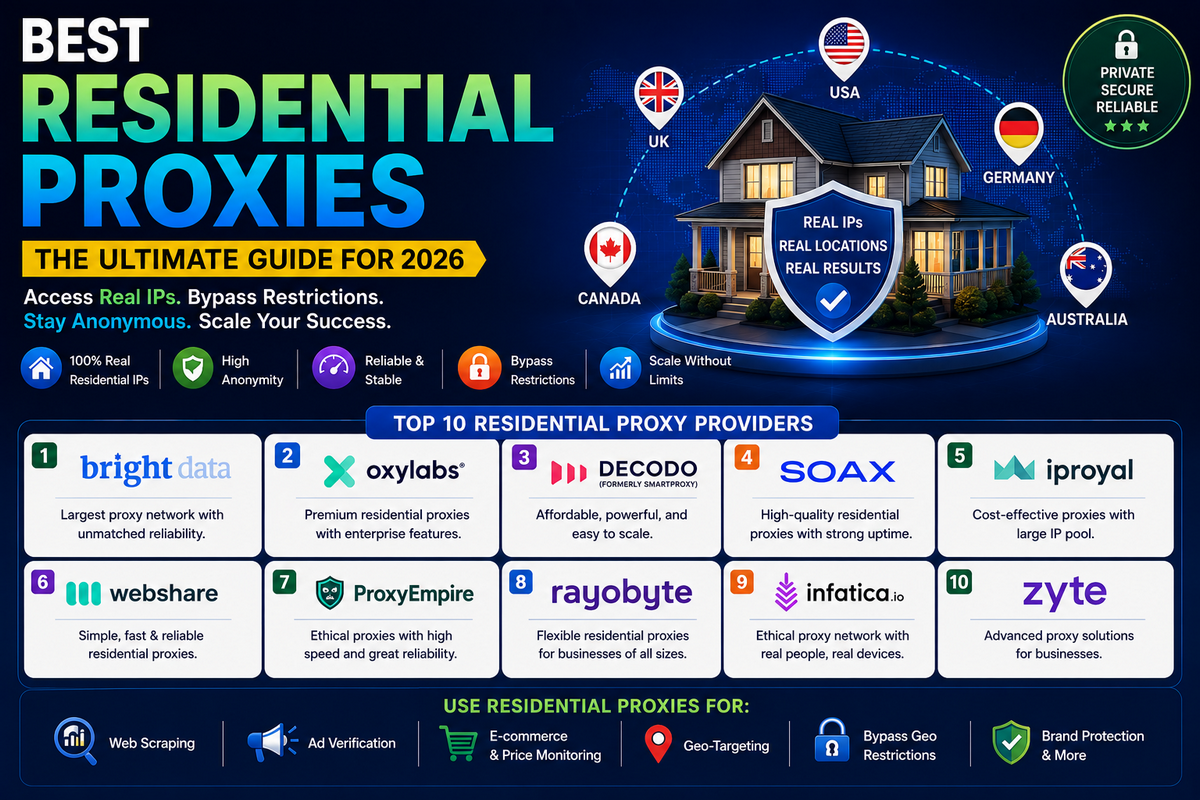
Looking for the best residential proxy service in 2026? We’ve researched and compared the top residential proxy providers based on network size, speed, pricing, success rate, global coverage, ease of use, and overall value.
Finding the best residential proxy can be challenging, especially with dozens of providers claiming to offer the fastest speeds, largest IP pools, and the most reliable connections.
Whether you’re an SEO professional tracking keyword rankings, a developer scraping publicly available web data, a digital marketer verifying advertisements, or an eCommerce business monitoring competitor prices, choosing the right residential proxy service can significantly improve your workflow while reducing the risk of IP bans and CAPTCHAs.
Unlike datacenter proxies, residential proxies use real IP addresses assigned by Internet Service Providers (ISPs). This makes your requests appear as though they originate from genuine residential users, resulting in higher anonymity, improved success rates, and more reliable access to websites.
They are widely used for SEO monitoring, SERP tracking, web scraping, market research, ad verification, social media management, brand protection, and location-specific content testing.
Quick Recommendation
If you’re looking for the best overall residential proxy, Bright Data stands out for its massive residential IP network, enterprise-grade infrastructure, advanced geo-targeting, and consistently high performance. For users seeking a more affordable solution, Decodo (formerly Smartproxy) offers excellent value for SEO professionals, while IPRoyal is a great choice for beginners and budget-conscious users.
To help you make an informed decision, we’ve researched and compared the best residential proxy providers based on the factors that matter most, including:
- Network size and residential IP pool
- Connection speed and reliability
- Success rate and uptime
- Country- and geo-targeting coverage
- Rotating and static residential proxy support
- HTTP(S) and SOCKS5 compatibility
- Dashboard usability and API access
- Customer support quality
- Pricing, free trials, and overall value
In this comprehensive guide, you’ll find detailed reviews of the top 10 residential proxy services, side-by-side comparison tables, real-world use cases, a residential proxy buying guide, frequently asked questions, and expert recommendations to help you choose the best provider for your specific needs.
What Is a Residential Proxy?
A residential proxy is a proxy server that routes your internet traffic through a real residential IP address assigned by an Internet Service Provider (ISP).
Because these IPs belong to actual users, websites are less likely to detect or block them. Residential proxies are commonly used for SEO monitoring, web scraping, ad verification, market research, price monitoring, and accessing geo-restricted content.
Best Residential Proxy Services at a Glance
If you’re short on time, here’s a quick overview of our top recommendations.
| Category | Winner | Why We Recommend It |
|---|---|---|
| 🏆 Best Overall | Bright Data | Largest residential IP network with enterprise-grade performance and advanced targeting. |
| 💰 Best Budget | IPRoyal | Affordable plans with reliable residential IPs for beginners and small businesses. |
| 🔍 Best for SEO | Decodo (formerly Smartproxy) | Excellent for SERP tracking, keyword monitoring, and competitor research. |
| 🕸️ Best for Web Scraping | Oxylabs | High success rate with AI-powered scraping tools and premium infrastructure. |
| 🏢 Best Enterprise | Bright Data | Built for large-scale data collection, automation, and enterprise projects. |
| 👨💻 Best for Beginners | Webshare | Easy setup, clean dashboard, and generous free plan. |
| 📍 Best Static Residential Proxy | SOAX | Reliable static residential IPs with precise geo-targeting capabilities. |
Editor’s Choice: Bright Data remains our overall winner thanks to its massive IP pool, excellent success rates, flexible targeting options, and powerful enterprise features. For users on a tighter budget, Decodo and IPRoyal offer an excellent balance between price and performance.
Residential Proxy Comparison Table
Compare the leading residential proxy providers side by side.
| Provider | IP Pool | Countries | SOCKS5 | HTTP(S) | Rotating | Static | Free Trial | Starting Price* | Best For |
|---|---|---|---|---|---|---|---|---|---|
| Bright Data | 150M+ | 195+ | ✅ | ✅ | ✅ | ✅ | ✅ | From $4.20/GB | Enterprise & Data Collection |
| Oxylabs | 100M+ | 195+ | ✅ | ✅ | ✅ | ✅ | Limited | From $4/GB | Large-scale Web Scraping |
| Decodo | 115M+ | 195+ | ✅ | ✅ | ✅ | ✅ | 3-Day Trial | From $2.20/GB | SEO & SERP Tracking |
| SOAX | 191M+ | 195+ | ✅ | ✅ | ✅ | ✅ | Trial Available | From $3.60/GB | Static Residential IPs |
| IPRoyal | 34M+ | 195+ | ✅ | ✅ | ✅ | ✅ | ❌ | From $1.75/GB | Budget-Friendly |
| Webshare | 30M+ | 195+ | ✅ | ✅ | ✅ | Limited | Free Plan | From $2.99/month | Beginners |
| ProxyEmpire | 25M+ | 170+ | ✅ | ✅ | ✅ | ✅ | Trial Available | From $2/GB | Flexible Pricing |
| Rayobyte | 40M+ | 150+ | ✅ | ✅ | ✅ | ✅ | Trial Available | Custom Pricing | eCommerce |
| Infatica | 15M+ | 150+ | ✅ | ✅ | ✅ | ✅ | Trial Available | From $4/GB | Market Research |
Note: Pricing shown is based on entry-level plans and may change over time. Always check the provider’s official website for the latest plans and discounts.
Why Trust TechyDen?
At TechyDen, we publish in-depth software and technology reviews to help readers make informed purchasing decisions. Our recommendations are based on consistent evaluation criteria, product research, publicly available performance data, feature comparisons, customer feedback, pricing, and overall value.
We regularly review and update our buying guides to ensure they reflect the latest features, pricing, and industry developments.
Last Updated: July 2026
Our Testing Methodology
Choosing the best residential proxy service isn’t just about comparing prices or marketing claims.
To ensure our recommendations are reliable and practical, we evaluated the most popular residential proxy providers using consistent testing criteria based on real-world use cases, industry reputation, and publicly available performance data.
Our goal was to identify services that deliver fast, secure, and dependable residential IPs for web scraping, SEO monitoring, market research, ad verification, social media management, eCommerce automation, and other business applications.
How We Evaluated Residential Proxy Providers
We assessed each provider using the following criteria:
- Provider Reputation: We shortlisted well-established residential proxy providers with a proven track record, positive customer reviews, regular platform updates, and strong industry recognition.
- Speed & Performance: Fast proxy response times are essential for web scraping, automation, and browsing. We compared providers based on connection speed, latency, and overall performance under typical workloads.
- Success Rate & Reliability: A high success rate means fewer blocked requests and more stable connections. We considered providers known for consistent uptime, reliable IP rotation, and successful access to popular websites.
- Pricing & Overall Value: Instead of focusing only on the lowest price, we evaluated whether each provider offers good value for money based on its features, bandwidth, IP pool size, and flexibility of pricing plans.
- Global IP & Country Coverage: We compared the number of available residential IP addresses, supported countries, cities, ASN targeting, and geo-targeting capabilities to help users access region-specific content.
- Dashboard & Ease of Use: A well-designed dashboard can save time during setup and daily management. We looked at account usability, proxy generation, API access, documentation, and beginner-friendliness.
- Customer Support: Reliable customer support is important when managing proxies at scale. We considered the availability of live chat, email support, documentation, tutorials, and response quality.
- Refund Policy & Free Trial: Providers offering free trials, pay-as-you-go options, or money-back guarantees received higher ratings because they allow users to evaluate the service with less financial risk.
- Rotation & Session Control: Different projects require different proxy behaviors. We evaluated support for rotating residential proxies, sticky sessions, configurable rotation intervals, and static residential IP options.
How We Ranked the Providers
Each residential proxy service was scored across these categories to determine its overall ranking. We also considered factors such as security, scalability, compatibility with popular scraping and automation tools, and suitability for beginners, businesses, and enterprise users.
Disclaimer: Performance may vary depending on your location, target websites, internet connection, and specific use case. We recommend taking advantage of free trials or a money-back guarantee.
Our Benchmark Criteria
| Evaluation Factor | Weight |
|---|---|
| Network Size & IP Pool | 20% |
| Speed & Performance | 20% |
| Success Rate | 15% |
| Global Coverage | 10% |
| Dashboard & Ease of Use | 10% |
| Pricing & Value | 10% |
| Customer Support | 5% |
| Rotation Features | 5% |
| Security & Privacy | 5% |
How We Score Residential Proxy Providers
Every provider receives an overall rating based on its performance across the evaluation criteria above. We also consider factors such as ease of integration, scalability, documentation quality, and suitability for different use cases, including SEO, web scraping, ad verification, market research, and enterprise automation.
While no single provider is perfect for everyone, our goal is to recommend services that offer the best combination of performance, reliability, features, and value for different budgets and requirements.
Best Residential Proxy Providers 2026
1. Bright Data
Best Overall Residential Proxy Service
Overall Rating: ⭐⭐⭐⭐⭐ (4.9/5)
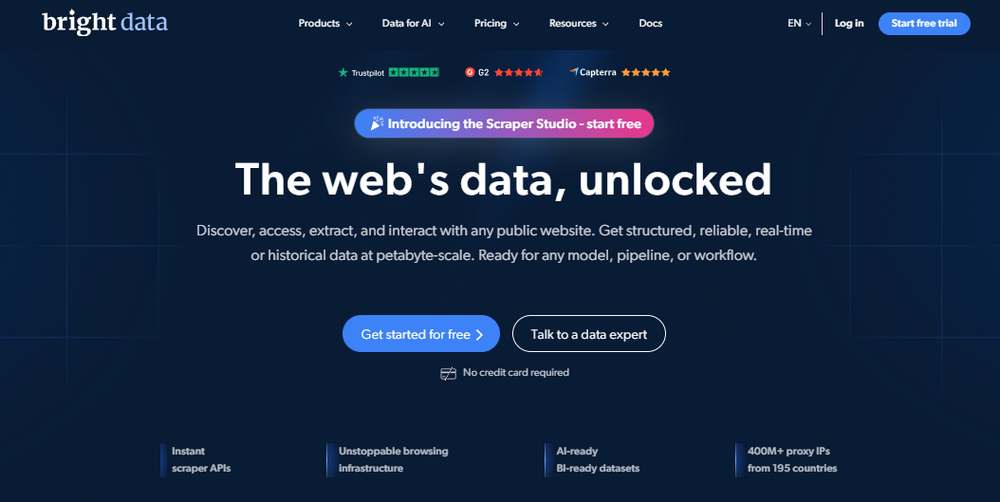
Bright Data is our top choice for the best residential proxy service in 2026. With a network of more than 150 million residential IPs across 195+ countries, it delivers exceptional reliability, advanced geo-targeting, and enterprise-grade performance.
Whether you’re running SEO campaigns, collecting public web data, verifying ads, or conducting market research, Bright Data offers one of the most powerful proxy platforms available.
Key Features
- 150M+ residential IPs
- Coverage in 195+ countries
- Rotating and static residential proxies
- HTTP, HTTPS, and SOCKS5 support
- City, ZIP code, ASN, and carrier targeting
- Advanced Proxy Manager
- High success rate for web scraping
- API access and automation tools
- 24/7 customer support
Pros
- Massive global IP network
- Excellent success rate and uptime
- Advanced geo-targeting options
- Enterprise-grade security
- Powerful dashboard and APIs
Cons
- Higher pricing than budget competitors
- Advanced features may have a learning curve for beginners
Best For
- Enterprise businesses
- SEO agencies
- Large-scale web scraping
- Ad verification
- Market research
Pricing
Starts at approximately $4.20 per GB (subject to change).
Our Verdict: If you need the most reliable residential proxy network with premium performance and advanced targeting, Bright Data is the best overall choice.
2. Oxylabs
Best Residential Proxy for Large-Scale Web Scraping
Overall Rating: ⭐⭐⭐⭐⭐ (4.8/5)
Oxylabs is one of the leading enterprise-grade residential proxy providers, trusted by Fortune 500 companies, data analysts, and developers.
Oxylabs is an enterprise-grade proxy and web intelligence platform recognized as an industry leader for large-scale data collection.
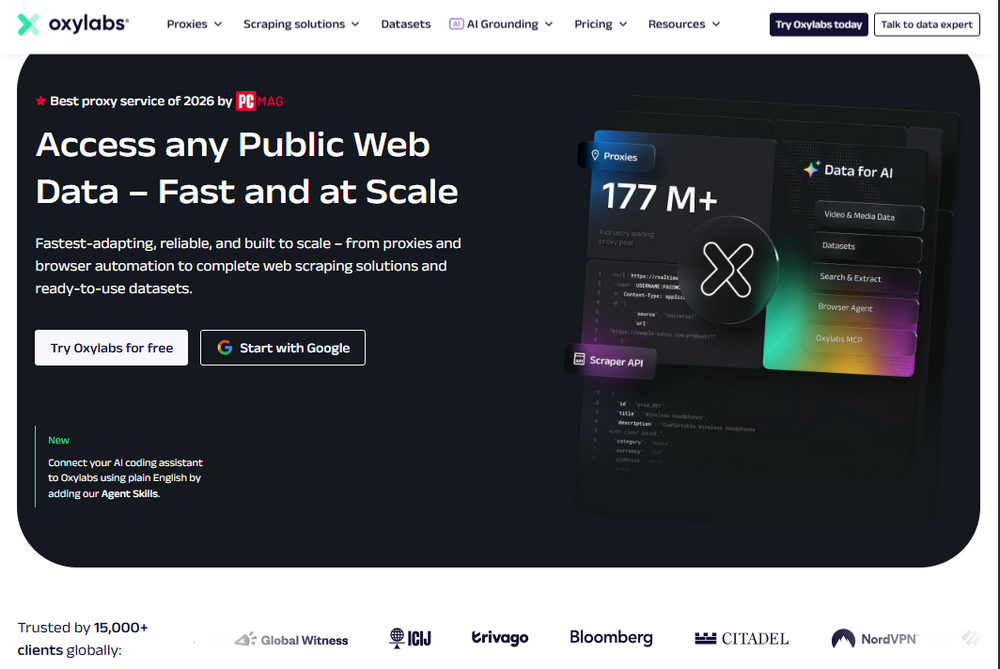
Featuring a pool of over 175 million ethically sourced residential IPs across 195+ locations worldwide, Oxylabs delivers sub-1-second average response times with a 99%+ success rate.
Built to fuel AI models, LLMs, and enterprise web scrapers, it offers country, city, state, and ASN-level targeting paired with seamless integration across popular AI frameworks like LangChain, CrewAI, and n8n.
Key Features
- Ethical & Massive IP Pool: Access 175M+ residential addresses compliant with strict legal standards to ensure minimal blocks and captcha friction.
- Granular Geo-Targeting: Precise IP routing by country, region, city, or specific ASN for localized data retrieval.
- Developer & AI Ready: Native code samples in Python, cURL, Node.js, and Java, plus custom MCP agents for AI developer tools like Cursor and ChatGPT.
- High Uptime & Speeds: Backed by ISO certifications, cyber insurance coverage, and sub-second response times for continuous data pipelines.
Pros
- Unmatched Network Scale: Massive coverage across 195+ regions with highly targeted routing options.
- Enterprise Security & Compliance: Fully insured against technical liability with ISO/IEC 27001 certifications.
- Top-Tier Performance: Outstanding reliability with a 99%+ success rate and sub-1-second response speeds.
- Vast Ecosystem: Integrates smoothly with over 30 external tools, headless browsers, and AI web scraper APIs.
Cons
- Higher Price Point: Subscriptions are geared toward businesses and power users, making it pricier for small-scale projects.
- Complex Feature Set: The wide array of developer tools and configuration settings may present a learning curve for beginners.
Best For
- Enterprise web scraping
- Price monitoring
- Travel aggregation
- Market intelligence
- Large-scale automation
Pricing:
Oxylabs provides pay-as-you-go flexibility along with scalable monthly subscription tiers:
- Pay As You Go: Starting at $8.00 / GB (no recurring monthly commitment required).
- Micro Plan: Starts around $49 / month for standard entry-level usage.
- Corporate Tiers: Higher-volume plans drop the effective per-GB cost significantly down to enterprise rates.
- Free Trial: Offers a 7-day free trial for businesses and testing environments
Our Verdict: If your business relies on collecting large volumes of public web data, Oxylabs is one of the most reliable residential proxy solutions available.
3. Decodo (Formerly Smartproxy)
Best Residential Proxy for SEO
Overall Rating: ⭐⭐⭐⭐⭐ (4.8/5)
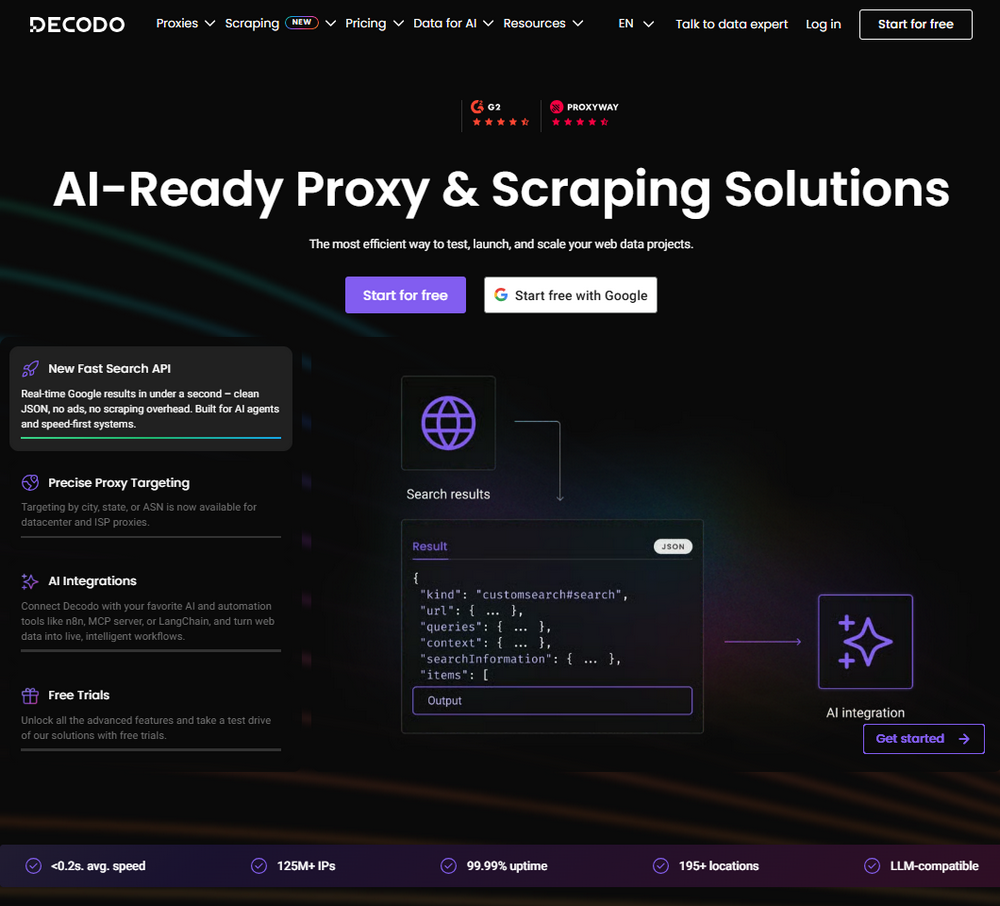
Decodo (formerly Smartproxy) is an AI-ready proxy and web scraping platform offering access to an ethically sourced network of over 125 million residential IPs across 195+ locations worldwide.
It is one of the best residential proxy providers for SEO professionals, affiliate marketers, agencies, and developers. It offers a large residential IP network, excellent speeds, affordable pricing, and powerful tools for SERP tracking, keyword research, and competitor analysis.
Engineered to bypass anti-bot defenses, IP blocks, and CAPTCHAs with sub-0.2-second average speeds and 99.99% uptime, Decodo is built for high-volume web scraping, market research, price aggregation, and multi-account management.
Key Features
- Flexible Geo-Targeting: Access real-user household IPs with precise targeting down to the country, state, city, and ASN levels.
- Cost-Effective Scaling: Residential proxy plans start at just $2/GB, providing genuine human-like behavior with low block rates.
- AI & Workflow Integrations: Integrates natively with AI pipelines, LLMs, and automation platforms via MCP servers, LangChain, and n8n nodes.
- Complete Ecosystem: Offers complementary tools including an AI parser for HTML-to-JSON conversion, Site Unblocker, and browser extensions for simplified proxy management.
Pros:
- Massive Global Network: Access over 125 million ethically sourced residential IPs across 195+ locations with state, city, and ASN-level targeting.
- Fast & Reliable Performance: Boasts an average response speed of under 0.2 seconds and 99.99% uptime, ensuring high success rates for data extraction.
- Competitive Pricing: Residential plans start at an affordable rate of $2/GB, making it a budget-friendly option for scaling operations.
- AI & Workflow Ready: Integrates easily with modern AI stacks, offering dedicated MCP servers, LangChain loaders, and n8n nodes alongside an AI Parser for HTML-to-JSON conversion.
- Comprehensive Ecosystem: Includes additional tools like Site Unblocker, Fast Search API, browser extensions (Chrome/Firefox), and a Proxy Checker.
Cons:
- Rebranding Transition: Formerly known as Smartproxy, users familiar with the legacy platform may need to adjust to the updated Decodo brand identity and interface layout.
- Usage-Based Traffic Costs: Pay-as-you-go bandwidth costs ($/GB) can escalate quickly for bandwidth-heavy, multi-gigabyte streaming or downloading tasks compared to static/unlimited models.
- Advanced Features Require Upgrades: Features like AI Parsing, Site Unblocker, and dedicated Scraping APIs carry separate pricing structures outside standard residential proxy plans.
Best For
- SEO professionals
- Rank tracking
- Keyword research
- Affiliate marketers
- Small and medium businesses
Pricing:
ecodo offers flexible payment options based on data usage, starting at $2/GB. All plans include access to 115M+ ethically sourced IPs across 195+ locations with HTTP(S) and SOCKS5 support.
Pay As You Go
- Price: $4.00 / GB
- Details: Pay per gigabyte without a recurring commitment. (Purchased 1 GB at a time via Wallet credits at $8.50/GB for standalone purchases).
Monthly Subscription Plans
| Data Allowance | Price per GB | Total Monthly Cost |
| 3 GB | $3.75 / GB | $11.25 + VAT |
| 10 GB | $3.50 / GB | $35.00 + VAT |
| 25 GB (Popular) | $3.25 / GB | $81.25 + VAT |
| 50 GB | $3.00 / GB | $150.00 + VAT |
| 100 GB | $2.75 / GB | $275.00 + VAT |
Free Trial & Guarantees
- 3-Day Free Trial: Includes 100 MB of traffic to test the proxies before committing to a paid plan.
- 14-Day Money-Back Guarantee: Eligible for first-time purchases on regular subscription plans (if less than 20% of traffic is used and the free trial was not used).
Our Verdict: For most SEO professionals and digital marketers, Decodo offers the best combination of performance, pricing, and ease of use.
4. SOAX
Best Static Residential Proxy Provider
Overall Rating: ⭐⭐⭐⭐⭐ (4.7/5)
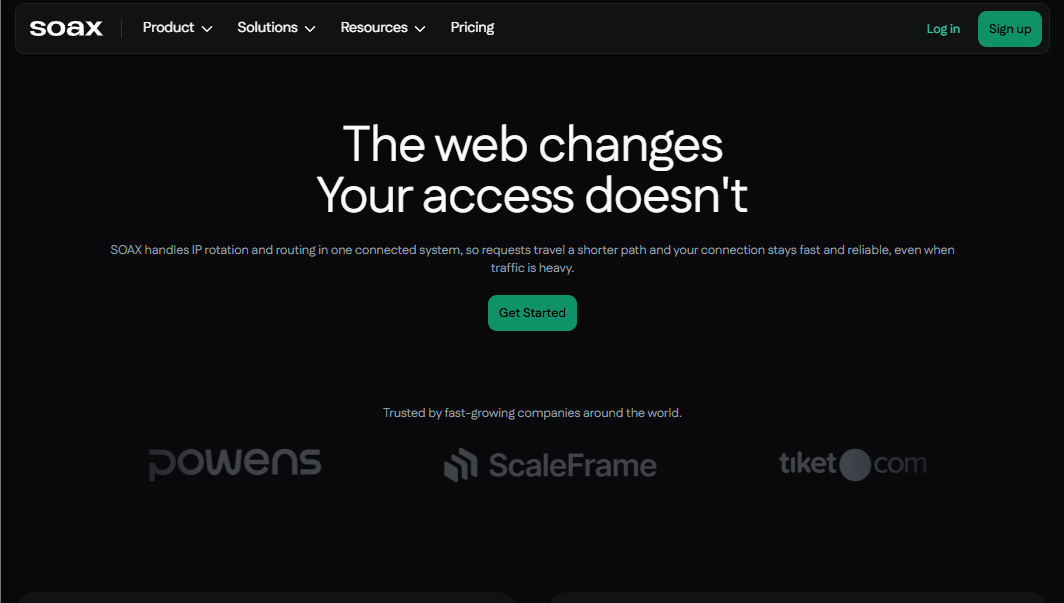
SOAX has become one of the fastest-growing residential proxy providers thanks to its extensive IP pool and advanced geo-targeting capabilities. It is particularly well known for providing reliable static residential IPs and precise location targeting.
SOAX is a premium proxy provider offering access to a clean, ethically sourced pool of over 155 million residential IPs across 195+ locations worldwide.
Designed for data scraping, web crawling, market research, and multi-account management, SOAX provides fine-grained targeting options down to the country, region, city, and ISP level.
Key Features
- Flexible IP Rotation: Choose between automatic IP rotation for each request or sticky sessions to maintain the same IP address for extended periods.
- High Anonymity & Uptime: Genuine residential addresses assigned by real ISPs ensure low block rates and high success rates for data collection.
- Protocol & Authentication Support: Fully supports HTTP, HTTPS, and SOCKS5 protocols with flexible authentication via username/password or IP allowlists.
- Granular Control: Offers custom routing rules, sessions management, and guardrails to optimize request paths and performance without requiring complex scripts.
Pros
- Huge IP network
- Excellent geo-targeting
- Reliable sticky sessions
- Flexible rotation controls
- Strong dashboard experience
Cons
- Premium pricing compared to budget providers
- Trial options may be limited
Best For
- Static residential IPs
- Geo-targeting
- Ad verification
- Social media management
- Local SEO
Pricing: Starts from approximately $3.60/GB.
Our Verdict: SOAX is an excellent choice for users who need precise location targeting and long-lasting residential IP sessions.
5. IPRoyal
Best Budget Residential Proxy Service
Overall Rating: ⭐⭐⭐⭐☆ (4.6/5)
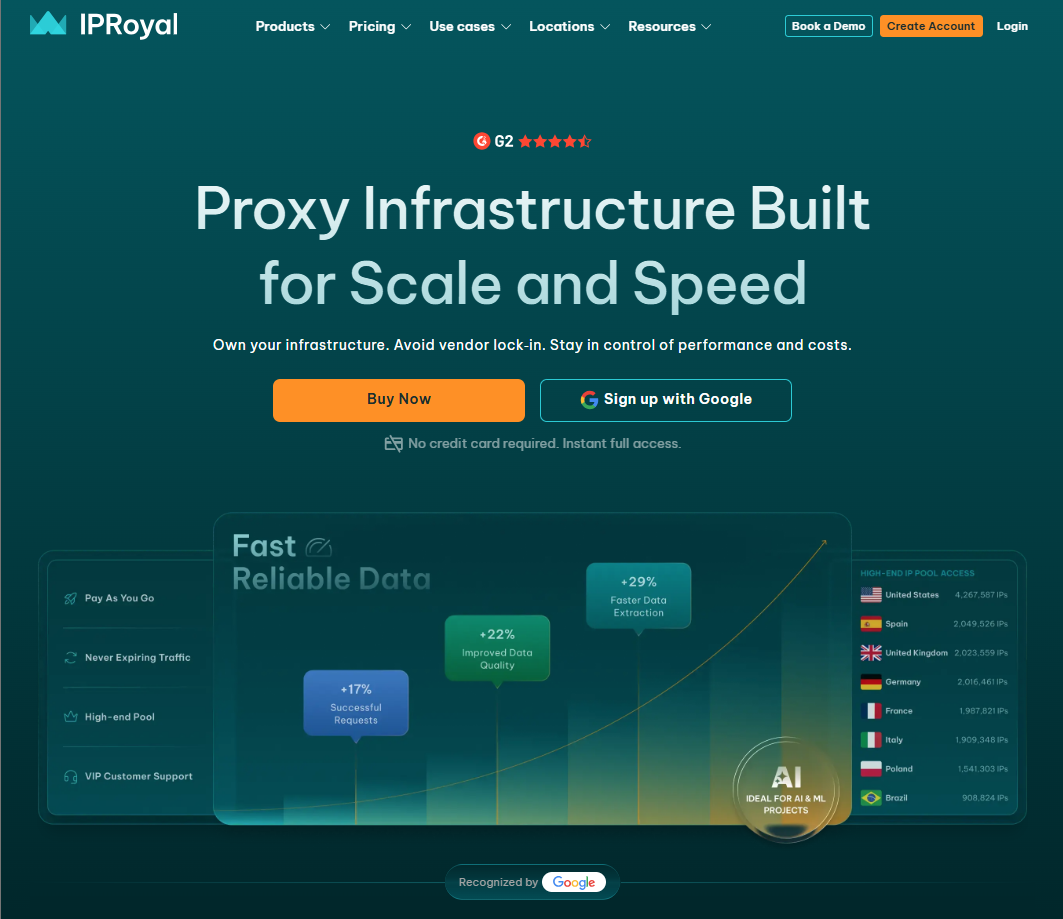
IPRoyal is a budget-friendly residential proxy provider recognized for its flexible, pay-as-you-go model and non-expiring data options.
Powered by an ethically sourced network of over 64 million residential IPs across 195+ locations worldwide, IPRoyal is tailored for freelancers, small businesses, SEO monitoring, and web scraping operations that require high reliability without a heavy recurring financial commitment.
IPRoyal has become one of the most popular residential proxy providers for freelancers, bloggers, small businesses, and developers looking for affordable yet reliable proxy solutions.
Despite its competitive pricing, IPRoyal offers a large residential proxy network, flexible pay-as-you-go plans, and excellent performance for SEO, web scraping, social media management, and market research.
Features of IPRoyal
- Non-Expiring Bandwidth: Purchased proxy traffic does not expire at the end of the month, allowing users to use data at their own pace.
- Precise Geo-Targeting: Access real-user IPs with pinpoint accuracy down to the state and city level.
- Protocol & Authentication Support: Full support for both HTTP(S) and SOCKS5 protocols with username/password or IP allowlist authentication.
- Session Control: Configurable sticky sessions (up to 24 hours) for stable, long-duration tasks or auto-rotation per request for anonymous web scraping.
Pros
- Cost-Effective Flexibility: Pay-as-you-go billing with non-expiring traffic eliminates high upfront costs or lost monthly allowances.
- Global Network Reach: Access 64M+ residential IPs spread across 195+ countries with fine-grained city and state targeting.
- Strong Uptime & Speed: Delivers reliable performance with high success rates and continuous redundancy across connections.
- Versatile Protocol Support: Full support for HTTP, HTTPS, and SOCKS5 integrations across 650+ third-party tools.
Cons
- Smaller Network than Market Leaders: While extensive, its 64M+ pool is smaller than enterprise competitors like Bright Data or Oxylabs.
- No Free Trial for All Users: Direct free trials are limited, though low entry costs and pay-as-you-go options lessen the testing risk.
Best For
- Bloggers
- SEO beginners
- Freelancers
- Affiliate marketers
- Small businesses
Pricing:
IPRoyal provides transparent, pay-as-you-go options along with bulk discount tiers for high-volume users:
- Starting Rate: $1.75 / GB for residential proxy traffic.
- Flexible Billing: Non-expiring traffic options ensure zero wasted data across monthly cycles.
- Custom Enterprise Plans: Volume discounts available for larger data allocations and custom infrastructure requirements.
Our Verdict: If you’re looking for an affordable residential proxy without sacrificing reliability, IPRoyal is one of the best choices available.
6. Webshare
Best Residential Proxy for Beginners
Overall Rating: ⭐⭐⭐⭐☆ (4.6/5)
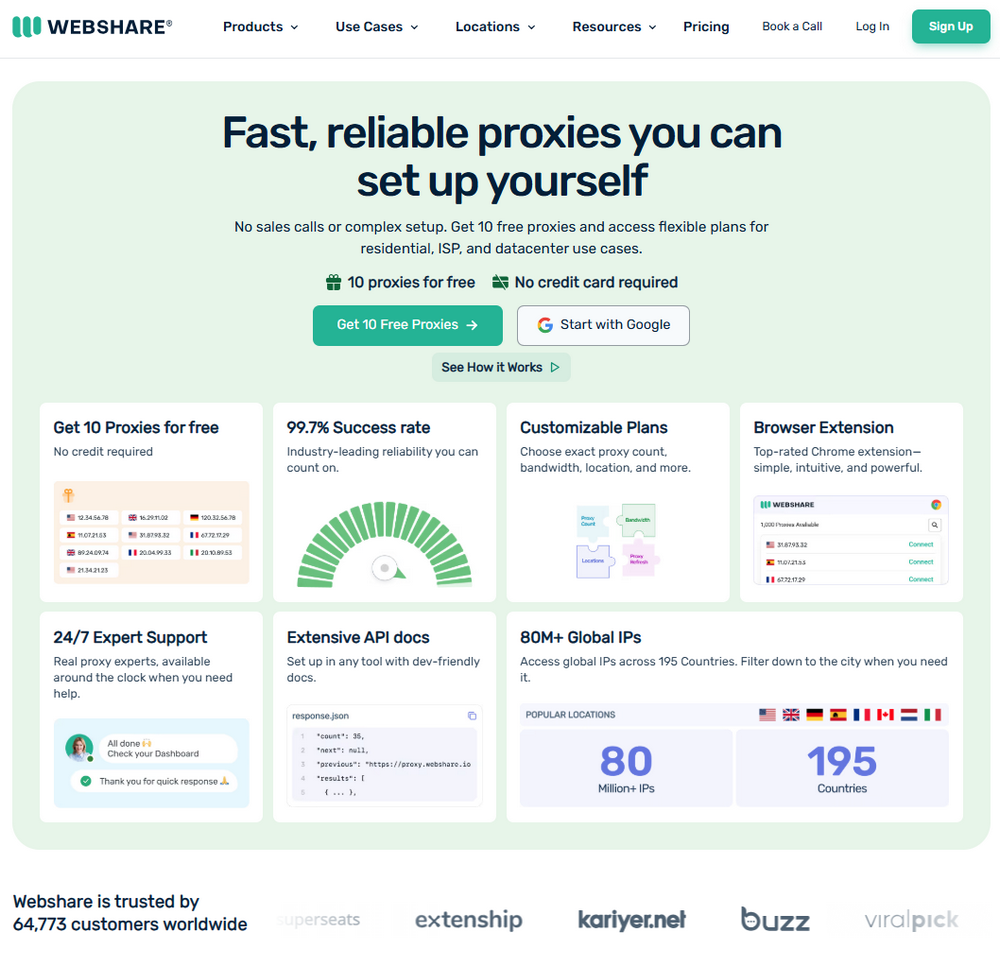
Webshare is a fast, highly accessible proxy provider known for its self-serve platform, developer-friendly dashboard, and affordable pricing options.
Featuring a network of over 80 million real residential IPs across 195+ countries, Webshare enables granular country and city-level targeting without complex onboarding processes or sales calls.
It is designed for pricing intelligence, public data scraping, e-commerce monitoring, and social media tasks.
Webshare is an excellent entry-level residential proxy provider known for its generous free plan, intuitive dashboard, and affordable paid plans. It’s ideal for beginners who want to explore proxy services without making a significant investment.
Key Features
- Self-Serve Dashboard: Quick setup with direct access to customizable plans, proxy customization, and real-time performance tracking.
- Granular Geo-Targeting: Access 80M+ global residential IPs filtered down to specific countries or cities.
- High Success Rates: Built for data scraping with an industry-leading 99.7% success rate and high uptime.
- Developer Ecosystem: Extensive API documentation for smooth integration into scraping scripts, alongside a dedicated Chrome browser extension.
Pros
- Free Plan Available: Offers 10 free proxies with no credit card required to test the service.
- Affordable Entry Tiers: Rotating residential plans start at an accessible rate of $3.50/month.
- User-Friendly Setup: No sales calls or manual approvals; accounts and custom proxy configurations are set up instantly.
- Diverse Product Ecosystem: Offers datacenter (proxy servers), static residential (ISP), and rotating residential proxies within a single platform.
Cons
- IP Refresh Requirements: Users report needing periodic proxy refreshes depending on the target site and task load.
- Smaller Network Than Top Enterprise Providers: While extensive at 80M+ IPs, it is smaller than massive enterprise pools like Oxylabs or Smartproxy/Decodo.
Best For
- Beginners
- Students
- Small projects
- Website testing
- Learning proxy management
Pricing: Webshare offers custom, flexible plans depending on proxy count and bandwidth needs:
Webshare offers custom, flexible plans tailored to specific bandwidth and proxy count requirements across three main product categories:
Rotating Residential Proxies
- Pay-As-You-Go/Entry Plan: Starts at $1.40/GB (or $3.50/month for the rotating residential tier) for access to 80M+ global IPs with country and city targeting.
Static Residential (ISP) Proxies
- Starting Price: Starts at $6.00 / month for dedicated static IPs sourced directly from major ISPs (like Comcast and AT&T), offering speed with higher anonymity.
Proxy Server (Datacenter) Plans
| Proxy Count | Price per Proxy | Total Cost / Month |
| 10 Proxies | $0.00 | FREE (No credit card required) |
| 100 Proxies | $0.0299 / proxy | $2.99 / mo |
| 1,000 Proxies | $0.0269 / proxy | $26.91 / mo (Save 10%) |
| 5,000 Proxies | $0.0239 / proxy | $119.60 / mo (Save 20%) |
| 60,000 Proxies | $0.0179 / proxy | $1,076.40 / mo (Save 40%) |
Our Verdict: Webshare is one of the easiest residential proxy providers for beginners and small businesses that need a simple, affordable solution.
7. ProxyEmpire
Best Residential Proxy for Flexible Pricing
Overall Rating: ⭐⭐⭐⭐☆ (4.5/5)
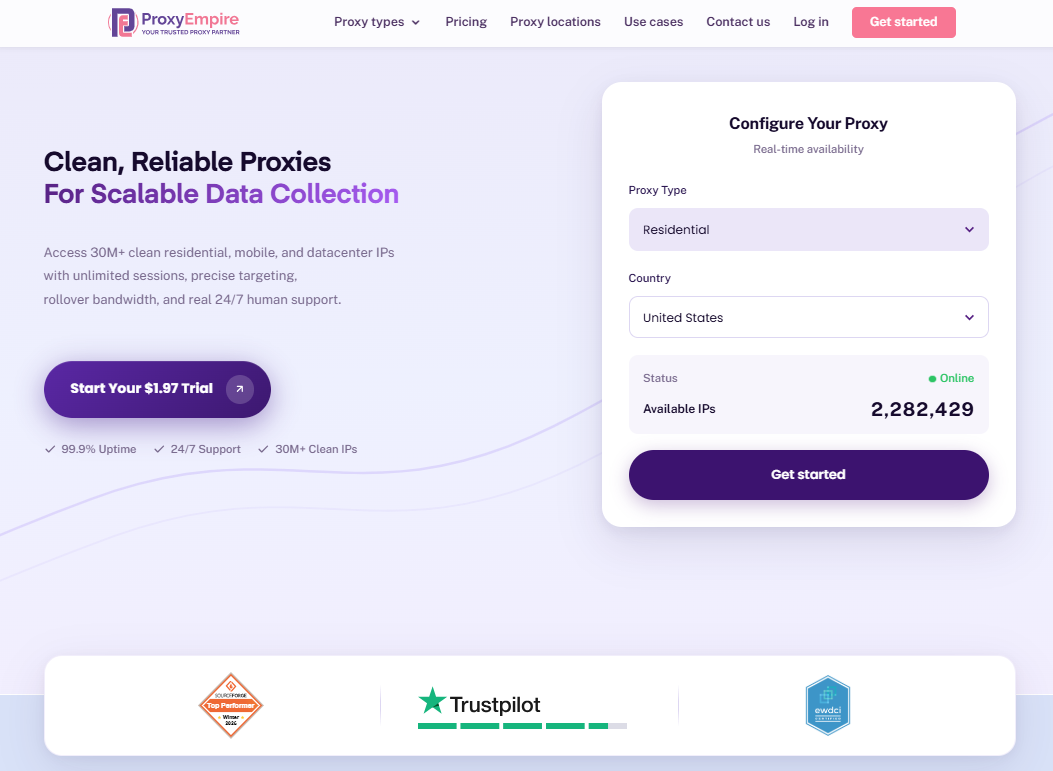
ProxyEmpire is a feature-rich proxy provider offering access to a clean pool of over 30 million ethically sourced residential IPs across 170+ countries worldwide.
Built for web scraping, market research, price monitoring, ad verification, and multi-account management, ProxyEmpire stands out for its rollover bandwidth feature, allowing unused data to carry over into the next month.
ProxyEmpire offers flexible pricing plans and a strong residential proxy network designed for businesses, marketers, and developers. Its rotating and sticky session options make it suitable for SEO, automation, social media management, and web scraping.
Key Features
- Flexible Session Control: Choose between automatic IP rotation per request or sticky sessions to keep the same IP address for extended workflows.
- Advanced Location Targeting: Filter residential connections down to specific country, region, city, ISP, and mobile carrier levels.
- Rollover Bandwidth: Ensures unused proxy data automatically rolls over to the following billing period so paid bandwidth is never lost.
- Broad Protocol & Tool Integration: Full support for HTTP, HTTPS, HTTP/2, and SOCKS5 protocols with quick integration across popular browser profile managers like Multilogin, GoLogin, and Dolphin Anty.
Pros
- Data Rollover Feature: Unused bandwidth carries over to subsequent months on active subscriptions.
- Granular IP Targeting: Pinpoint traffic down to specific cities, regions, ISPs, and mobile carriers.
- Unlimited Sessions & Concurrent Threads: Run multiple data collection and monitoring workflows simultaneously without artificial session limits.
- Trial Option Available: Paid trial available ($1.97) to test network speed and performance before committing to a larger package.
Cons
- Smaller Pool Than Major Enterprise Competitors: The 30M+ IP network is smaller compared to enterprise leaders like Oxylabs or Bright Data.
- Minimum Spend for Custom Enterprise Tiers: Higher-tier static or custom bandwidth options require commitment for lower per-GB rates.
Best For
- SEO agencies
- Market research
- Social media automation
- Data collection
Pricing: ProxyEmpire Rotating Residential Proxy Pricing
ProxyEmpire offers tier-based bandwidth plans for rotating residential proxies, with a $1.97 paid trial available across all plans to test performance.
| Plan | Data Included | Price per GB | Total Cost |
| Pay As You Go | 1 GB | $7.00 / GB | $7.00 |
| Starter | 7 GB | $5.71 / GB | $40.00 |
| Hobby | 28 GB | $5.36 / GB | $150.00 |
| Startup | 60 GB | $5.00 / GB | $300.00 |
| Business | 135 GB | $4.44 / GB | $600.00 |
| Company (Best Value) | 315 GB | $3.97 / GB | $1,250.00 |
| Corporation | 500 GB | $3.50 / GB | $1,750.00 |
| Enterprise | 1,000 GB | $3.00 / GB | $3,000.00 |
| Custom Plans | 5 TB+ | From $0.75 / GB | Contact Sales |
Our Verdict: ProxyEmpire is a solid choice for users who want flexible billing options and dependable residential proxies at a reasonable price.
8. Rayobyte
Best Residential Proxy for eCommerce
Overall Rating: ⭐⭐⭐⭐☆ (4.5/5)
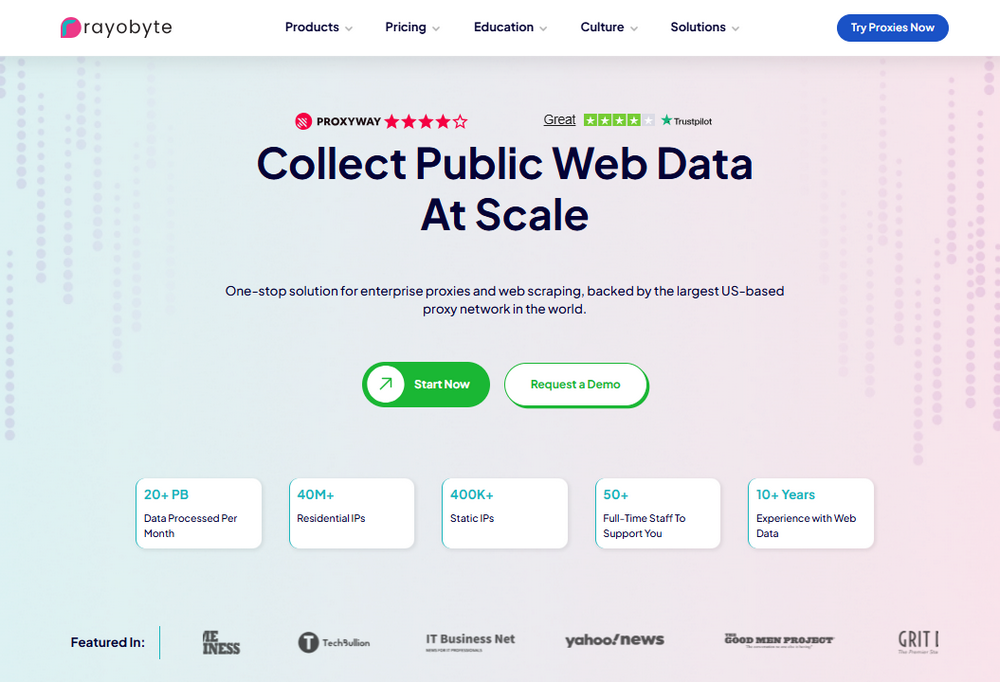
Rayobyte is an enterprise-grade proxy provider known for its strict ethical sourcing, robust infrastructure, and focus on web scraping and data extraction.
Sourced with end-user consent, Rayobyte offers access to over 40 million residential IPs across 163+ countries worldwide.
Built to handle large-scale data collection, SEO monitoring, e-commerce price scraping, and ad verification, it provides high network stability alongside flexible rotation and sticky session controls.
Rayobyte is well known for its ethical proxy sourcing and reliable infrastructure. It offers residential proxy solutions tailored for eCommerce businesses, market researchers, and developers who require dependable residential IPs.
Key Features
- Ethical IP Sourcing: 100% of the 40M+ IP pool is sourced directly from real end-users with informed consent and fair compensation, ensuring clean IP reputations.
- Free Granular Geo-Targeting: Filter residential proxy traffic down to specific countries, states, and cities at no additional cost.
- Flexible Session Control: Choose between automatic rotation or sticky sessions to retain the same IP address for extended tasks.
- Enterprise Dashboard: Built-in usage analytics, IP allowlisting, and team expenditure controls to manage proxies at scale.
Pros
- Non-Expiring Pay-As-You-Go Traffic: Bandwidth purchased under pay-as-you-go options never expires, allowing users to use data at their own pace.
- Unrestricted Concurrency: Offers unlimited concurrent threads and sessions across all plan levels.
- Zero Geo-Targeting Fees: Country, state, and city-level targeting are included free of charge across all subscription tiers.
- High Ethical Compliance: Strong adherence to ethical acquisition lowers block rates and safeguards brand reputation.
Cons
- Smaller Pool Than Enterprise Competitors: While 40M+ IPs is substantial, it is smaller than massive networks like Oxylabs or Bright Data.
- High Entry Price for Ultra-Low Rates: Reaching the lowest per-GB tiers requires committing to high monthly data allowances (5,000 GB+).
Best For
- eCommerce monitoring
- Product research
- Inventory tracking
- Market intelligence
- Brand protection
Pricing: Pricing varies depending on bandwidth and business requirements. Rayobyte provides tier-based pay-as-you-go and monthly subscription pricing depending on total data consumption:
- Enterprise (5,000 GB+): As low as $0.50 / GB (custom billing available)
- Starter (1 GB – 49 GB): $3.50 / GB
- Consumer (50 GB – 249 GB): $2.00 / GB
- Professional (250 GB – 999 GB): $1.50 / GB
- Corporate (1,000 GB – 4,999 GB): $0.70 / GB
Our Verdict: Rayobyte is an excellent residential proxy provider for businesses that prioritize ethical sourcing, stability, and long-term reliability.
9. Infatica
Best Residential Proxy for Market Research
Overall Rating: ⭐⭐⭐⭐☆ (4.4/5)
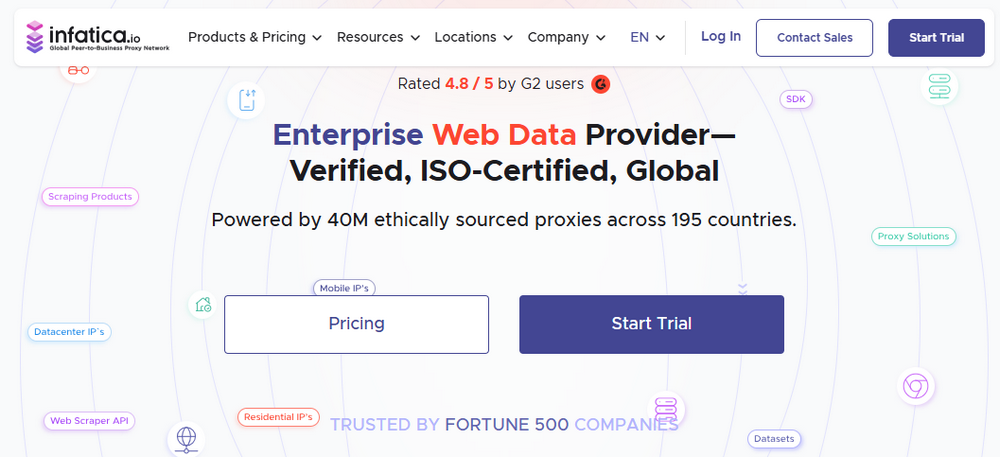
Infatica is an enterprise-grade web data provider that offers access to an ethically sourced pool of over 35 million residential IPs across 195+ countries.
Featuring ISO-certified infrastructure, Infatica is built to bypass aggressive anti-bot defenses, CAPTCHAs, and geo-restrictions with a 99.9% uptime and sub-0.4-second response times.
It provides flexible HTTP and SOCKS5 proxy solutions designed for market research, SEO monitoring, cybersecurity testing, and automated web scraping.
Infatica offers a growing residential proxy network focused on businesses that need reliable IPs for market research, competitor analysis, advertising verification, and public web data collection.
Key Features
- Ethically Sourced & Verified Network: 100% ethically acquired residential IPs from real user devices, backed by ISO certifications and strict compliance standards.
- Granular Geo-Targeting: Precise IP routing options with country, region, city, and ISP-level selection across major global locations.
- Flexible Rotation & Session Control: Configurable rotation intervals and sticky session capabilities to maintain the same identity for continuous tasks.
- No-Code Platform & Scraper APIs: Integrates seamlessly into scraping scripts and offers a built-in UI for SERP and web data extraction without coding.
Pros
- High Success Rates & Performance: Outstanding 99.9% uptime and low 0.4-second response times ensure stable data extraction.
- Versatile Management Dashboard: Clean user interface with rotation controls, IP allowlisting, and proxy management APIs for developers.
- Risk-Free Trial: Offers a 7-day trial for $4.00 to let users test speeds and performance before making larger commitments.
- Flexible Protocol Support: Fully supports HTTP, HTTPS, and SOCKS5 connections with dual login/password and IP whitelist authentication.
Cons
- Smaller Pool Than Enterprise Leaders: While substantial at 35M+ IPs, it is smaller than competitors like Oxylabs or Bright Data.
- Entry-Level Costs: Per-gigabyte rates for low-volume packages are higher compared to budget-focused alternative platforms.
Best For
- Market research
- Brand protection
- Ad verification
- Public data collection
- Competitor analysis
Pricing: Infatica provides pay-as-you-go options alongside monthly and annual subscription tiers based on bandwidth usage:
- Pay As You Go: $4.00 / GB (no long-term commitment required).
- 25 GB Plan: $96.00 / month ($3.84 / GB).
- 100 GB Plan: $360.00 / month ($3.60 / GB).
- 241 GB Plan (Most Popular): $700.00 / month ($2.90 / GB).
- 500 GB Plan: $1,350.00 / month ($2.70 / GB).
- 1,000 GB Plan: $2,600.00 / month ($2.60 / GB).
- Trial Offer: $4.00 for a full 7-day trial period.
Our Verdict: Infatica is a dependable residential proxy provider for businesses looking to perform market research and collect public web data without investing in a premium enterprise platform.
10. Zyte
Best Residential Proxy for Market Research
Overall Rating: ⭐⭐⭐⭐☆ (4.4/5)
Zyte (formerly Scrapinghub) is an enterprise-grade web data and proxy platform built specifically for large-scale data extraction, web scraping, and crawl automation.
Powered by AI-driven anti-bot detection and smart IP rotation, Zyte API automatically manages proxies, headless browsers, and ban mitigation behind a single endpoint, billing users strictly on successful requests.
Key Features:
- Smart Proxy Rotation & Ban Handling: Automatically selects the leanest access strategy and handles IP rotation, retries, and CAPTCHAs to ensure high success rates.
- AI & Structured Data Extraction: Extracts clean, schema-ready data (e.g., e-commerce products, prices, SERPs) directly into structured JSON formats without manual parser setup.
- Full Browser Rendering: Optional headless browser support for dynamic, JavaScript-heavy web applications.
- Managed Data Services: Offers a fully managed data delivery option (Zyte Data) for businesses wanting turn-key data pipelines directly to their data warehouses.
Pros:
- Success-Based Billing: Users are only charged for successful API requests, minimizing wasted bandwidth on blocked attempts.
- Unified Scraping API: Eliminates the need to manage proxy pools, rotation scripts, and browser instances manually.
- High Reliability at Scale: Built on top of the open-source Scrapy framework, ensuring robust infrastructure for high-volume enterprise tasks.
- Flexible Extraction Tiers: Seamlessly scales from simple raw HTTP requests to full browser rendering based on target site difficulty.
Cons:
- API-Centric Approach: Operates primarily as an extraction API rather than a standard backconnect proxy list (unsuited for general web browsing or multi-account management).
- Cost Structure for Complex Sites: Pricing scales based on request complexity (e.g., browser rendering and dynamic execution cost more request units).
Zyte Pricing
Zyte offers pricing tiers across its products, including the Zyte API (which manages proxy rotation and web scraping) and Zyte Data (managed data extraction services).
Zyte API Plans
Zyte API uses a flexible usage-based model billed by Request Units (RUs), charging only for successful requests:
- Pay As You Go: $0.00 / mo platform fee (pay strictly for API usage as you go).
- Starter: $29 / mo + usage (ideal for individual developers and small projects).
- Growth: $99 / mo + usage (includes increased throughput and standard support).
- Business: $349 / mo + usage (adds high concurrency, priority support, and enterprise features).
Zyte Data (Managed Extraction Services)
For businesses that want turn-key, fully managed web scraping pipelines without writing code:
| Plan | Price | Key Details |
| Standard | $500 / month | $0 setup fee for standard AI schemas (e-commerce, SERP, articles). Delivered via AWS S3 in JSON/CSV/XML. |
| Custom | $1,000 / month | Custom schemas and advanced post-processing. Multi-cloud delivery with a 24/7 enterprise SLA. |
Quick Winner Box: Best Residential Proxy Services at a Glance
If you’re short on time, here’s a quick summary of our top residential proxy recommendations based on different use cases.
| Category | Recommended Provider | Why We Recommend It |
|---|---|---|
| 🏆 Best Overall | Bright Data | Massive residential IP pool, excellent performance, advanced targeting, and enterprise-grade reliability. |
| 💰 Best Budget | IPRoyal | Affordable pricing, flexible pay-as-you-go plans, and excellent value for individuals and small businesses. |
| 🔍 Best for SEO | Decodo (formerly Smartproxy) | Ideal for SERP tracking, keyword research, rank monitoring, and competitor analysis with reliable rotating residential IPs. |
| 🕸️ Best for Web Scraping | Oxylabs | High success rates, AI-powered scraping solutions, and one of the largest residential proxy networks available. |
| 🏢 Best Enterprise Solution | Bright Data | Advanced proxy management, automation tools, compliance features, and premium customer support for large-scale businesses. |
| 👨💻 Best for Beginners | Webshare | Easy setup, user-friendly dashboard, generous free plan, and affordable upgrades for new users. |
| 📍 Best Static Residential Proxy | SOAX | Reliable static residential IPs, precise geo-targeting, sticky sessions, and excellent location coverage. |
Editor’s Choice: Bright Data remains our top recommendation for most users because it offers the largest residential proxy network, industry-leading performance, advanced targeting features, and enterprise-grade security. However, if you’re looking for a more affordable alternative, Decodo and IPRoyal provide excellent value without sacrificing reliability.
Expert Recommendation
If you’re an SEO professional or blogger, Decodo provides the best balance of affordability, speed, and SEO-focused features.
For enterprise businesses, Bright Data and Oxylabs remain the strongest options thanks to their massive IP pools, advanced targeting capabilities, and enterprise-grade infrastructure.
If you’re just getting started with residential proxies, Webshare and IPRoyal offer excellent entry points with affordable pricing and easy setup.
Best Residential Proxies for Different Use Cases
Not every residential proxy service is designed for the same purpose. Some providers excel at SEO and SERP tracking, while others are better suited for web scraping, ad verification, or enterprise automation. Below are our top recommendations based on specific use cases.
Best Residential Proxies for SEO
SEO professionals rely on residential proxies to collect accurate search engine results, monitor keyword rankings, analyze competitors, and perform local SEO research without triggering CAPTCHA challenges or IP blocks. Here are my Top Picks
🥇 1. Decodo (Formerly Smartproxy)
Decodo is our top recommendation for SEO because it combines affordable pricing, reliable rotating residential IPs, excellent geo-targeting, and powerful SERP scraping tools. It’s ideal for keyword rank tracking, competitor analysis, and local search monitoring.
Best For:
- Rank tracking
- Local SEO
- Competitor research
- SERP monitoring
- SEO agencies
🥈 2. Bright Data
Bright Data offers enterprise-grade residential proxies with advanced location targeting and one of the largest IP pools available, making it perfect for agencies managing thousands of keywords across multiple countries.
🥉 3. Oxylabs
Oxylabs provides high success rates and premium scraping infrastructure, making it suitable for large SEO teams and enterprise-level keyword tracking.
Best SEO Proxy Comparison
| Provider | SEO Rating | Best Feature |
|---|---|---|
| Decodo | ⭐⭐⭐⭐⭐ | SERP Tracking |
| Bright Data | ⭐⭐⭐⭐⭐ | Enterprise SEO |
| Oxylabs | ⭐⭐⭐⭐☆ | Large-scale Monitoring |
| SOAX | ⭐⭐⭐⭐☆ | Local SEO |
| IPRoyal | ⭐⭐⭐⭐☆ | Budget SEO |
Best Residential Proxies for Web Scraping
Residential proxies help developers and businesses collect publicly available web data while minimizing detection and improving request success rates.
Recommended Providers
- 🥇 Bright Data: The industry’s largest residential IP network with powerful APIs, advanced rotation, and excellent success rates.
- 🥈 Oxylabs: Perfect for enterprise scraping projects requiring millions of requests every day.
Honorable Mentions
- Decodo
- ProxyEmpire
- Rayobyte
Best Scraping Proxy Comparison
| Provider | Success Rate | Ideal For |
|---|---|---|
| Bright Data | ⭐⭐⭐⭐⭐ | Enterprise Scraping |
| Oxylabs | ⭐⭐⭐⭐⭐ | Large Projects |
| Decodo | ⭐⭐⭐⭐☆ | Small Businesses |
| ProxyEmpire | ⭐⭐⭐⭐☆ | Flexible Projects |
Best Residential Proxies for Price Monitoring
Retailers and eCommerce businesses use residential proxies to monitor competitor pricing, stock availability, discounts, and regional promotions without being blocked.
Recommended Providers
- 🥇 Bright Data
- 🥈 Oxylabs
- 🥉 SOAX
Ideal Use Cases
- Amazon price tracking
- Walmart monitoring
- Shopify competitor analysis
- Dynamic pricing
- Inventory monitoring
Best Residential Proxies for Ad Verification
Advertisers need residential proxies to verify that advertisements display correctly across different cities and countries while detecting click fraud and geo-targeting issues.
Top Providers
- Bright Data
- SOAX
- Oxylabs
Common Use Cases
- Ad verification
- Brand protection
- Geo-targeted advertising
- Fraud detection
- Campaign testing
Best Residential Proxies for Sneaker Bots
Residential proxies are widely used to reduce IP bans during limited sneaker releases and flash sales. Reliable rotating IPs help distribute requests across multiple residential addresses.
Recommended Providers
- IPRoyal
- SOAX
- Decodo
- Bright Data
Note: Always use automation tools responsibly and comply with the terms of service of the websites you access.
Best Residential Proxies for Social Media Management
Managing multiple social media accounts often requires stable residential IP addresses to reduce the likelihood of security checks and account restrictions.
Best Providers
- SOAX
- Bright Data
- IPRoyal
Suitable Platforms
- X (Twitter)
- TikTok
Best Residential Proxies for Affiliate Marketing
Affiliate marketers use residential proxies to perform location-based testing, monitor advertisements, verify affiliate links, and analyze competitors.
Recommended Providers
- Decodo
- Bright Data
- IPRoyal
- Webshare
Common Tasks
- Geo-targeted landing page testing
- Affiliate link verification
- Competitor monitoring
- SEO research
- Ad campaign analysis
Which Residential Proxy Should You Choose?
Still unsure which provider is right for you? Here’s a quick recommendation based on your needs.
| If You Need… | Recommended Provider |
|---|---|
| Best Overall | 🏆 Bright Data |
| Best Value | 💰 IPRoyal |
| Best for SEO | 🔍 Decodo |
| Best for Web Scraping | 🕸️ Oxylabs |
| Best for Beginners | 👨💻 Webshare |
| Best Enterprise | 🏢 Bright Data |
| Best Static Residential Proxy | 📍 SOAX |
| Best Social Media Management | 📱 SOAX |
| Best Affiliate Marketing | 💼 Decodo |
Our Expert Recommendation
Choosing the best residential proxy depends on your goals and budget.
- For bloggers, affiliate marketers, and SEO professionals, Decodo offers the best balance of affordability, speed, and SEO-focused features.
- For enterprise businesses, Bright Data remains the strongest overall solution thanks to its massive IP pool, advanced targeting, and enterprise-grade infrastructure.
- For developers and data analysts, Oxylabs is ideal for large-scale web scraping and automation projects.
- If you’re new to residential proxies, Webshare and IPRoyal provide beginner-friendly dashboards, affordable pricing, and excellent value for smaller projects.
By selecting a provider that aligns with your specific use case, you’ll achieve better performance, lower costs, and a more reliable proxy experience.
Residential Proxy Buying Guide
Selecting the right residential proxy service can be challenging, as providers differ significantly in features, pricing structures, and performance levels. Rather than focusing solely on cost, it is important to evaluate the capabilities that align with your specific use case.
Whether you are an SEO professional, developer, digital marketer, or business owner, an effective proxy solution should deliver consistent performance, strong security, and overall value.
Factors to Consider Before Buying a Residential Proxy
1. IP Pool Size
The size of a provider’s residential IP network has a direct impact on reliability and anonymity. Larger IP pools reduce the likelihood of IP blocks and improve success rates when accessing target websites.
Recommendation: Opt for providers offering at least 30 million residential IPs for most professional applications.
2. Country and Geo-Targeting Support
For localized search results or region-specific content access, choose providers that support granular geo-targeting, including country, state, city, ZIP code, ASN, or ISP-level targeting.
Leading Providers
- Bright Data
- SOAX
- Oxylabs
- Decodo
3. Rotating vs. Static Residential Proxies
Different use cases require different IP behaviors. Some workflows benefit from frequent IP rotation, while others require a stable and consistent identity.
- Rotating residential proxies are best suited for web scraping, price monitoring, and SERP tracking.
- Static residential proxies are ideal for account management, social media operations, and long-duration browsing sessions.
4. Speed and Reliability
High performance is essential for automation and data collection workflows. Faster response times directly improve efficiency and throughput.
Prioritize providers that offer:
- Low latency
- High uptime
- Stable connections
- Strong request success rates
5. Supported Protocols
Leading residential proxy providers support multiple connection protocols to ensure compatibility across different tools and environments.
Common protocols include:
- HTTP
- HTTPS
- SOCKS5
Among these, SOCKS5 is generally preferred for its flexibility and broader compatibility.
6. Pricing Model
Residential proxy pricing varies depending on the provider and service structure.
Common models include:
- Pay-as-you-go
- Monthly subscriptions
- Bandwidth-based pricing
- Unlimited traffic plans
Select a pricing model that aligns with your expected monthly usage and operational requirements.
7. Dashboard and Ease of Use
An intuitive dashboard significantly simplifies proxy management and improves operational efficiency.
Key features to look for include:
- One-click proxy generation
- Comprehensive API documentation
- Usage analytics and reporting
- Flexible authentication options
8. Customer Support
Reliable customer support is critical for maintaining continuity in business-critical operations.
Preferred support offerings include:
- 24/7 live chat
- Email support
- Comprehensive knowledge base
- API documentation
- Dedicated account management
9. Free Trial or Refund Policy
Evaluating a provider before committing reduces risk and ensures suitability for your needs.
Many premium providers offer:
- Free trials
- Trial credits
- Money-back guarantees
Residential Proxies vs. Datacenter Proxies
Both residential and datacenter proxies offer distinct advantages, and the appropriate choice depends on your specific workload and objectives.
| Feature | Residential Proxy | Datacenter Proxy |
|---|---|---|
| IP Source | Real ISP Users | Cloud Servers |
| Detection Risk | Very Low | Medium to High |
| Speed | Fast | Very Fast |
| Cost | Higher | Lower |
| Reliability | Excellent | Good |
| Best For | SEO, Scraping, Research | General Browsing, Bulk Tasks |
| Geo-targeting | Excellent | Limited |
| Success Rate | Higher | Moderate |
Which One Should You Choose?
Choose residential proxies if you require:
- SEO monitoring
- SERP tracking
- Web scraping
- Ad verification
- Market research
- Price monitoring
Choose Datacenter Proxies if you require:
- High-speed browsing
- Lower operational costs
- Simple automation tasks
- Non-sensitive workloads
Rotating vs. Static Residential Proxies
One of the most important decisions when selecting residential proxies is choosing between rotating and static configurations.
Rotating Residential Proxies
Rotating proxies automatically change your IP address after each request or at defined intervals.
Advantages
- Lower detection rates
- Improved performance for large-scale scraping
- Enhanced anonymity
- Reduced risk of IP bans
Best Use Cases
- Web scraping
- Search engine monitoring
- Price tracking
- Large-scale data collection
Static Residential Proxies
Static residential proxies maintain the same IP address for extended sessions.
Advantages
- Stable and consistent connections
- Persistent identity
- Improved account management
- Reduced login verification challenges
Best Use Cases
- Social media management
- Online shopping
- Banking and financial platforms
- Business account operations
How We Tested Residential Proxies
Our rankings are based on comprehensive research and a standardized evaluation framework designed to ensure fair and consistent comparisons across providers.
Each residential proxy provider was assessed using the following criteria:
| Evaluation Area | Importance |
|---|---|
| Network Size | ⭐⭐⭐⭐⭐ |
| Speed | ⭐⭐⭐⭐⭐ |
| Success Rate | ⭐⭐⭐⭐⭐ |
| Pricing | ⭐⭐⭐⭐☆ |
| Ease of Use | ⭐⭐⭐⭐☆ |
| Customer Support | ⭐⭐⭐⭐☆ |
| Global Coverage | ⭐⭐⭐⭐⭐ |
| Security | ⭐⭐⭐⭐☆ |
| Rotation Features | ⭐⭐⭐⭐☆ |
Evaluation Criteria
- Residential IP network size
- Geographic coverage
- Connection speed
- Request success rates
- Dashboard usability
- Documentation quality
- API functionality
- Pricing transparency
- Customer support quality
- Overall value proposition
This methodology ensures that our recommendations remain objective, practical, and relevant for users with varying budgets and requirements.
Common Mistakes When Choosing Residential Proxies
Many users select proxy services based primarily on price, which can lead to suboptimal performance and limitations.
- Focusing Exclusively on Price: The lowest-cost option is not always the most effective. Budget providers may offer reduced speed, smaller IP pools, or limited functionality.
- Overlooking Geographic Coverage: Always verify that your required countries, regions, and cities are supported before making a purchase.
- Selecting the Wrong Proxy Type: Rotating and static residential proxies serve different purposes. Choosing incorrectly can negatively impact performance and reliability.
- Overestimating Bandwidth Requirements: Accurately assess your monthly usage to avoid overpaying for unused bandwidth.
- Neglecting Customer Support: Responsive and knowledgeable support can significantly reduce downtime and resolve technical issues efficiently.
- Skipping the Testing Phase: Whenever possible, take advantage of free trials or refund policies to evaluate performance before committing to a long-term plan.
Are Residential Proxies Worth It?
For professionals who rely on accurate and consistent online data, residential proxies represent a valuable investment. They offer superior anonymity, lower detection rates, and more reliable access to web resources compared to traditional datacenter proxies.
Residential proxies are particularly beneficial for:
- SEO professionals
- Digital marketers
- Data analysts
- Developers
- eCommerce businesses
- Advertising agencies
- Cybersecurity researchers
Although they are typically more expensive than datacenter alternatives, their higher success rates, improved reliability, and advanced geo-targeting capabilities often justify the cost in professional and business environments.
Are Residential Proxies Legal?
Yes, residential proxies are legal in many countries when used for legitimate purposes such as SEO research, public web data collection, ad verification, cybersecurity testing, market research, and accessing geographically available content.
However, legality also depends on how the proxy is used. Activities such as unauthorized access, fraud, hacking, copyright infringement, or violating a website’s Terms of Service may be illegal or result in account restrictions.
Before using any residential proxy service, always:
- Review your local laws and regulations.
- Read the provider’s acceptable use policy.
- Respect the target website’s terms of service.
- Use proxies only for ethical and lawful purposes.
Using residential proxies responsibly helps protect your privacy while maintaining compliance with applicable laws.
Frequently Asked Questions (FAQs) on Residential Proxies
What Is a Residential Proxy?
A residential proxy routes your internet traffic through a real IP address assigned by an Internet Service Provider (ISP). Because these IP addresses belong to real devices, they provide greater anonymity and are less likely to be blocked than datacenter proxies.
Are Residential Proxies Better Than Datacenter Proxies?
For SEO, web scraping, ad verification, and market research, residential proxies generally offer higher success rates and lower detection risks. Datacenter proxies are usually faster and less expensive but are more likely to be identified and blocked by websites.
Which Residential Proxy Is Best for SEO?
Decodo is our top recommendation for SEO professionals because it combines affordable pricing, reliable rotating residential IPs, excellent geo-targeting, and powerful SERP tracking capabilities. Bright Data is the preferred choice for enterprise SEO projects.
Which Residential Proxy Is Best for Web Scraping?
Bright Data and Oxylabs are the best options for enterprise-scale web scraping thanks to their massive IP networks, advanced proxy management tools, and consistently high request success rates.
How Much Do Residential Proxies Cost?
Residential proxy pricing varies by provider and plan. Entry-level services typically start at around $2–$5 per GB, while enterprise plans with advanced features, dedicated support, and larger bandwidth allocations cost significantly more.
What is a residential proxy used for?
Residential proxies are commonly used for SEO monitoring, web scraping, market research, ad verification, price monitoring, social media management, cybersecurity testing, and accessing geo-restricted content.
Are residential proxies safe?
Yes. Reputable providers use secure authentication and privacy protections. Always choose trusted proxy providers with transparent policies and a strong reputation.
Can websites detect residential proxies?
Although residential proxies are much harder to detect than datacenter proxies, no proxy is completely undetectable. Responsible usage and appropriate request rates significantly reduce the risk of detection.
What is the difference between rotating and static residential proxies?
Rotating residential proxies change your IP automatically, making them ideal for scraping and automation. Static residential proxies maintain the same IP address for longer sessions, making them better suited for account management and long-term browsing.
Which residential proxy is best for beginners?
Webshare and IPRoyal are excellent options for beginners because they offer affordable plans, user-friendly dashboards, and straightforward setup processes.
Which residential proxy has the largest IP pool?
Bright Data and SOAX currently offer some of the largest residential proxy networks, with access to hundreds of millions of residential IP addresses worldwide.
Are residential proxies faster than datacenter proxies?
Generally, datacenter proxies deliver higher raw speeds. However, residential proxies often achieve better real-world performance because they experience fewer blocks and CAPTCHA challenges.
Can I use residential proxies for Google Search?
Yes. Residential proxies are widely used for SERP tracking, local SEO analysis, keyword monitoring, and competitor research while reducing the likelihood of temporary blocks.
Do residential proxies support SOCKS5?
Most leading providers—including Bright Data, Decodo, SOAX, Oxylabs, and IPRoyal—support both HTTP(S) and SOCKS5 protocols.
Are free residential proxies recommended?
Free residential proxies generally offer limited reliability, slower speeds, weaker security, and uncertain privacy practices. For professional work, a reputable paid provider is strongly recommended.
What happened during the July 2026 seizure of NetNut?
In July 2026, a coordinated law enforcement and industry operation—led by the FBI, IRS-CI, and Google Threat Intelligence Group—seized key domains associated with NetNut (including netnut.com, netnut.io, proxyjet.io, and divinetworks.com). The disruption followed cybersecurity investigations alleging that part of NetNut’s residential proxy pool relied on Popa, a botnet comprising over 2 million unconsenting host devices (such as Android TV boxes and streaming devices) infected via trojanized SDKs. Alongside the domain seizures, Google disabled backend command-and-control accounts, updated Google Play Protect to flag associated apps, and shared technical data with security partners, severely degrading NetNut’s infrastructure and its white-label reseller network.
Final Verdict
Residential proxies have become an essential tool for SEO professionals, developers, businesses, marketers, and researchers who require reliable access to public web data while minimizing IP blocks and detection.
After comparing the leading providers, our recommendations are
- 🏆 Best Overall: Bright Data
- 🔍 Best for SEO: Decodo (formerly Smartproxy)
- 🕸️ Best for Web Scraping: Oxylabs
- 💰 Best Budget Option: IPRoyal
- 👨💻 Best for Beginners: Webshare
- 📍 Best Static Residential Proxy: SOAX
No single provider is perfect for every use case. Your ideal choice depends on your budget, project size, geographic targeting requirements, and technical needs. By selecting a provider that aligns with your goals, you can improve reliability, reduce detection, and achieve better results.
Why Trust TechyDen?
At TechyDen, our recommendations are based on structured research, feature comparisons, pricing analysis, publicly available performance information, product documentation, user feedback, and real-world use cases. We regularly review and update our buying guides to ensure they remain accurate and relevant.
Last Updated: August 2026