AI Agents vs Chatbots: What’s the Difference?
Artificial intelligence is changing the way people communicate with technology. From answering customer questions to automating business tasks, AI-powered tools are becoming an important part of everyday work. Two popular technologies in this space are AI agents and chatbots.
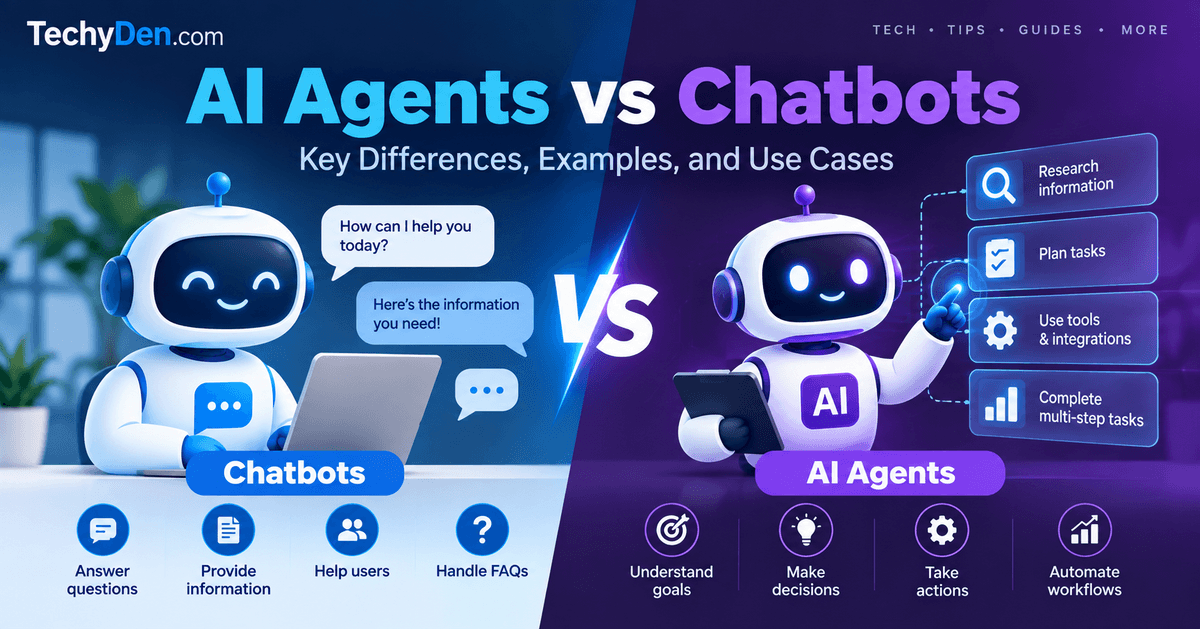
Although AI agents and chatbots can both communicate with users through natural language, they are not the same. Traditional chatbots are mainly designed to provide answers and guide users through predefined conversations. AI agents can understand goals, make decisions, use tools, and complete tasks with greater independence.
So, what is the difference between AI agents and chatbots? In this guide, we will explain AI agents vs chatbots, how they work, their key differences, real-world examples, advantages, and which technology is best for your needs.
AI Agents vs Chatbots: Quick Comparison
The main difference between AI agents and chatbots is their purpose and level of autonomy.
| Feature | AI Agents | Chatbots |
|---|---|---|
| Primary purpose | Complete goals and tasks. | Answer questions and assist users. |
| How they work | Plan, reason, and take action. | Follow rules and workflows or generate responses |
| Decision-making | Can make decisions within assigned permissions | Usually limited to conversation flows |
| Tool usage | Can use APIs, databases, browsers, and other tools | May use integrations, depending on the chatbot |
| Task completion | Can complete multi-step tasks | Usually handles questions or simple actions |
| Memory | May maintain task context or long-term memory | Often uses conversation history or session context |
| Autonomy | Higher, depending on design | Usually lower |
| Best for | Automation, research, workflows, and operations | Customer support, FAQs, and basic assistance |
In simple words: A chatbot mainly talks with you, while an AI agent can talk with you and take actions to achieve a goal.
However, the difference is not always absolute. Modern chatbots can use AI, tools, and automation. Some advanced chatbots are also AI agents.
What Is a Chatbot?
A chatbot is a software application that communicates with users through text or voice. It is designed to answer questions, provide information, and help users complete specific interactions.
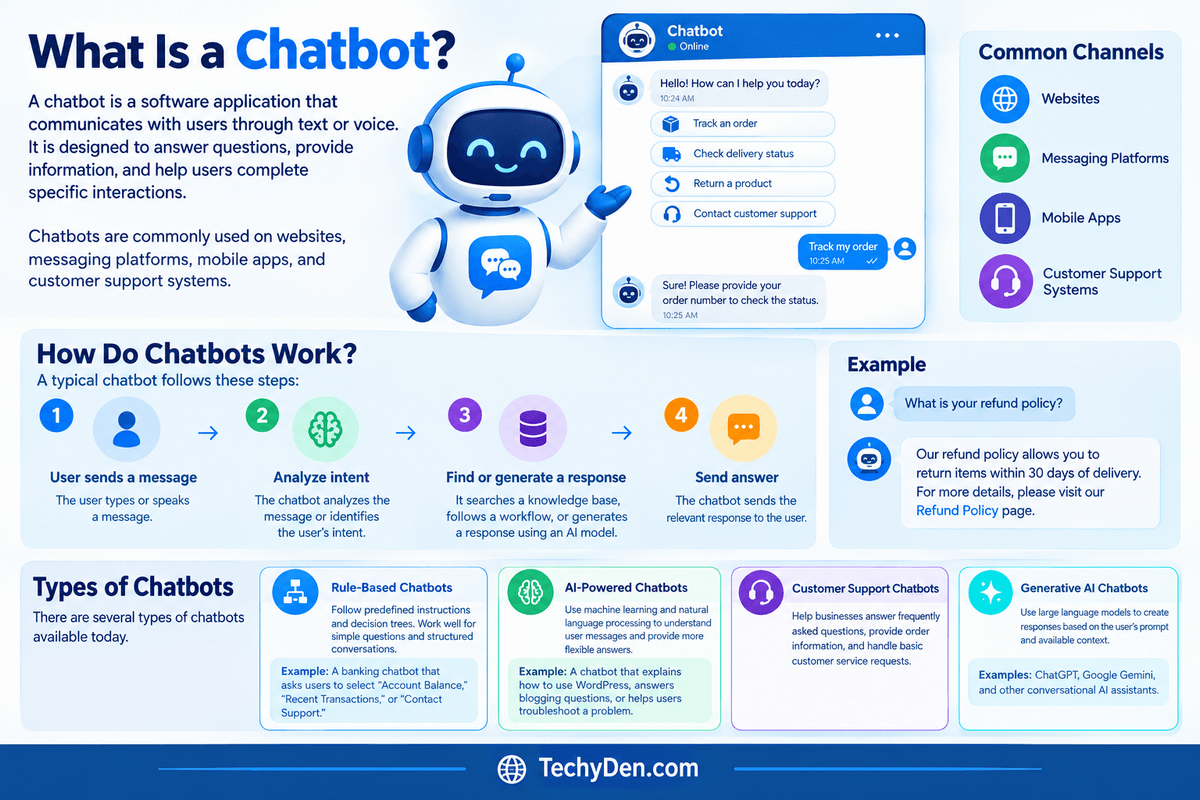
Chatbots are commonly used on websites, messaging platforms, mobile apps, and customer support systems.
Traditional chatbots use predefined rules and conversation flows. For example, a customer support chatbot might display options such as
- Track an order
- Check delivery status
- Return a product
- Contact customer support
The user selects an option, and the chatbot provides the relevant response.
Modern AI chatbots use large language models (LLMs) to understand natural language and generate more flexible responses. They can answer questions, summarize content, explain concepts, and assist with many everyday tasks.
How Do Chatbots Work?
A typical chatbot follows these steps:
- The user sends a message.
- The chatbot analyzes the message or identifies the user’s intent.
- It searches a knowledge base, follows a predefined workflow, or generates a response using an AI model.
- The chatbot sends an answer to the user.
For example, if you ask a website chatbot, “What is your refund policy?” it may retrieve the refund policy from its knowledge base and display the answer.
Types of Chatbots
There are several types of chatbots available today.
- Rule-Based Chatbots: Rule-based chatbots follow predefined instructions and decision trees. They work well for simple questions and structured conversations. Example: A banking chatbot that asks users to select “Account Balance,” “Recent Transactions,” or “Contact Support.”
- AI-Powered Chatbots: AI-powered chatbots use machine learning and natural language processing to understand user messages and provide more flexible answers. Example: A chatbot that explains how to use WordPress, answers blogging questions, or helps users troubleshoot a software problem.
- Customer Support Chatbots: These chatbots help businesses answer frequently asked questions, provide order information, and handle basic customer service requests.
- Generative AI Chatbots: Generative AI chatbots use large language models to create responses based on the user’s prompt and available context. Examples include ChatGPT, Google Gemini, and other conversational AI assistants.
What Is an AI Agent?
An AI agent is a software system that uses artificial intelligence to pursue a goal by observing information, making decisions, and taking actions within its available tools and permissions.
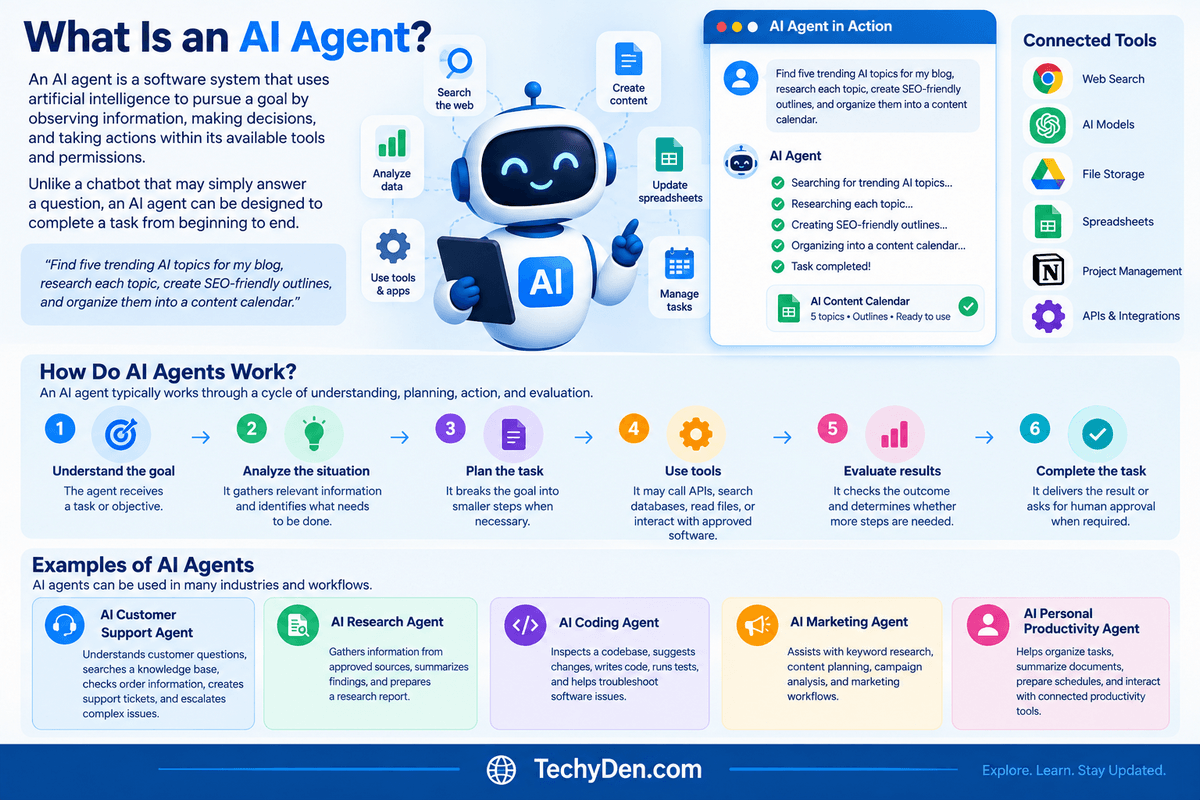
Unlike a chatbot that may simply answer a question, an AI agent can be designed to complete a task from beginning to end.
For example, imagine asking an AI agent:
"Find five trending AI topics for my blog, research each topic, create SEO-friendly outlines, and organize them into a content calendar."
An AI agent could be designed to search for information, evaluate potential topics, create outlines, and update a spreadsheet or project management tool.
The exact capabilities depend on its design, connected tools, permissions, and instructions.
How Do AI Agents Work?
An AI agent typically works through a cycle of understanding, planning, action, and evaluation.
- Understand the goal: The agent receives a task or objective.
- Analyze the situation: It gathers relevant information and identifies what needs to be done.
- Plan the task: It breaks the goal into smaller steps when necessary.
- Use tools: It may call APIs, search databases, read files, or interact with approved software.
- Evaluate results: It checks the outcome and determines whether more steps are needed.
- Complete the task: It delivers the result or asks for human approval when required.
This process is sometimes called an agentic workflow.
Examples of AI Agents
AI agents can be used in many industries and workflows.
- AI Customer Support Agent: An AI customer support agent can understand customer questions, search a knowledge base, check order information through approved systems, create support tickets, and escalate complex issues to human agents.
- AI Research Agent: An AI research agent can gather information from approved sources, summarize findings, and prepare a research report.
- AI Coding Agent: An AI coding agent can inspect a codebase, suggest changes, write code, run tests, and help troubleshoot software issues.
- AI Marketing Agent: An AI marketing agent can assist with keyword research, content planning, campaign analysis, and marketing workflows.
- AI Personal Productivity Agent: A productivity agent can help organize tasks, summarize documents, prepare schedules, and interact with connected productivity tools.
AI Agents vs Chatbots: Key Differences
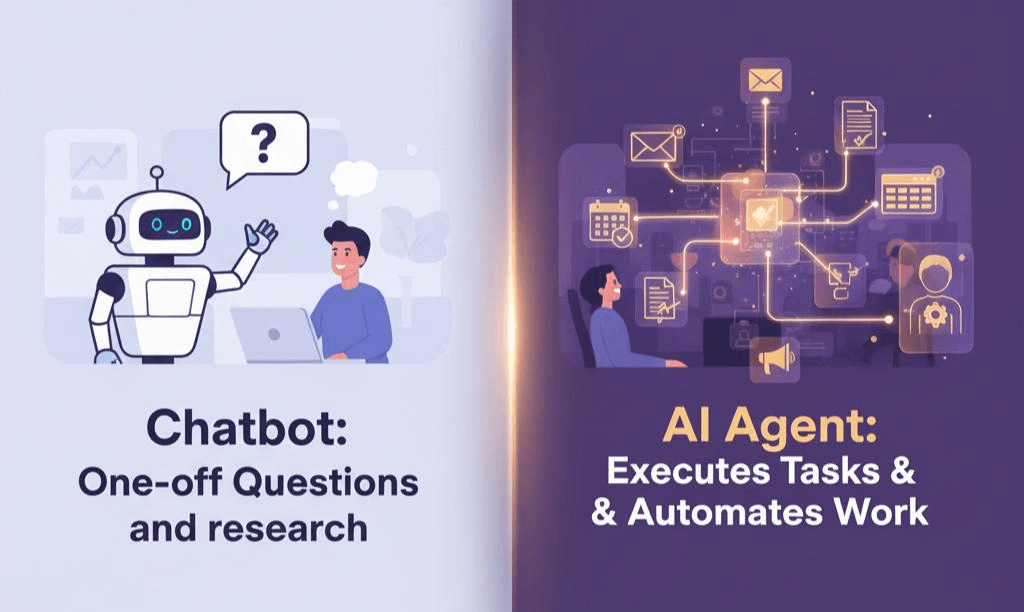
While both technologies use AI in many modern implementations, their capabilities and goals can differ significantly.
1. Purpose and Main Function
The primary purpose of a chatbot is to communicate with users and provide helpful responses.
An AI agent is designed to achieve a goal by performing one or more actions.
Chatbot example:
- User: “What are the benefits of using WordPress?”
- Chatbot: “WordPress is a popular content management system that helps users create websites and blogs.”
AI agent example:
- User: “Create a WordPress blog content plan for the next 30 days.”
- AI agent: It may research topics, organize a content calendar, and prepare a plan, depending on its tools and permissions.
2. Conversation vs Task Completion
Chatbots are primarily conversation-focused. Their success is often measured by how accurately and helpfully they answer questions.
AI agents are task-focused. Their success is measured by whether they can complete the assigned objective.
For example, a chatbot can explain how to book a flight. An AI travel agent could be designed to search flights, compare options, and prepare a booking for approval.
A chatbot can also book a flight if it has the necessary integrations. Therefore, task completion is a useful distinction, but it is not an exclusive feature of AI agents.
3. Autonomy and Decision-Making
Traditional chatbots follow predefined rules or answer questions based on a model and available information.
AI agents generally have more freedom to decide which steps and tools to use to complete a task.
For example, an AI agent may decide to:
- Search a database.
- Compare available options.
- Ask the user for missing information.
- Complete the next step.
- Report the result.
This does not mean AI agents can do anything independently. They still operate within their instructions, tool access, and safety limits.
4. Tool Usage and Integrations
Many chatbots can connect to databases, APIs, and business systems. These integrations allow them to provide real-time information or perform simple actions.
AI agents are often designed around tool usage. They can select and combine different tools as part of a workflow.
- Chatbot example: A support chatbot retrieves an order status from a database.
- AI agent example: An AI support agent checks the order, identifies a delivery problem, creates a support ticket, and sends a response.
The difference is the complexity and flexibility of the workflow, not simply whether an integration exists.
5. Memory and Context
Both chatbots and AI agents can use conversation history, stored information, and external databases.
However, AI agents often use different forms of memory to support longer tasks.
For example, an AI agent may remember:
- The user’s objective.
- Completed steps.
- Information gathered from tools.
- Pending tasks.
- Previous decisions relevant to the workflow.
A chatbot may only need the current conversation context to answer questions.
Memory capabilities depend on the specific software. Not every AI agent has long-term memory, and not every chatbot has limited memory.
6. Multi-Step Workflows
Chatbots are often designed to handle individual questions or short workflows.
AI agents are especially useful for multi-step tasks that require planning and decisions.
Example: Creating a blog post
A chatbot might generate a blog post when asked.
An AI content agent could be designed to:
- Research a topic.
- Identify relevant keywords.
- Create an article outline.
- Draft the content.
- Check the article against SEO requirements.
- Prepare the content for a CMS.
Human review may still be needed for accuracy, originality, and publishing decisions.
7. Human Interaction
Chatbots are designed to interact with users directly through conversation.
AI agents can also communicate with users, but they may work in the background or operate through software tools.
For example:
- A chatbot answers a customer question in a website chat window.
- An AI agent monitors an approved workflow and alerts a team when an issue requires attention.
Both can be conversational, automated, or integrated into business applications.
AI Agents vs Chatbots: Real-World Examples
Understanding practical examples makes the difference easier to remember.
Example 1: Online Shopping
- Chatbot: A customer asks, “Where is my order?” The chatbot checks the order status and provides the estimated delivery date.
- AI Agent: A customer says, “My order is late. Please check the issue and help me resolve it.” An AI agent could check the order, review delivery information, create a support request, and recommend the next step, depending on the tools available.
Example 2: Blogging and SEO
- Chatbot: A blogger asks, “What is keyword research?” The chatbot explains the concept and provides examples.
- AI Agent: A blogger asks, “Find relevant keywords for my WordPress blog and create a content plan.” An AI agent could be designed to research keywords, organize topics, and prepare a content calendar using approved tools.
Example 3: Customer Support
- Chatbot: “How can I reset my password?”. The chatbot provides password reset instructions.
- AI Agent: “Help me recover access to my account.” An AI agent could verify the available information through an approved process, initiate the recovery workflow, and escalate the issue if necessary.
Example 4: Software Development
- Chatbot: A developer asks, “Explain this Python error.” The chatbot explains the likely cause and suggests a fix.
- AI Agent: A developer asks, “Fix the failing tests in this project.” A coding agent could inspect the project, identify the issue, modify code, run tests, and present the changes for review.
Advantages of AI Agents
AI agents provide several benefits for businesses, developers, and individual users.
- Automate Repetitive Tasks: AI agents can automate repetitive workflows such as data entry, information gathering, reporting, and ticket management.
- Handle Complex Workflows: They can break large tasks into smaller steps and coordinate different tools to achieve a goal.
- Improve Productivity: AI agents can reduce the time spent on routine tasks, allowing people to focus on more important work.
- Support Business Operations: Businesses can use AI agents for customer service, marketing, sales assistance, internal research, and operations.
- Work With Existing Tools: Many AI agents can connect to software applications, APIs, databases, and business systems.
Advantages of Chatbots
Chatbots remain useful for many businesses and everyday tasks.
- Easy Customer Communication: Chatbots provide a convenient way for customers to ask questions and get answers.
- 24/7 Availability: A chatbot can provide automated assistance at any time, depending on the service’s availability.
- Reduce Support Workload: Chatbots can answer frequently asked questions and handle simple requests.
- Easy to Deploy: Many chatbot platforms offer templates, knowledge-base integrations, and visual builders.
- Cost-Effective for Simple Tasks: For FAQs and basic customer support, a chatbot may be more practical than building a complex AI agent.
Limitations of AI Agents
AI agents are powerful, but they also have limitations.
- Incorrect decisions: AI agents can misunderstand goals or produce inaccurate results.
- Tool errors: Connected APIs or software systems may fail.
- Security risks: Improper permissions can allow unwanted actions.
- Higher complexity: Building and maintaining agentic workflows can require more technical work.
- Unpredictable behavior: Complex tasks may require monitoring and human approval.
- Higher operating costs: Multi-step workflows may consume more computing resources or API usage.
For sensitive tasks such as financial transactions, account changes, or publishing important information, human oversight is often necessary.
Limitations of Chatbots
Chatbots also have some disadvantages.
- They may provide generic or incorrect answers.
- Rule-based chatbots can struggle with unexpected questions.
- They may not handle complex multi-step tasks well.
- Some chatbots have limited access to real-time information.
- Poorly designed chatbots can frustrate customers.
- They may need human escalation for complicated problems.
Modern AI chatbots can overcome some of these limitations through better models, retrieval systems, and integrations.
AI Agents vs Chatbots: Which One Should You Choose?
The right technology depends on what you want to accomplish.
Choose a chatbot if:
- You need to answer frequently asked questions.
- You want a website customer support assistant.
- You need a simple conversational interface.
- You want to provide product or service information.
- You need a basic helpdesk assistant.
- Your workflow is straightforward and predictable.
Choose an AI Agent If:
- You want to automate multi-step tasks.
- You need an AI system to use several tools.
- You want to coordinate workflows across applications.
- You need research, analysis, or task execution.
- You want to automate business operations.
- You need an AI assistant that can take actions toward a goal.
Choose Both If:
Many businesses benefit from using both chatbots and AI agents.
For example, a customer support system could use a chatbot as the front-end conversation interface and an AI agent to handle more complex requests behind the scenes.
This approach combines simple communication with advanced automation.
Are AI Agents Replacing Chatbots?
AI agents are not necessarily replacing chatbots. Instead, they are expanding what conversational AI systems can do.
Traditional chatbots are still useful for simple, predictable interactions. AI agents are useful when tasks require planning, tool usage, and multiple actions.
In some cases, a chatbot can become an agentic assistant by adding tools, memory, planning, and task-execution capabilities.
The future of conversational AI will likely include systems that combine:
- Natural language conversations.
- AI-powered reasoning.
- Automated workflows.
- External tools and integrations.
- Human supervision.
- Personalized assistance.
The best technology is the one that solves the user’s problem efficiently and reliably.
Frequently Asked Questions on AI Agents vs Chatbots in 2026
What is the main difference between AI agents and chatbots?
The main difference is that chatbots are primarily designed to communicate with users, while AI agents are designed to pursue goals and perform tasks. Chatbots usually focus on answering questions or guiding conversations. AI agents can plan steps, use tools, make decisions, and complete workflows within their permissions.
Is ChatGPT a chatbot or an AI agent?
ChatGPT is a conversational AI assistant that can also support agentic capabilities. In a basic conversation, it behaves like a chatbot by answering questions and generating content. With supported tools and agent features, it can perform more complex tasks. Whether a particular interaction is chatbot-like or agentic depends on the capabilities being used.
Can a chatbot become an AI agent?
Yes, a chatbot can be extended with agentic capabilities. Developers can add tools, planning, memory, decision-making, and task execution. For example, a customer support chatbot could be connected to order systems and ticketing tools to handle more complex requests. However, adding a tool alone does not automatically make every chatbot a fully autonomous AI agent.
Are AI agents more expensive than chatbots?
AI agents can cost more to build and operate because they may require additional tools, integrations, monitoring, and multiple AI model calls. A simple chatbot can be less expensive for answering FAQs. The actual cost depends on the platform, usage, complexity, and level of automation. For simple tasks, a chatbot may provide better value.
Which is better for customer support: AI agents or chatbots?
Both can be useful for customer support. A chatbot is ideal for FAQs, basic troubleshooting, and simple customer questions. An AI agent is better suited to multi-step tasks such as checking orders, creating tickets, and coordinating support workflows. Many businesses use a chatbot for conversations and AI agents for more complex support operations.
Do AI agents work without human intervention?
Some AI agents can complete tasks with limited human intervention, but they are not completely independent. Their capabilities depend on available tools, instructions, and permissions. Human approval may be required for sensitive actions, financial transactions, account changes, or important business decisions. Monitoring and clear safety controls help reduce errors and unwanted actions.
Can AI agents and chatbots use the same AI models?
Yes. Both AI agents and modern AI chatbots can use large language models such as GPT-based models or other generative AI systems. The main difference is how the model is integrated into the application. An AI agent adds tools, workflows, and decision-making capabilities, while a chatbot may use the model primarily to generate conversational responses.
Are AI agents the future of automation?
AI agents are an important part of AI automation because they can handle multi-step tasks and interact with software tools. However, traditional automation, rule-based systems, and chatbots will remain useful for predictable workflows. The most effective solution depends on the task, cost, reliability requirements, and level of human oversight needed.
Final Thoughts on AI Agents vs Chatbots
The difference between AI agents and chatbots comes down to how they are designed to help users.
Chatbots are primarily conversation-based tools that answer questions and provide assistance. AI agents are goal-oriented systems that can plan, use tools, and take actions to complete tasks.
If you need a simple customer support assistant or FAQ system, a chatbot may be the best choice. If you want to automate complex workflows and connect multiple applications, an AI agent may be more suitable.
As artificial intelligence continues to evolve, the line between chatbots and AI agents will become less distinct. Many future AI assistants will combine conversational abilities with powerful task automation.
What do you think about AI agents vs chatbots? Which technology would you choose for your business or personal projects? Share your thoughts in the comments below.