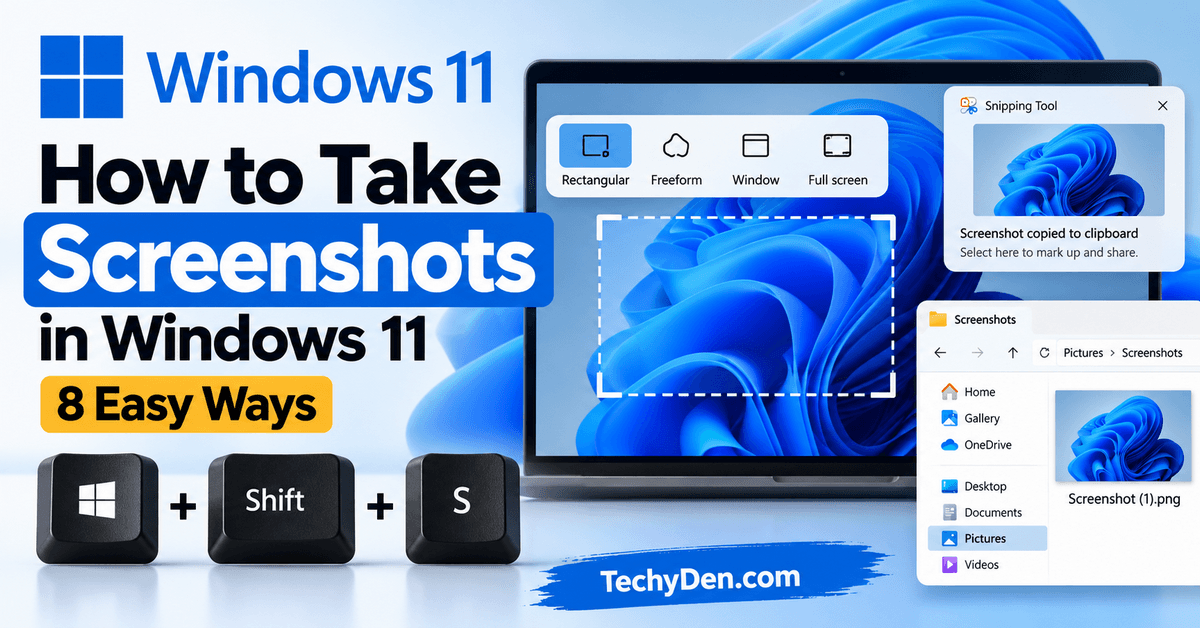
Taking screenshots in Windows 11 is easy once you know the right keyboard shortcuts and built-in tools. Whether you want to capture your entire screen, save a specific window, record an error message, or take a screenshot of a selected area, Windows 11 offers several convenient options.
The quickest way to take a screenshot is to press Windows + Shift + S. This opens the Snipping Tool capture toolbar, allowing you to select the area you want to capture. If you want to save an image of your entire screen automatically, press Windows + PrtScn instead.
For more helpful tips, explore our Windows 11 Guide: Features, Settings, Tips, and Troubleshooting to learn about essential settings, features, and troubleshooting solutions.
In this guide, you’ll learn how to take screenshots in Windows 11 using eight different methods, where your screenshots are saved, and how to fix common screenshot problems.
Windows 11 Screenshot Shortcuts at a Glance
If you want to take a screenshot quickly, use one of the following Windows 11 screenshot shortcuts.
| Screenshot method | Keyboard shortcut | What it does |
|---|---|---|
| Capture a selected area | Windows + Shift + S | Opens the screenshot selection toolbar |
| Capture the entire screen | Windows + PrtScn | Saves a full-screen screenshot to a file on supported configurations |
| Capture the active window | Alt + PrtScn | Copies the active window to the clipboard |
| Open the Snipping Tool capture toolbar | Windows + Shift + S | Lets you choose a screenshot mode |
| Open Xbox Game Bar | Windows + G | Opens the Game Bar overlay |
| Capture a game | Windows + Alt + PrtScn | Takes a screenshot using Xbox Game Bar |
| Capture using the Print Screen key | PrtScn | Behavior depends on your Windows keyboard settings |
Quick tip: On some laptops, you may need to press the Fn key along with PrtScn. Keyboard behavior can vary by manufacturer and configuration.
Explore our Windows 11 tutorials and guides for more step-by-step instructions and tips.
1. Take a Screenshot Using Windows + Shift + S
The easiest way to take a screenshot in Windows 11 is to use the Windows + Shift + S keyboard shortcut. It opens the Snipping Tool capture toolbar and lets you select exactly what you want to capture.

Follow these steps:
- Open the window, webpage, document, or application you want to capture.
- Press Windows + Shift + S on your keyboard.
- Choose a capture mode from the toolbar.
- Select the screen area or window you want to capture.
- Click the screenshot notification that appears to open the captured image.
- Edit the screenshot if necessary, then save it using the Save button.
Windows 11 provides several capture modes, including rectangular snips, freeform snips, window snips, and full-screen snips.
The captured image is generally copied to the clipboard. Depending on your Snipping Tool settings, it may also be saved automatically. If it is not saved automatically, open the screenshot notification and save the image manually.
Best for: Capturing a specific section of a webpage, an error message, a document, or part of your desktop.
For additional instructions, see Microsoft’s official guide to using Snipping Tool to capture screenshots.
2. Take a Full-Screen Screenshot Using Windows + PrtScn
If you want to capture everything visible on your screen and save it as an image, use the Windows + PrtScn keyboard shortcut.

This method is particularly useful when you need to save screenshots for documentation, tutorials, presentations, or troubleshooting.
Steps to take a full-screen screenshot
- Display the screen you want to capture.
- Press Windows + PrtScn simultaneously.
- Your screen may briefly dim to indicate that the screenshot has been captured.
- Open File Explorer by pressing Windows + E.
- Navigate to Pictures → Screenshots.
- Find your screenshot in the folder.
Windows typically saves the image as a PNG file.
If your laptop does not have a dedicated Print Screen key, look for a secondary key label or try the manufacturer’s supported Fn combination.
Best for: Saving the entire desktop without manually opening an image editor.
3. Capture the Active Window Using Alt + PrtScn
Sometimes, you only need a screenshot of one application rather than your entire desktop. For example, you may want to capture a browser window, an error dialog, or a document without including other open applications.

In this situation, use Alt + PrtScn.
How to capture an active window
- Open the application or window you want to capture.
- Click the window to make sure it is active.
- Press Alt + PrtScn.
- Open Microsoft Paint, Word, or another application that supports image pasting.
- Press Ctrl + V to paste the screenshot.
- Save the image if you want to keep it as a separate file.
This shortcut copies the active window to the clipboard rather than automatically saving it as a screenshot file.
If nothing appears in your image editor, try clicking inside the editor before pressing Ctrl + V.
Best for: Capturing a single application window while excluding the rest of the desktop.
4. Use the Snipping Tool in Windows 11
The Snipping Tool is a built-in Windows 11 application that allows you to capture, edit, and save screenshots. It is especially useful if you want more control over the screenshot than a basic keyboard shortcut provides.
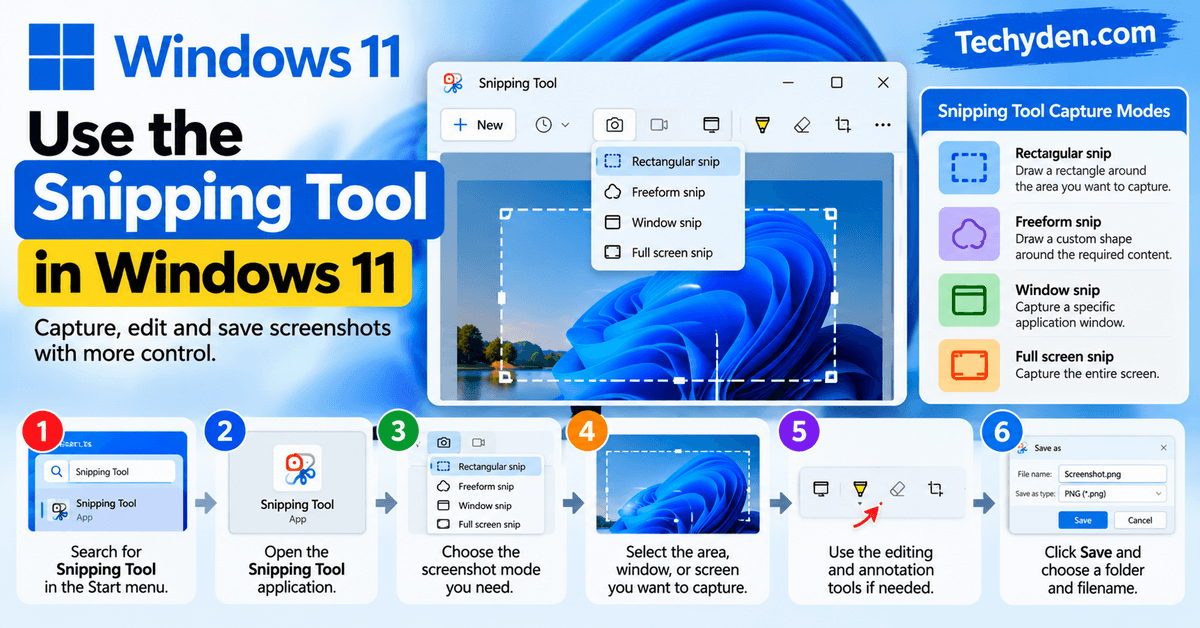
How to take a screenshot with Snipping Tool
- Open the Start menu.
- Search for Snipping Tool.
- Select the application.
- Choose the screenshot mode you need.
- Click New, if required by the current interface.
- Select the area, window, or screen you want to capture.
- Use the available editing and annotation tools.
- Click Save and choose a folder and filename.
Screenshot modes available in Snipping Tool
- Rectangular snip: Draw a rectangle around the area you want to capture.
- Freeform snip: Draw a custom shape around the required content.
- Window snip: Capture a specific application window.
- Full-screen snip: Capture the entire screen.
The app’s available features can vary by Windows version and application update. Some versions also provide a delay timer, which is useful for capturing menus or interface elements that disappear when you click elsewhere.
Best for: Users who frequently capture and annotate screenshots for tutorials, work, study, or troubleshooting.
5. Take a Screenshot Using the Print Screen Key
The Print Screen key, commonly labeled PrtScn, PrtSc, or Print Scr, is another way to take a screenshot on a Windows 11 PC.

However, pressing this key does not always produce the same result on every computer. Depending on your Windows settings, it may copy the screen to the clipboard or open the Snipping Tool capture toolbar.
How to use the Print Screen key
- Open the screen you want to capture.
- Press the PrtScn key.
- Check whether the Snipping Tool toolbar appears or the screenshot is copied to the clipboard.
- If the image is copied, open Paint or another compatible application.
- Press Ctrl + V to paste the screenshot.
- Save the image.
How to change the Print Screen setting
If pressing PrtScn opens the Snipping Tool instead of copying the full screen, you can check the related keyboard setting.
- Open Settings.
- Select Accessibility.
- Choose Keyboard.
- Find the option labeled Use the Print screen key to open screen capture or similar wording.
- Turn the setting on or off according to your preference.
The exact wording may differ between Windows 11 releases.
For more details, consult Microsoft’s documentation on the Print Screen keyboard shortcut.
Best for: Users who prefer a single-key screenshot method.
6. Take Screenshots Using Xbox Game Bar
Xbox Game Bar is a Windows feature designed primarily for gaming, but it can also be useful for capturing screenshots in supported applications.
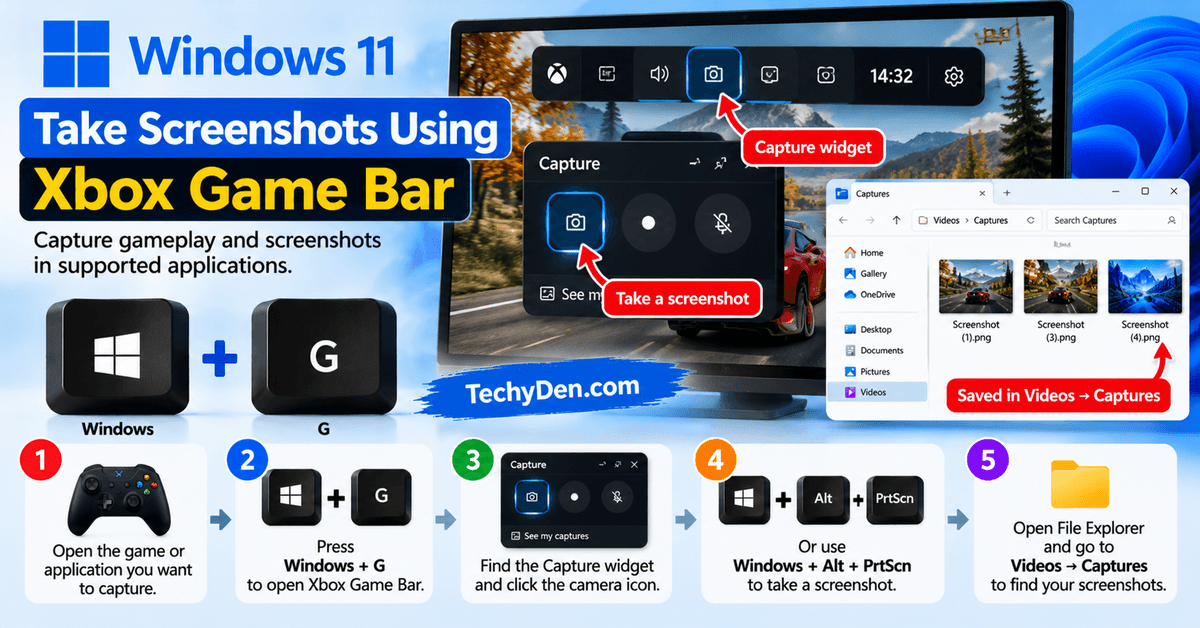
How to take a screenshot with Xbox Game Bar
- Open the game or application you want to capture.
- Press Windows + G to open Xbox Game Bar.
- Find the Capture widget.
- Select the camera icon to take a screenshot, or use the supported shortcut Windows + Alt + PrtScn.
- Open File Explorer and navigate to Videos → Captures to find saved Game Bar screenshots.
The exact behavior may vary depending on the application and Windows configuration. Game Bar is particularly useful for capturing gameplay, but it is not a replacement for every desktop screenshot method.
Best for: Capturing gameplay and screenshots in supported applications.
7. Take a Screenshot on a Windows 11 Laptop Without a PrtScn Key
Some compact laptops and keyboards do not have a dedicated Print Screen key. Others combine the screenshot function with another key.

You can still take screenshots using Windows 11’s built-in tools.
Method 1: Use the Snipping Tool shortcut
- Open the screen you want to capture.
- Press Windows + Shift + S.
- Select the required capture mode.
- Capture the desired area.
- Open the notification and save the image if needed.
This is usually the easiest solution because it does not require a dedicated Print Screen key.
Method 2: Check your laptop’s Fn combinations
Look for a secondary screenshot label on your keyboard. Depending on the laptop model, you may need to hold Fn while pressing a key that provides the Print Screen function.
Some devices also support Windows + Fn + Spacebar, but this is not a universal Windows 11 shortcut. Check your laptop manufacturer’s documentation for the correct combination.
Best for: Users with compact laptops, tablet keyboards, or external keyboards without a dedicated PrtScn key.
8. Use Paint to Edit and Save Screenshots
Microsoft Paint is useful when you want to crop, annotate, or resize a screenshot before saving it.

You can use Paint with screenshots captured through the Print Screen key, Alt + PrtScn, or Windows + Shift + S.
How to save a screenshot using Paint
- Capture a screenshot using your preferred method.
- Open Microsoft Paint from the Start menu.
- Press Ctrl + V to paste the screenshot if it is on the clipboard.
- Use the selection and crop tools to remove unwanted areas.
- Add text, arrows, or other annotations if needed.
- Select File → Save As.
- Choose a format such as PNG or JPEG.
- Enter a filename and select the destination folder.
PNG is a good choice for screenshots containing text, interface elements, and sharp edges. JPEG can be useful when you need a smaller image file, although it uses lossy compression.
Best for: Creating polished screenshots for articles, presentations, tutorials, and technical documentation.
Where Are Screenshots Saved in Windows 11?
The location depends on the screenshot method you use.
| Screenshot method | Typical destination |
|---|---|
| Windows + PrtScn | Pictures → Screenshots |
| Windows + Shift + S | Clipboard and Snipping Tool; save manually unless automatic saving is enabled |
| Alt + PrtScn | Clipboard |
| PrtScn | Clipboard or Snipping Tool, depending on settings |
| Xbox Game Bar | Videos → Captures |
| Paint | The folder you select when saving |
How to find a missing screenshot
If you cannot find your screenshot, try the following:
- Open File Explorer by pressing Windows + E.
- Check the Pictures and Videos folders.
- Look in the Screenshots and Captures subfolders.
- Search for recent image files with extensions such as PNG or JPG.
- Check whether OneDrive redirects or backs up your Pictures folder.
- If you used a clipboard-based method, paste the image into Paint and save it.
Remember that copying a screenshot to the clipboard does not necessarily create a permanent image file. You must save it if you want to keep it.
How to Fix Screenshots Not Working in Windows 11
If your Windows 11 screenshot shortcut is not working, use the following troubleshooting steps.
- Check the keyboard shortcut: Make sure you are pressing the correct combination. For example, Windows + Shift + S opens the capture toolbar, while Alt + PrtScn captures the active window to the clipboard.
- Try the Fn key: On some laptops, the Print Screen function is assigned to a secondary key. Try the manufacturer’s supported Fn combination.
- Check the Print Screen setting: Open Settings → Accessibility → Keyboard and review the Print Screen shortcut option. Change it if you want the key to behave differently.
- Restart the Snipping Tool: Close the app and reopen it. If the problem persists, open Settings → Apps → Installed apps, locate Snipping Tool, and check the available repair or reset options.
- Check the clipboard: If the screenshot appears to be captured but does not save automatically, open Paint and press Ctrl + V. If the image appears, save it manually.
- Check the save location: Look in Pictures → Screenshots or Videos → Captures, depending on the method you used. Also check OneDrive if your folders are backed up.
- Install available Windows updates: Open Settings → Windows Update and check for available updates. Keeping Windows and its built-in applications up to date can resolve some software-related issues.
You can also learn how to enable hibernate on Windows 11 to access another useful Windows power-management feature.
If a specific application prevents screenshots, the restriction may be intentional. For example, protected content or organization-managed applications may limit screen capture.
If your PC is also running slowly, follow our guide on how to fix Windows 11 slow performance to troubleshoot common performance problems.
Can You Take a Scrolling Screenshot in Windows 11?
Windows 11’s built-in Snipping Tool does not provide a general-purpose scrolling screenshot feature for capturing an entire long webpage or document.
If you need to capture a full webpage, try these options:
- Check your browser: Some browsers provide built-in full-page screenshot features through their developer tools or other browser-specific functions.
- Use a browser extension: Choose a reputable extension with clear privacy practices, especially if you capture pages containing personal or confidential information.
- Use an appropriate application: For long documents or specialized software, check whether the application has its own export or capture feature.
For a normal screenshot of the visible portion of a webpage, Windows + Shift + S remains a convenient option.
Frequently Asked Questions
What is the shortcut for screenshots in Windows 11?
The most versatile shortcut is Windows + Shift + S, which opens the screenshot capture toolbar. To save a full-screen screenshot directly to a file, use Windows + PrtScn on a supported configuration.
How do I take a screenshot of only part of my screen?
Press Windows + Shift + S and choose rectangular snip or freeform snip. Select the area you want to capture, then open the notification to edit and save the screenshot if necessary.
How do I take a screenshot without the Print Screen key?
Press Windows + Shift + S to open the Snipping Tool capture toolbar. You can also launch Snipping Tool from the Start menu and capture your screen without using the Print Screen key.
Where are screenshots saved in Windows 11?
Screenshots captured using Windows + PrtScn are typically stored in Pictures → Screenshots. Xbox Game Bar screenshots are usually stored in Videos → Captures. Clipboard-based screenshots must be pasted into an application and saved unless another feature saves them automatically.
How do I take a screenshot and save it as a JPG?
Capture the screen, open Microsoft Paint, and paste the image if necessary. Select File → Save As → JPEG picture, choose a folder, enter a filename, and save it.
Why is Windows + Shift + S not working?
Check that the keyboard combination is correct, restart Snipping Tool, and install available application or Windows updates. If the capture toolbar appears but the screenshot does not save, open the notification or paste the image into Paint and save it manually.
Can I take screenshots in Windows 11 without installing software?
Yes. Windows 11 includes Snipping Tool, Print Screen shortcuts, and Xbox Game Bar. These built-in options are sufficient for most everyday screenshot tasks.
How do I capture a scrolling webpage in Windows 11?
The built-in Snipping Tool does not offer general-purpose scrolling capture. Check whether your browser has a full-page capture option, or use a reputable screenshot extension if you need to capture an entire webpage.
Conclusion
There are several easy ways to take screenshots in Windows 11, and the best method depends on what you want to capture. Use Windows + Shift + S to select a specific area, Windows + PrtScn to save a full-screen screenshot, or Alt + PrtScn to capture the active window. For more control, use Snipping Tool or Paint to edit and save your images.
Visit our Windows 11 features guide to discover more features and capabilities of the operating system.
Once you learn these shortcuts, you can capture, edit, and share screenshots on your Windows 11 PC without installing additional software.