
Learning how to improve typing speed can help you save time, complete work faster, and become more productive on your computer. Whether you are a student writing assignments, an office worker preparing reports, a blogger creating content, or someone who spends hours online, typing faster can make everyday tasks easier.
The good news is that you do not need an expensive keyboard or special software to improve your typing skills. With proper finger placement, regular practice, and a focus on accuracy, you can gradually increase your words per minute (WPM).
The most effective approach is to learn touch typing, practice common words and sentences, and identify the keys that slow you down. Free online typing tools can also help you measure your progress and stay motivated.
In this guide, you will learn 12 practical ways to improve typing speed, discover free typing practice websites, and follow a simple seven-day plan to develop better typing habits.
12 Practical Tips on How to Improve Typing Speed
Improving your typing speed takes consistent practice, proper finger placement, and a focus on accuracy.
Whether you are a student, blogger, or professional, these 12 practical tips will help you learn how to type faster, reduce typing mistakes, and improve your overall productivity.
From mastering touch typing to using free typing practice tools, each tip provides a simple way to develop better typing skills.
1. Measure Your Current Typing Speed
Before trying to type faster, find out how quickly you can type right now. Measuring your current typing speed gives you a starting point and helps you track your progress.
Typing speed is usually measured in words per minute (WPM). It indicates how many standardized words you can type in one minute.
For example, if you type 250 characters in one minute, including spaces, your gross typing speed is approximately 50 WPM. This calculation treats every five characters as one standardized word.
However, some typing tests calculate a net score by accounting for mistakes. As a result, two websites may display slightly different results for the same performance.
How to Take a Typing Speed Test
Follow these steps to measure your typing speed:
- Open a free online typing test.
- Choose a one-minute test.
- Type the displayed text at your normal pace.
- Avoid looking down at the keyboard whenever possible.
- Check your WPM and accuracy percentage.
- Repeat the test two or three times and record your average result.
Record your initial speed, accuracy, and test duration. Repeat the test under similar conditions each week to see whether your typing skills are improving.
Tip: Do not worry if your initial score is low. Your starting speed is simply a baseline, not a measure of your potential.
2. Learn Proper Finger Placement
Proper finger placement is one of the most important steps in improving typing speed. If you frequently search for individual keys or use only a few fingers, typing can become slower and less consistent.
The standard QWERTY keyboard uses a technique called touch typing, in which you learn to press keys using the appropriate fingers without constantly looking at the keyboard.
Understand the Home Row
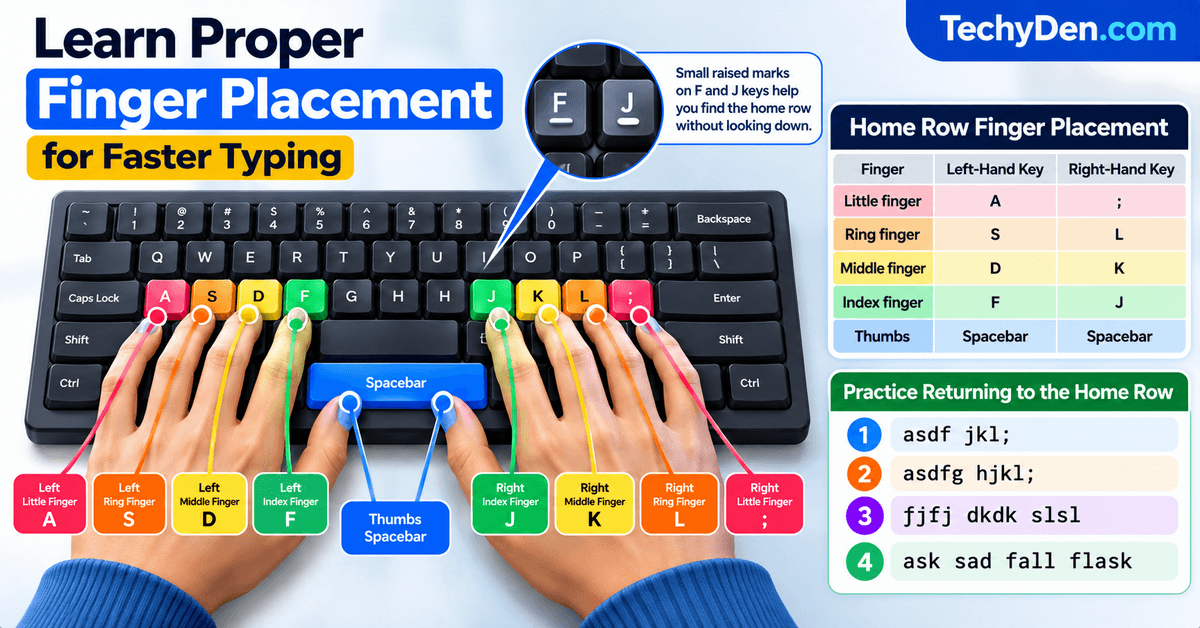
The home row is the middle row of letters on a standard QWERTY keyboard.
Place your left-hand fingers on A, S, D, and F. Place your right-hand fingers on J, K, L, and the semicolon key.
| Finger | Left-Hand Key | Right-Hand Key |
|---|---|---|
| Little finger | A | ; |
| Ring finger | S | L |
| Middle finger | D | K |
| Index finger | F | J |
| Thumbs | Spacebar | Spacebar |
The small raised marks on the F and J keys help you find the correct hand position without looking down.
Practice Returning to the Home Row
Start by typing these combinations slowly:
asdf jkl;asdfg hjkl;fjfj dkdk slslask sad fall flask
Focus on pressing the correct keys with the appropriate fingers. After pressing keys in other rows, return your fingers to the home-row position when appropriate.
Avoid stretching your fingers uncomfortably. Good touch typing involves natural finger movement rather than keeping your hands rigid.
3. Practice Touch Typing Without Looking at the Keyboard
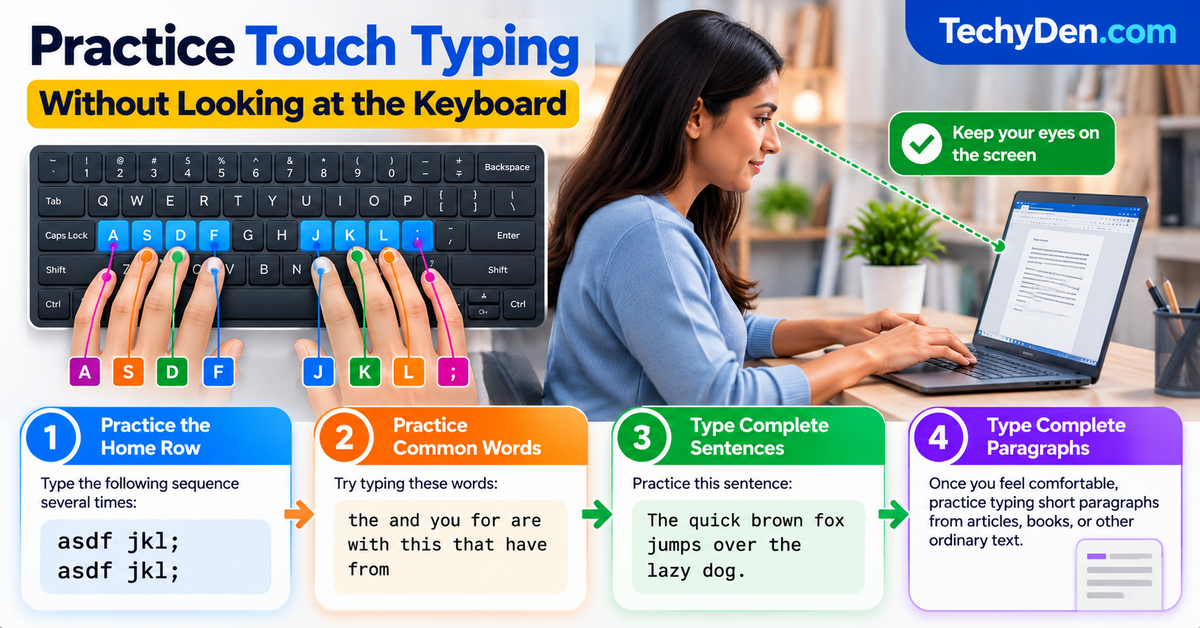
Touch typing is the ability to type using muscle memory rather than visually searching for each key.
When you learn touch typing, your fingers gradually become familiar with the keyboard layout. This reduces the need to look down and helps you maintain a more consistent typing rhythm.
Although learning touch typing may initially slow you down, consistent practice can help you become more comfortable and efficient.
How to Learn Touch Typing
Start with simple exercises and increase the difficulty gradually.
- Stage 1: Practice the home row – Type the following sequence several times:
asdf jkl; asdf jkl; - Stage 2: Practice common words – Try typing:
the and you for are with this that have from - Stage 3: Type complete sentences – Practice this sentence: “The quick brown fox jumps over the lazy dog.” This sentence contains every letter of the English alphabet, making it useful for practicing different keys.
- Stage 4: Type complete paragraphs – Once you feel comfortable with individual words and sentences, practice typing short paragraphs from articles, books, or other ordinary text.
Keep your eyes on the screen as much as possible. If you make mistakes, slow down and focus on accuracy instead of immediately trying to increase your speed.
4. Focus on Typing Accuracy Before Speed
One common mistake beginners make is trying to type as quickly as possible before learning to type accurately.
Typing speed matters, but frequent mistakes can interrupt your rhythm and force you to spend additional time correcting errors.
For example, someone who types quickly but makes numerous mistakes may take longer to finish a document than someone who types slightly more slowly with better accuracy.
How to Improve Typing Accuracy
Use these techniques during practice:
- Slow down when you repeatedly mistype certain letters.
- Pay attention to capitalization and punctuation.
- Practice difficult words separately.
- Use the correct fingers instead of reaching awkwardly.
- Review the errors displayed after each typing test.
- Increase your speed gradually as your accuracy improves.
Choose an accuracy goal that challenges you without making practice frustrating. The appropriate target depends on your current skill level and the type of text you are typing.
Remember: The goal is not simply to increase your WPM. It is to develop a typing technique that helps you work quickly and accurately.
5. Use Free Typing Practice Websites
Free typing practice websites can help you learn keyboard placement, complete structured exercises, test your speed, and monitor your performance.
You do not need to pay for a typing course when you are just starting. Several online tools offer useful lessons and practice tests at no cost.
Here are four options worth trying.
Typing.com
Typing.com is a useful starting point for beginners who want structured typing lessons.
It offers typing practice designed to help learners develop keyboard familiarity and improve their skills through guided exercises.
Best for: Beginners who prefer step-by-step lessons rather than unstructured practice.
Monkeytype
Monkeytype is an online typing test that lets you practice typing and review performance statistics.
You can use it to measure your WPM, check your accuracy, and repeat tests to track your progress.
Best for: Users who want customizable typing tests and a simple way to monitor performance.
Keybr
Keybr helps users practice typing through exercises that focus on keyboard familiarity and difficult letter combinations.
Its adaptive approach can help you spend more time practicing keys that need additional attention.
Best for: Learners who want targeted practice with unfamiliar or frequently mistyped keys.
10FastFingers
10FastFingers provides online typing speed tests that let you measure how quickly you can type common words.
It is particularly useful for short practice sessions when you want to check your current WPM.
Best for: People who want quick typing tests and a straightforward way to compare results over time.
Which Typing Website Should You Choose?
Choose a tool based on your current needs.
| Typing Tool | Best Use |
|---|---|
| Typing.com | Structured lessons for beginners |
| Monkeytype | Typing tests and performance tracking |
| Keybr | Targeted keyboard practice |
| 10FastFingers | Quick typing speed tests |
You can combine these tools rather than relying on just one. For example, complete a structured lesson on Typing.com and then take a short test on Monkeytype to check your performance.
Before committing to a tool, check its current features and whether any particular lessons require an account or paid plan.
6. Practice for 15–20 Minutes Every Day
Regular practice is one of the most effective ways to improve typing speed.
You do not need to spend hours practicing every day. A short, focused session can help you build consistency without making typing feel like a chore.
The important thing is to practice deliberately rather than repeatedly taking speed tests without addressing your weaknesses.
A Simple 20-Minute Typing Practice Routine
Follow this schedule each day:
| Activity | Time |
|---|---|
| Warm up with home-row exercises | 3 minutes |
| Practice difficult letters and words | 5 minutes |
| Complete a structured typing lesson | 5 minutes |
| Type sentences or paragraphs | 5 minutes |
| Review your speed and accuracy | 2 minutes |
| Total | 20 minutes |
During the warm-up, concentrate on finger placement. Use the next five minutes to practice letters or combinations that frequently cause mistakes.
Complete a lesson or typing exercise, then spend a few minutes typing ordinary sentences. Finish by reviewing your results and identifying one area to improve during your next session.
If you have limited time, start with five to ten minutes and build a sustainable routine.
Avoid continuing through pain or significant discomfort. Take breaks when needed.
7. Maintain Proper Posture and Hand Position
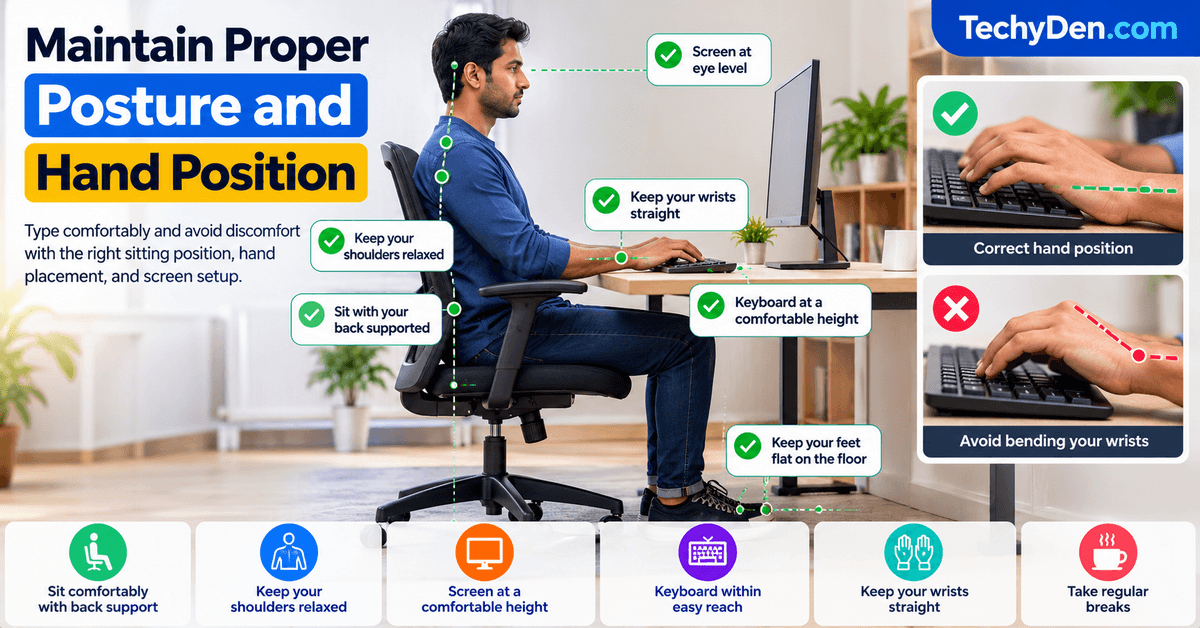
Your typing technique is not just about finger movement. Comfortable posture can also make longer typing sessions easier.
Poor positioning may contribute to discomfort in your hands, wrists, shoulders, or neck. Discomfort can interrupt practice and make it harder to maintain a consistent routine.
Tips for Comfortable Typing
Follow these basic guidelines:
- Sit in a comfortable position with your back supported.
- Keep your shoulders relaxed rather than raised or tense.
- Position your keyboard so you can reach the keys comfortably.
- Keep your wrists relatively straight instead of bending them sharply.
- Place your screen at a comfortable viewing height.
- Press the keys gently rather than striking them with excessive force.
- Take regular breaks during extended typing sessions.
Your hands should move naturally across the keyboard. Avoid stretching your fingers excessively to reach distant keys.
If your current keyboard forces you into an uncomfortable position, consider adjusting your desk setup before purchasing new equipment.
Persistent pain, numbness, or tingling should not be ignored. Stop the activity that aggravates your symptoms and seek appropriate medical advice.
If you are planning to upgrade your computer, consider the important factors when choosing a comfortable laptop, including keyboard design, screen size, and overall usability.
8. Stop Looking Down at the Keyboard Constantly
Looking down at the keyboard after every few keystrokes can interrupt your typing rhythm.
Each time you shift your attention between the keyboard and the screen, you may lose track of the text you are typing. Learning to locate keys through touch can help reduce this interruption.
However, you do not need to eliminate every glance immediately.
How to Reduce Your Dependence on the Keyboard
Try these techniques:
- Use the raised markers on the F and J keys to find the home row.
- Practice short words without looking down.
- Keep your attention on the screen while typing simple sentences.
- Use structured touch-typing exercises to learn unfamiliar keys.
- Increase the length of your practice passages gradually.
If you repeatedly look down to find a particular letter, pause and practice that key separately.
Some learners find it helpful to cover their hands while practicing, but this is optional. Do not use a method that makes you uncomfortable or prevents you from learning the keyboard layout.
The goal is to develop familiarity with the keys so that typing becomes more natural over time.
9. Practice Difficult Keys and Common Words
Not every key will feel equally comfortable when you begin learning touch typing.
You may find certain letters, punctuation marks, or combinations difficult to type. Practicing these areas directly can be more productive than repeating exercises you have already mastered.
Identify Your Weak Points
After completing a typing test, review the mistakes you made.
Ask yourself:
- Which letters did I mistype most often?
- Did I struggle with the upper or lower keyboard rows?
- Did I make errors when using capital letters?
- Did punctuation slow me down?
- Did I frequently press the wrong key with my index fingers?
Once you identify a pattern, create a short exercise around it.
For example, if you struggle with the letters R, T, and Y, practice words containing those letters before moving to longer sentences.
You can also practice common English words such as:
the, and, that, with, from, have, this, your, they, about
Repeated exposure to common words can help you become more familiar with frequently used letter combinations.
However, do not practice only simple words. Include complete sentences, punctuation, capitalization, and unfamiliar vocabulary so your skills transfer to everyday writing.
10. Learn Keyboard Shortcuts to Work More Efficiently
Keyboard shortcuts do not directly increase your measured typing speed, but they can improve overall computer productivity.
Instead of repeatedly moving your hand to the mouse and navigating menus, you can use shortcuts to complete common actions quickly.
Here are several useful Windows keyboard shortcuts.
| Keyboard Shortcut | Function |
|---|---|
| Ctrl + C | Copy selected text or items |
| Ctrl + V | Paste copied content |
| Ctrl + X | Cut selected text or items |
| Ctrl + Z | Undo the previous action |
| Ctrl + A | Select all content in the active area |
| Ctrl + F | Find text in supported applications |
| Ctrl + S | Save the current document |
| Alt + Tab | Switch between open applications |
These shortcuts are particularly useful for students, office workers, bloggers, and anyone who regularly works with documents.
For example, a blogger can use copy, paste, undo, and save shortcuts while editing an article in WordPress.
Learn two or three shortcuts at a time and use them regularly until they become familiar.
Keep in mind that some shortcuts behave differently across applications and operating systems.
Besides learning keyboard shortcuts, you can discover more ways to improve productivity with Windows 11 by using built-in features and tools that simplify everyday tasks.
To discover more shortcuts for everyday computer tasks, consult Microsoft’s documentation on Windows keyboard shortcuts.
11. Practice With Real-World Content
Typing exercises are useful for learning finger placement, but you should also practice with the kinds of text you use in everyday life.
Real-world practice helps you become comfortable typing different words, sentence structures, numbers, and punctuation marks.
Choose practice material based on your daily activities.
- For students: Type class notes, assignments, summaries, and study material.
- For office workers: Practice emails, reports, meeting notes, and business documents.
- For bloggers and writers: Type article introductions, outlines, paragraphs, and draft content.
- For programmers: Practice code snippets, documentation, and text that includes symbols and punctuation.
- For general computer users: Practice messages, online forms, and everyday documents.
Start with a short paragraph and focus on maintaining a comfortable rhythm. As your accuracy improves, increase the length and complexity of the material.
If you regularly type numbers, symbols, or code, include those elements in your practice. Ordinary English typing tests may not accurately represent the demands of these tasks.
Real-world practice also helps you recognize whether your improved typing skills are making everyday work easier.
If your computer responds slowly while you are typing or switching between applications, learn how to fix Windows 11 slow performance to troubleshoot potential system-related issues.
12. Track Your Progress and Set Realistic Goals
Tracking your typing speed helps you understand what is improving and where you still need practice.
Without a record of your results, it can be difficult to distinguish genuine progress from the natural variation between typing tests.
What Should You Track?
Record these details after your practice sessions:
- Words per minute.
- Accuracy percentage.
- Practice duration.
- Frequently mistyped keys.
- Areas that need additional work.
You can use a notebook or spreadsheet to maintain a simple progress log.
For example:
| Practice Day | WPM | Accuracy | Focus Area |
|---|---|---|---|
| Day 1 | Record your baseline | Record your baseline | Identify weak keys |
| Day 3 | Record your result | Record your result | Improve finger placement |
| Day 5 | Record your result | Record your result | Maintain typing rhythm |
| Day 7 | Record your result | Record your result | Compare with baseline |
These are tracking prompts, not predicted results. Your actual speed and accuracy will depend on your starting ability and the consistency of your practice.
Set a Personal Typing Goal
Suppose your starting speed is 25 WPM.
Instead of immediately aiming for 80 WPM, you might initially target 28–30 WPM while maintaining or improving your accuracy.
Once you reach that goal consistently, set another achievable target.
The best goal is one that challenges you without encouraging careless typing.
Measure progress under similar test conditions, and remember that speed can vary depending on text difficulty, punctuation, keyboard layout, and test duration.
7-Day Typing Speed Improvement Plan
If you are unsure where to start, follow this simple seven-day typing practice plan.
Spend approximately 15–20 minutes each day on the suggested activities. Adjust the duration to suit your schedule and comfort.
| Day | Focus | Practice Activity |
|---|---|---|
| Day 1 | Measure your baseline | Take a typing test and record your WPM and accuracy |
| Day 2 | Learn the home row | Practice A, S, D, F, J, K, L, and semicolon |
| Day 3 | Develop touch typing | Practice reaching the upper and lower letter rows |
| Day 4 | Improve accuracy | Repeat exercises involving frequently mistyped keys |
| Day 5 | Build typing rhythm | Practice common words and complete sentences |
| Day 6 | Use real-world text | Type a short email, paragraph, or article introduction |
| Day 7 | Review your progress | Repeat the initial test and compare your results |
How to Get the Most From This Plan
- Day 1: Find your starting point. Do not worry about achieving a particular score.
- Days 2–3: Concentrate on correct finger placement and gradually reduce the need to look at the keyboard.
- Days 4–5: Identify recurring mistakes and practice words or sentences that address them.
- Day 6: Apply your developing skills to ordinary writing tasks.
- Day 7: Repeat the typing test under conditions similar to those on Day 1. Compare your WPM and accuracy.
You may notice improvements in keyboard familiarity, rhythm, or confidence during the first week. However, substantial increases in typing speed can take longer.
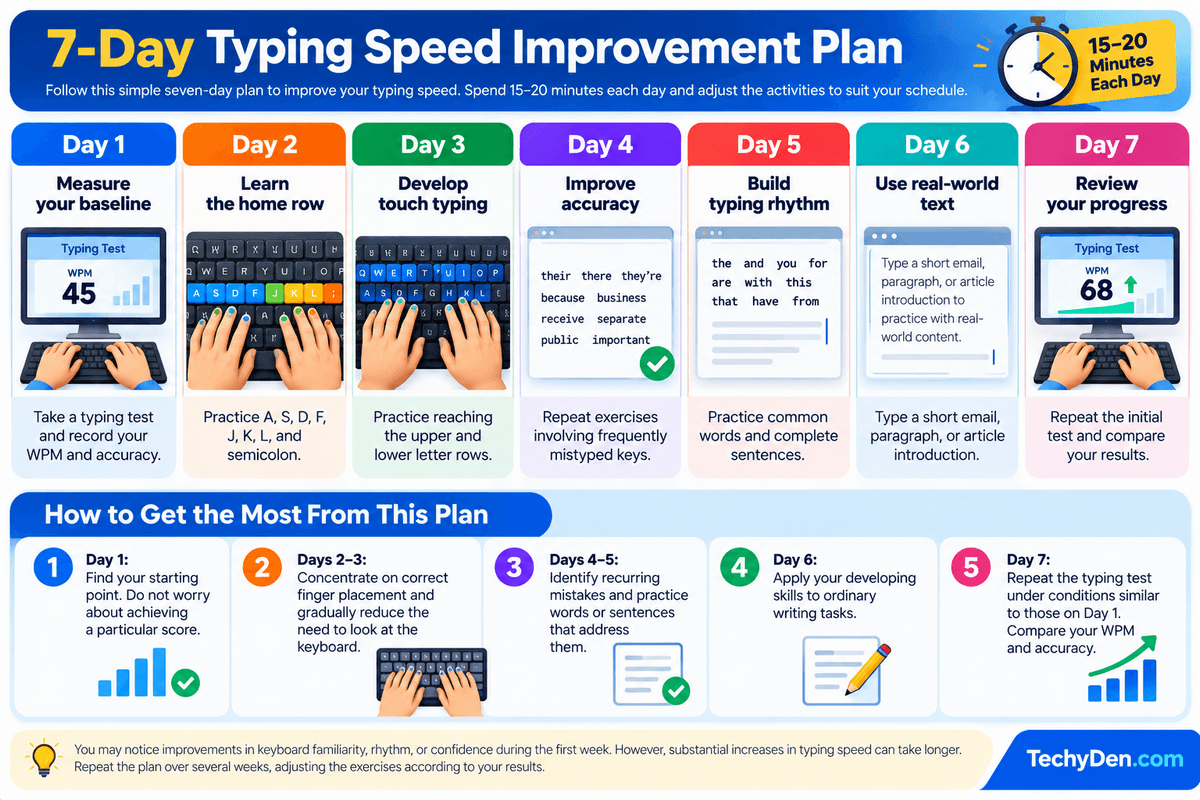
Repeat the plan over several weeks, adjusting the exercises according to your results.
Common Mistakes to Avoid When Improving Typing Speed
Even with regular practice, certain habits can slow your progress.
Avoid these common mistakes when learning how to type faster.
- Prioritizing speed over accuracy: Typing too quickly can create unnecessary errors. Focus on correct keystrokes before increasing your pace.
- Using only a few fingers: Depending on just two or three fingers can limit your ability to use a consistent touch-typing technique.
- Looking down constantly: Repeatedly searching for keys interrupts your rhythm. Practice touch typing gradually.
- Practicing without a plan: Random tests may be less useful than exercises that target your specific weaknesses.
- Ignoring difficult keys: Spend extra time on the letters, punctuation marks, and combinations that cause repeated mistakes.
- Practicing for too long without breaks: Long sessions can cause fatigue and discomfort. Short, focused sessions are often easier to maintain.
- Expecting instant results: Typing skills develop through repetition. Avoid judging your progress by a single session.
- Ignoring discomfort: Stop and adjust your setup if typing causes pain or other concerning symptoms.
The most effective approach is to practice consistently, correct mistakes, and increase difficulty as your skills develop.
If you also work online, understanding your internet connection can help you troubleshoot slow-loading websites and web-based typing tools. Learn more in our guide to understanding your internet speed.
Frequently Asked Questions About Typing Speed
How can I improve my typing speed quickly?
To improve typing speed, learn proper finger placement, practice touch typing, focus on accuracy, and complete short daily exercises. Use a typing test to measure your progress and spend extra time on the keys that cause the most mistakes. Consistent practice is more useful than trying to type as quickly as possible in every session.
What is a good typing speed for beginners?
There is no single typing speed that defines every beginner. Your current ability, experience, and typing technique all affect your results. Start by measuring your WPM and accuracy, then set a realistic improvement goal based on your baseline.
How many WPM is considered fast typing?
A speed of around 60 WPM is a useful practical goal for many general computer users, although expectations vary by occupation and task. Some professional roles require higher speeds, while others place greater emphasis on accuracy. Your ideal target depends on what you need to accomplish.
Can I improve my typing speed in seven days?
You may notice improvements in keyboard familiarity, accuracy, and typing rhythm after a week of consistent practice. However, the amount of progress varies between individuals. Treat a seven-day plan as a starting point and continue practicing to develop more reliable skills.
Is typing accuracy more important than speed?
Both matter, but accuracy is an essential foundation for efficient typing. Frequent mistakes can interrupt your rhythm and require additional correction. Work toward improving speed while maintaining a level of accuracy appropriate for your tasks.
What is the best free typing practice website?
Typing.com is a good starting point for structured lessons, while Keybr offers targeted practice. Monkeytype and 10FastFingers are useful for testing your WPM and reviewing performance. The best option depends on whether you need lessons, targeted exercises, or quick typing tests.
Should I look at the keyboard while typing?
Beginners may occasionally need to look down, but gradually learning touch typing can reduce this dependence. Practice locating keys through finger placement and use the F and J markers to find the home row. Keep your attention on the screen whenever possible.
How long should I practice typing every day?
Start with 15–20 minutes of focused practice daily. Divide the time between finger-placement exercises, difficult words, typing lessons, and short passages. If you have limited time, begin with shorter sessions and increase the duration as your routine becomes more comfortable.
Can I improve typing speed on a laptop keyboard?
Yes. You can improve your typing speed using a laptop keyboard by learning correct finger placement and practicing consistently. Focus on comfort and accuracy rather than assuming that you need an expensive external keyboard.
Does keyboard type affect typing speed?
Keyboard layout, key spacing, familiarity, and comfort can affect individual typing performance. However, buying a more expensive keyboard does not automatically make you type faster. Improving your technique and practicing consistently are more useful starting points.
Conclusion of How to Improve Typing Speed
Learning how to improve typing speed takes practice, patience, and the right technique. You do not need expensive equipment or paid software to get started. Focus on proper finger placement, learn touch typing, prioritize accuracy, and use free typing practice websites to measure your performance.
Start with 15–20 minutes of daily practice and use the seven-day plan to build a consistent routine. Track your WPM and accuracy, identify your weak points, and adjust your exercises as you improve.
Remember that typing faster is not just about pressing keys quickly. The goal is to type comfortably, accurately, and efficiently while completing everyday computer tasks.
Improving your typing skills is one way to work more efficiently, and these Windows 11 performance optimization tips can help you make your computer experience smoother.
Ready to get started? Take a free typing speed test today, record your current WPM, and begin your seven-day typing improvement plan.