ChatGPT Atlas: OpenAI’s Bold Move to Rethink the Web Browser
OpenAI has taken a major stride into the browser market. It has launched ChatGPT Atlas — a web browser built around its flagship chatbot ChatGPT. The release marks a strategic expansion for OpenAI, directly challenging long-dominant players in the browser space, especially Google Chrome.
Here’s everything you need to know. Discover what Atlas offers. Learn how it differs and why it matters. Be aware of what to watch out for.
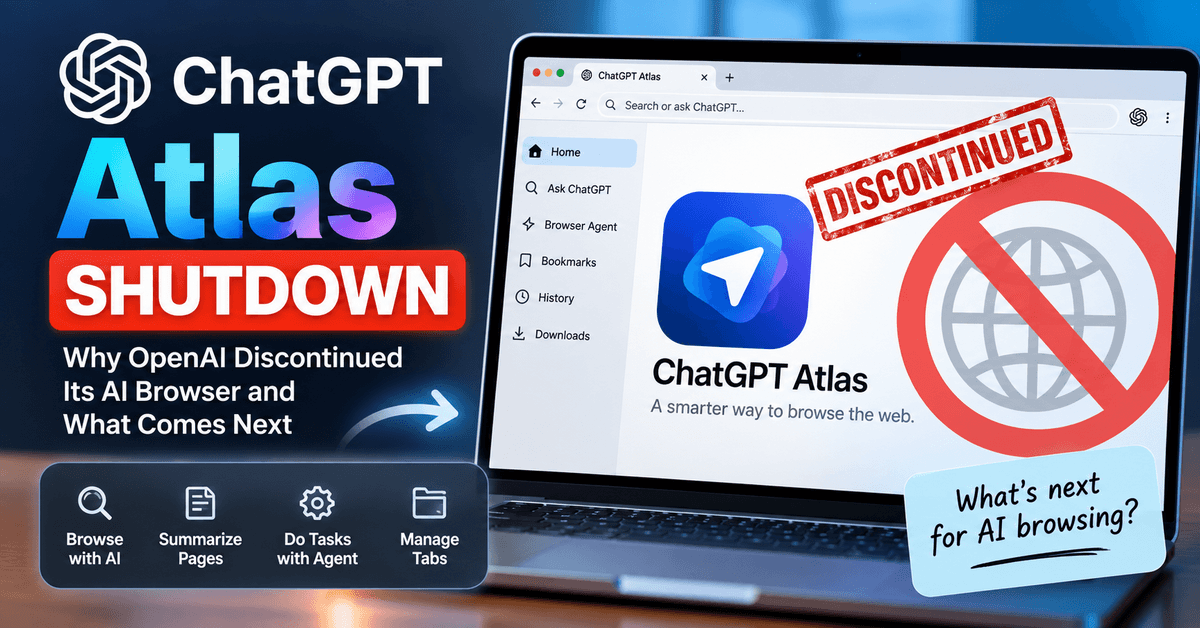
Latest Update: ChatGPT Atlas Browser Discontinued
OpenAI’s ChatGPT Atlas browser, launched on October 21, 2025, has now been discontinued. The official shutdown took place on August 9, 2026. Atlas was originally introduced as an AI-powered browser with built-in ChatGPT, Agent Mode, and Browser Memories. OpenAI is now moving browser-based agent capabilities into ChatGPT and Codex instead of maintaining Atlas as a standalone browser. Read our latest ChatGPT Atlas Shutdown article for the shutdown details, feature changes, and what users should do next.
What is Atlas?
Atlas is a full-fledged web browser. It is designed from the ground up to integrate ChatGPT as a core part of the browsing experience. According to OpenAI’s announcement, it represents “a browser built with ChatGPT.” This browser takes us closer to a true super-assistant. It understands your world and helps you achieve your goals.
Similar to Comet Browser, Atlas combines traditional navigation with advanced AI assistance to enhance productivity and user experience.
Key Features
- Sidebar Chat Integration: Users can open a ChatGPT sidebar within the browser. They can ask questions about the current page, get summaries, or perform edits. All of this happens without switching tabs.
- Agent Mode: This mode is available for premium users. It allows ChatGPT to actively perform tasks. These tasks include editing documents, booking flights, or filling forms automatically.
- Browser Memories: Atlas can optionally record browsing context. It can also recall this context. This means remembering what you viewed previously and offering suggestions based on that. Users can turn this off or delete stored data anytime.
- Traditional Browser Features: Tabs, bookmarks, extensions, and auto-fill are all supported, providing a familiar browsing environment.
Availability
- At launch, Atlas is available for macOS users (Apple Silicon, macOS 12 Monterey or later).
- Versions for Windows, iOS, and Android are in active development and expected soon.
Underlying Technology
- Atlas is built on the Chromium engine, ensuring compatibility with modern web standards and web extensions.
Technical Overview
| Feature | Description |
|---|---|
| Developer | OpenAI |
| Technology Base | Chromium Engine |
| Core Integration | ChatGPT (GPT-4.5/5 models) |
| AI Features | Summarization, Q&A, automation, memory, and agent mode |
| Current Version | macOS (Windows & mobile coming soon) |
| Launch date and year | 21st October, 2025 |
Why This Matters: The Strategic Shift
1. Competing with Chrome
Google Chrome currently dominates the browser market with billions of active users. Atlas repositions the browser as an AI-driven personal assistant rather than just a navigation tool. OpenAI CEO Sam Altman described it as “a once-in-a-decade opportunity to rethink what a browser can be.”
2. Redirecting Web Traffic
By embedding ChatGPT directly into the browser, OpenAI gains access to richer user-interaction data and new potential revenue streams. This could shift a portion of web traffic — and ad revenue — away from traditional search engines.
AI at the Core: Atlas is not just a browser with an AI add-on; it’s a browser built around AI. The assistant is seamlessly integrated into the browsing experience, acting as a proactive companion rather than a reactive chatbot.
Fact Check & Key Statistics
- ChatGPT has over 800 million users worldwide, according to OpenAI’s October 2025 statement.
- Atlas is seen as OpenAI’s direct challenge to Chrome’s dominance, offering an AI-centric experience.
- Major reviews highlight five primary aspects: memory, agent mode, privacy options, user interface, and platform rollout.
- Atlas supports inline webpage editing and contextual side-chat, making it ideal for researchers, students, and professionals.
- Privacy remains a top concern: early testers noted that Atlas’s memory feature can retain sensitive data unless explicitly cleared.
Benefits & Use-Cases
- Productivity boost: ChatGPT being built into the browser provides efficiency for tasks like summarizing articles. It also helps with editing text in-line or collating research. This setup reduces context-switching.
- Smart assistant behavior: Agent mode can automate multi-step tasks (e.g., plan a trip, add shopping items) that traditionally required multiple tools.
- Personalized browsing experience: The “memory” feature lets the browser adapt to your habits (if you opt in).
- Seamless workflow: Because it’s built on Chromium, most existing browser features (extensions, bookmarks) work.
Concerns, Risks & What to Watch
- Data Privacy: Atlas’s deep integration means it can collect more browsing context than typical browsers. Although OpenAI states data isn’t used for training without consent, privacy advocates urge caution.
- AI Reliability: When acting autonomously, ChatGPT may occasionally produce errors or misinterpret instructions.
- User Inertia: Competing against Chrome, Edge, and Safari — all with massive user bases — poses a major challenge.
- Enterprise Readiness: The business version of Atlas is still in beta, lacking advanced enterprise management and compliance features.
Impact for India and Asia-Pacific
Though initially available only for macOS globally (including India), users in India should:
- Check system compatibility: Apple-silicon Macs running macOS 12 or later only.
- Be aware of data-localization and regional privacy laws: Use of a browser that records browsing context may raise concerns. This is particularly relevant under India’s evolving data-protection regime.
- Watch rollout to Windows/Android: Many users in India use Windows/Android. The full potential will be unlocked when Atlas lands on those platforms.
What’s Next for Atlas
- Platform Expansion: Windows, Android, and iOS versions are on the roadmap.
- Feature Growth: Expect smarter agent capabilities and integrations with third-party tools.
- Market Disruption: If adoption grows, Atlas could redefine browsing—from a passive task to an interactive, AI-driven experience.
- Regulatory Oversight: As Atlas collects more browsing context, regulators are expected to monitor its data policies closely.
Bottom Line
ChatGPT Atlas marks a significant pivot for OpenAI from a standalone chatbot to a full-browser platform. It promises a smarter, AI-centric web experience—if users are willing to trade some browsing data for convenience. Time will tell whether the world is ready to browse differently.
Atlas is currently available for macOS. Android users can explore our latest guide on the best web browsers for Android. This helps them find fast, secure, and customizable options.
In the world of AI assistants, Perplexity continues to evolve rapidly. It offers smart, concise answers directly within your browsing experience.