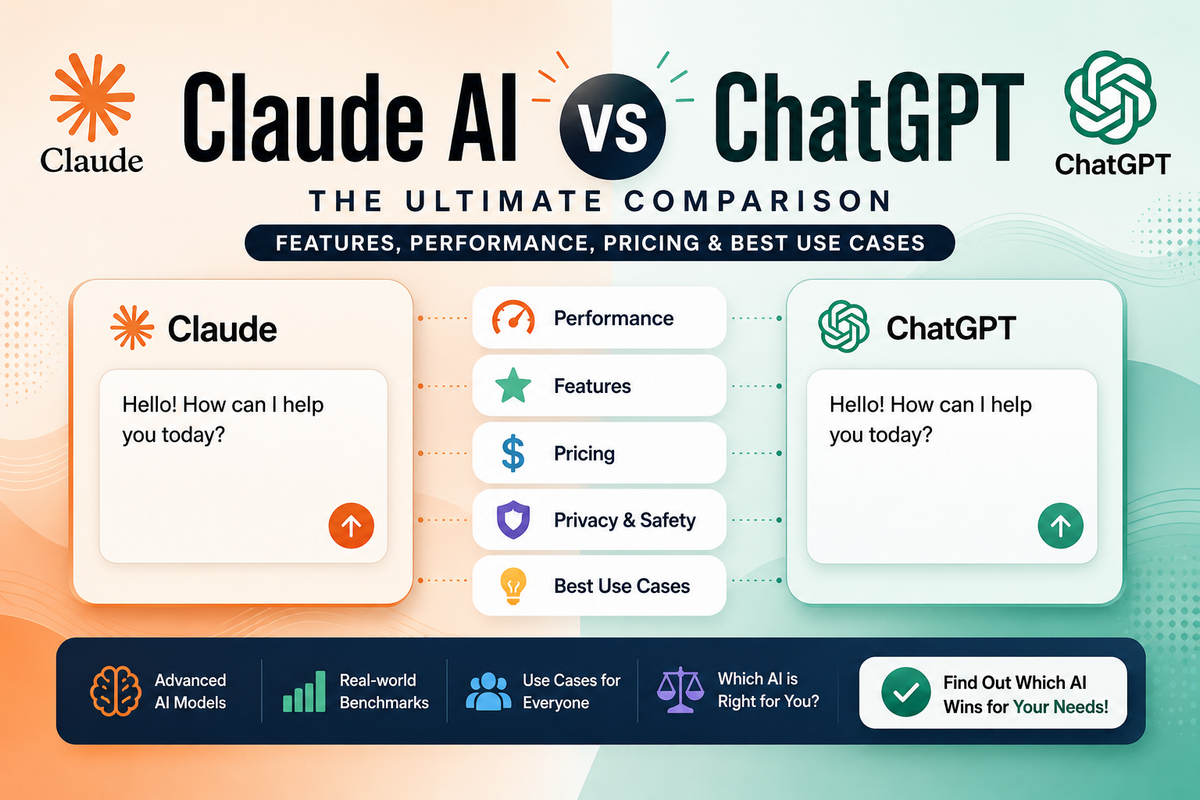
Two AI tools dominate every conversation about productivity in 2026: Claude AI vs ChatGPT. If you’re paying $20/month for one of them — or trying to choose between them — this guide gives you the honest breakdown based on real benchmarks, updated features, and practical use cases.
Both use powerful natural language processing (NLP) and machine learning (ML) to understand your prompts and generate human-like responses. But they have genuinely different strengths, philosophies, and feature sets. The right tool depends entirely on what you’re trying to do.
At a Glance:
- Best for coding, long-form writing, and giant context → Claude AI (Fable 5 / Opus 4.8 / Sonnet 5)
- Best for images, video, voice, and ecosystem → ChatGPT (GPT‑5.6 Sol / GPT‑5.4)
- Both still start at about 20 USD/month at the standard paid tier
- better—yourNeither is universally better — your workload and budget decide.

Who Makes These Tools?
Claude AI is built by Anthropic, an AI safety company founded in 2021 by former OpenAI researchers. Anthropic’s mission is to build AI that is safe, interpretable, and reliably beneficial. Claude’s design philosophy is rooted in “Constitutional AI” — a set of principles embedded into the model to reduce harmful, biased, or deceptive outputs.
ChatGPT is built by OpenAI, the organization that launched the modern AI chatbot era in November 2022. OpenAI developed ChatGPT using a method called Reinforcement Learning from Human Feedback (RLHF), fine-tuning its large language models (LLMs) based on human ratings. ChatGPT has grown into the most widely-used AI assistant in the world.
The two approaches produce tools with meaningfully different behaviors — Claude tends to be more careful and analytical, while ChatGPT tends to be more versatile and feature-rich.
What’s New in 2026: Current Model Lineup
Before comparing features, it’s important to know exactly which models are in play in April 2026 — because the landscape has changed dramatically since early comparisons of these tools.
Claude’s Current Models (Anthropic)

| Model | Strength | API Pricing (per 1M tokens) |
|---|---|---|
| Claude Fable 5 | Most capable, long-running agents & complex coding | $10 input / $50 output |
| Claude Opus 4.8 | Flagship for demanding knowledge work & coding | $5 input / $25 output |
| Claude Sonnet 5 | Default workhorse, best balance of speed & IQ | Intro: $2/$10, then $3/$15 |
| Claude Haiku 4.5 | Fast, budget-friendly | ~$1 input / $5 output platform. |
Claude Fable 5 is Anthropic’s newest top public model in the Mythos class, designed for long-running agent workflows, 1M‑token context, and advanced coding tasks. Claude Sonnet 5 became the default mid‑tier model in late June 2026 and significantly improves reasoning, coding, and tool use over Sonnet 4.6 while keeping pricing aggressive.
- Claude AI Models 2026: Opus 5.5 vs Sonnet 5.5 vs Haiku
- Claude AI Review 2026: Features, Pricing, Pros, Cons & Hands-On Test
Claude Fable 5 reaches around 72–80% on SWE‑bench Pro, depending on the benchmark methodology, making it one of the strongest coding models available, while Opus 4.8 and Sonnet 5 close much of the gap at lower cost tiers
ChatGPT’s Current Models (OpenAI)

| Model | Strength | API Pricing (per 1M tokens) |
|---|---|---|
| GPT‑5.6 Sol | Latest frontier model for reasoning & agents | Around $5 input / $30 output (preview) |
| GPT‑5.4 | General‑purpose flagship | $2.50 input / $15 output |
| GPT‑5 (base) | Budget model | About $1.25 input / $10 output |
GPT‑5.6 introduces three preview variants (Sol, Terra, Luna) focused on higher‑effort reasoning, with Sol already available in ChatGPT Plus and Pro for certain workloads. OpenAI reports that GPT‑5.6 Sol outperforms earlier GPT‑5.4 models on many reasoning benchmarks and competitive programming tasks, though full, public benchmarks and pricing are still evolving in mid‑2026.
Head-to-Head Feature Comparison
Here’s the full feature comparison between Claude and ChatGPT in 2026:
| Feature | Claude (Fable 5 / Opus 4.8 / Sonnet 5) | ChatGPT (GPT‑5.6 / GPT‑5.4) | Winner |
|---|---|---|---|
| Coding (SWE‑bench Pro) | Fable 5 ~72–80% depending on setup | GPT‑5.6 Sol ~65–70% vendor/third‑party reports | Slight edge: Claude for single‑shot correctness, ChatGPT for speed/value |
| Long‑form Writing | Nuanced, context‑aware prose | Clean, structured, sometimes templated | Claude |
| Image Generation | ❌ Still not built‑in | ✅ GPT Image / DALL‑E | ChatGPT |
| Video Generation | ❌ Not available | ✅ Sora‑powered short clips | ChatGPT |
| Voice Mode | ❌ No native advanced voice | ✅ Advanced Voice Mode | ChatGPT |
| Web Browsing | Targeted search / partner integrations | Full browsing with Bing | ChatGPT |
| Standard Context Window | Up to 1M tokens on Sonnet 5 and Fable 5 | Up to 128K–272K, depending on the model | Claude |
| Max Context Window | 1M+ tokens (API, higher tiers) platform.claude+1 | 1M‑scale for some GPT‑5.4/5.6 configs | Rough tie |
| Terminal Coding Agent | Claude Code (local, agentic) | Cloud coding (sandboxed) | Claude for local control |
| Multi‑Agent Workflows | ✅ Agent Teams and Cowork | Limited multi‑agent orchestration in‑chat | Claude |
| Extended Thinking / Reasoning | ✅ Extended effort levels on Opus/Sonnet | ✅ GPT‑5.6 higher reasoning modes | Tie |
| PDF & Document Analysis | Excellent, 1M context | Very strong, slightly smaller context | Claude platform. |
| Custom AI Assistants | Projects, MCP tools | GPTs + GPT Store | ChatGPT |
| Plugin / Integration Ecosystem | Growing MCP ecosystem | Very broad plugin / app ecosystem | ChatGPT |
| Persistent Memory | Projects & manual memory | Automatic conversational memory | ChatGPT |
| Hallucination Rate | Very low vs older gens | Improved, but still slightly higher | Claude |
| Prompt Caching (API) | ✅ Significant cost savings | ✅ Available | Slight edge: Claude platform. |
| Monthly Cost (Paid) | Pro at ~20 USD/month | Plus, at ~20 USD/month | Tie |
Coding: Claude Wins
This is where Claude pulls ahead most clearly in 2026. The combination of Claude Opus 4.8 and Fable 5’s benchmark performance and the Claude Code agent creates the strongest AI-powered coding workflow available today.
Claude Code is a terminal-native agent — meaning it works directly in your local development environment. It reads your actual project files, runs your test suites, manages git branches, and edits code in place. Nothing leaves your machine except the API calls to Anthropic. For developers who want full control over their environment, this is a game-changer.
The Agent Teams feature takes this further — you can spawn multiple Claude instances that work on different parts of a codebase simultaneously. One handles the frontend, another the backend, and another writes tests — all coordinating through shared task lists. No other AI provider offers this kind of parallel multi-agent coding workflow at the $20/month tier.
ChatGPT’s Codex is cloud-based rather than local. It runs in secure sandboxes, which makes setup faster and eliminates local dependency issues, but you get less control over the environment. Codex integrates tightly with GitHub Copilot and VS Code, making it excellent for developers already in that ecosystem.
In independent 30-day testing, Claude achieved ~95% functional accuracy on coding tasks vs ~85% for ChatGPT. Claude also writes cleaner, more idiomatic code with better variable naming and structure, and handles complex multi-file debugging more reliably.
Independent benchmarks in mid‑2026 show Fable 5 leading on complex, agentic coding tasks, while GPT‑5.6 Sol wins some speed‑sensitive and competitive programming tests, so the “best” choice depends on whether you prioritize correctness or throughput.
Bottom line for coding: If you write code professionally, Claude is the stronger platform in 2026. If you prefer fast, cloud-based task execution tightly integrated with VS Code and GitHub, Codex is a solid alternative.
Writing: Claude Wins for Long-Form, ChatGPT for Quick Copy
For bloggers, content writers, and researchers, this comparison matters most, and it’s genuinely nuanced.
Claude is better for:
- Long-form articles, essays, and reports (200K context window handles entire manuscripts)
- Persuasive and nuanced writing with tonal consistency
- Research synthesis where accuracy matters more than speed
- Summarizing complex PDFs and source documents accurately
ChatGPT is better for:
- Quick emails, social media posts, and short marketing copy
- Structured templates and formatted outputs
- Following exact instructions without pushback
- Fast content drafts where speed matters more than depth
Writers consistently report that Claude produces more natural, varied prose. Where ChatGPT tends to follow instructions literally and output clean-but-formulaic content, Claude varies sentence structure, considers edge cases, and occasionally suggests a better approach than what you asked for.
Claude’s extended reasoning features are now built into Sonnet 5 and Opus 4.8, with visible step‑by‑step reasoning in higher‑effort modes that help you inspect how the model arrived at a conclusion.
For SEO-focused content writers, Claude’s lower hallucination rate is a critical advantage. When Claude synthesizes information from multiple sources, it is more careful about attributing claims accurately — reducing the risk of publishing factually incorrect content.
Multimodal Features: ChatGPT Wins Clearly
This is where the comparison tilts decisively toward ChatGPT, and it’s an important gap for anyone whose workflow involves visual or voice content.
ChatGPT supports:
- Image generation via GPT Image / DALL-E — generate marketing assets, illustrations, diagrams, and edit existing images with text overlays
- Video generation via Sora — up to 5-second clips at 720p on the Plus plan
- Advanced Voice Mode — real-time, natural-sounding voice conversations with emotional expressiveness, available to all Plus subscribers
- Web browsing with Bing integration — real-time search, live data, and source citations mid-conversation
- Code execution sandbox — run Python, analyze data, visualize outputs in-chat
Claude supports:
- Image understanding — analyzing images you upload (charts, diagrams, screenshots)
- Limited web search (added via Claude Sonnet 4.5 in 2025/2026)
- No native image, video, or voice generation
If your workflow involves creating visual assets, recording voice interactions, or building multimedia content, ChatGPT Plus at $20/month offers significantly more value. Claude simply doesn’t have these features yet. This is the biggest practical gap between the two tools in 2026.
Context Window & Document Analysis: Claude Leads
Claude’s 1M‑token context on Sonnet 5 and Fable 5 gives it a clear lead over ChatGPT’s 128K–272K context at similar price points when you need to load very large documents or codebases into a single session.
- Claude (Sonnet 5 / Fable 5): up to 1,000,000‑token context windows in regular use for many users, especially via Claude Code and API.
- ChatGPT (GPT‑5.4 / 5.6): typical context windows in the 128K–272K range depending on model and plan.
- Both vendors experiment with 1M‑scale context at higher tiers, but Claude exposes that size more broadly via Sonnet 5’s default configuration
Claude’s 200K standard context window beats ChatGPT’s 128K at the same price point. In practical terms, this means Claude can process an entire book manuscript, a full codebase, or dozens of long documents in a single conversation—without losing coherence in later responses.
For PDF and document analysis, Claude is noticeably more methodical. Upload a 50-page research report, a contract, or a lengthy client brief, and Claude will synthesize the key information more carefully than ChatGPT’s default behavior.
Pricing: What You Get at Each Tier
Both tools are competitively priced — neither has raised its $20/month tier despite releasing significantly upgraded models in 2026.
| Plan | Claude | ChatGPT |
|---|---|---|
| Free | Limited Sonnet 5 access | Limited GPT‑5 models |
| Pro / Plus (~20 USD/mo) | Higher limits, Opus 4.8 & Cowork/Code access | GPT‑5.6 Sol (medium reasoning), GPT‑5.4, images, Sora preview, Voice claude+1 |
| Max / Pro (100–200 USD/mo) | More Opus/Fable usage, 1M+ context | Higher reasoning modes, higher limits claude+2 |
| Team | Available with per‑seat pricing | Available with per‑seat pricing claude+1 |
| Enterprise | Custom terms | Custom terms claude+1 |
At the $20/month tier, ChatGPT bundles more multimedia features (image gen, video, voice), while Claude bundles Claude Code, which is a serious competitive advantage for developers and power users who want terminal-based coding.
API cost analysis:
- For budget use, Claude Haiku 4.5 at about $1 / $5 per 1M tokens stays very competitive vs GPT‑5 base around $1.25 / $10.platform.
- For mid‑tier use, Sonnet 5’s intro pricing at $2 / $10 undercuts many GPT‑5.6 tiers while offering a 1M context window. anthropic+1
- For flagship use, Opus 4.8 and Fable 5 at $5 / $25 and $10 / $50 are cheaper than many GPT‑5.6 high‑reasoning modes that can reach $30+ / $120+ per 1M tokens.
Safety, Hallucinations & Reliability
Anthropic’s own evaluations and independent reviewers report that Sonnet 5 further reduces undesirable or hallucinated behavior compared to Sonnet 4.6, narrowing the gap to Opus while preserving Claude’s “careful by default” behavior.
Anthropic built Claude with a “Constitutional AI” framework a set of principles embedded at training time that make Claude more conservative and careful. Claude will sometimes decline requests that ChatGPT would handle, and it occasionally adds unsolicited caveats. But the upside is a significantly lower hallucination rate.
GPT models have historically been more prone to confidently stating incorrect information though this gap has narrowed considerably with GPT-5.4. For content writers and bloggers who publish factual content, Claude’s lower hallucination rate reduces editing overhead and the risk of publishing errors.
Neither tool is perfectly reliable. Always verify important facts regardless of which one you use.
Ecosystem & Integrations
ChatGPT has a far broader plugin and integration ecosystem:
- GPT‑5.6 Sol is already accessible in ChatGPT Plus and Pro for many users, integrated into the same interface that powers GPT Store apps and plugins, which makes it easy to upgrade to the latest models without changing tools.
- Thousands of custom GPTs in the GPT Store are built for writing, coding, data analysis, education, and more
- Deep integration with Microsoft products via Copilot
- Third-party app connectors for dozens of popular tools
Claude has solid integrations, particularly for developers:
- Model Context Protocol (MCP) allows Claude to connect with external tools and data sources
- Claude Code integrates directly with your local filesystem and git
- Excellent API documentation and developer experience
If you work inside Google Workspace or Microsoft 365, ChatGPT’s integrations will likely save more time. If you’re building custom developer workflows or using the API for automation, Claude’s architecture is cleaner and more controllable.
“Best For” Use Case Recommendations
Choosing between Claude and ChatGPT doesn’t have to be complicated. Here’s the straightforward breakdown:
- Best for Bloggers & Content Writers → Claude (Sonnet 5, Fable 5 for the heaviest workloads, 1M context, low hallucinations).
- Best for Coders & Developers → Claude (Fable 5 / Opus 4.8 plus Claude Code and Cowork).
- Best for Designers & Creatives → ChatGPT (GPT‑5.4 / GPT‑5.6 with GPT Image and Sora)
- Best for Students & Researchers → Claude (document analysis, accurate citations, extended thinking)
- Best for Everyday General Use → ChatGPT (broader feature set, voice mode, web browsing)
- Best for SEO Analysts → Claude (nuanced writing, lower hallucinations, large context for competitor research)
- Best for Social Media Marketers → ChatGPT (quick copy, image generation, voice content)
- Power Users → Use both ($40/month total for the best of both worlds)
Claude AI vs ChatGPT: Strengths Summary
Strengths of Claude AI (2026)
- Superior coding accuracy — 80.8% SWE-bench Verified score; ~95% functional accuracy in real-world tests
- Claude Code terminal agent — works locally, reads your filesystem, manages git
- Agent Teams — parallel multi-agent workflows for complex projects
- 200K standard context window — process entire books, codebases, or research papers
- Extended effort levels — visible step-by-step reasoning for complex topics
- Lower hallucination rate — more reliable for factual content publishing
- Constitutional AI safety — thoughtful, principled responses by design
Strengths of ChatGPT (2026)
- GPT Image / DALL-E — generate and edit images natively in conversation
- Sora video generation — create short clips from text prompts
- Advanced Voice Mode — real-time, emotionally expressive voice conversations
- Full Bing web browsing — live search, real-time data, source citations
- GPT Store — thousands of specialized custom AI assistants
- Automatic persistent memory — remembers you across all conversations
- Broader ecosystem — Microsoft Copilot, third-party integrations, VS Code/GitHub Codex
Frequently Asked Questions on Claude AI vs ChatGPT
Is Claude AI better than ChatGPT for coding in 2026?
Claude’s Fable 5 and Opus 4.8 give it a slight edge on many coding benchmarks, especially SWE‑bench Pro and long, multi‑file tasks, while GPT‑5.6 Sol now leads on some competitive programming and agentic coding benchmarks. For most developers, Claude Code plus Sonnet 5 or Opus 4.8 is still the best local coding combo, while GPT‑5.6 is a great choice if you prioritize raw speed and are already deep into the VS Code / GitHub ecosystem.
Which is better for content writing — Claude or ChatGPT?
Claude wins for long-form, nuanced writing like blog articles, research reports, and essays. Its 200K context window that handles entire manuscripts without losing coherence. ChatGPT is better for quick drafts, structured templates, short-form social copy, and situations where speed matters more than depth.
Can Claude AI generate images like ChatGPT?
As of July 2026, Claude still cannot generate images; ChatGPT Plus continues to include GPT Image / DALL‑E and Sora for graphics and short video.
What is Claude’s context window in 2026?
Claude’s most popular models (Sonnet 5, Fable 5) offer up to 1,000,000 tokens of context, whereas ChatGPT’s GPT‑5.4 and GPT‑5.6 generally provide 128K–272K contexts at similar subscription levels.
What is Claude’s extended effort levels?
extended effort levels in Sonnet 5 and Opus 4.8 and Fable 5, lets Claude show its reasoning step-by-step before delivering an answer. This is particularly useful for complex research, technical analysis, and fact-heavy content where you want to verify the logic.
Is Claude cheaper than ChatGPT?
Both cost $20/month at the standard paid tier. At the API level, Claude Haiku ($1/$5 per 1M tokens) is cheaper on output than GPT-5 base ($1.25/$10). At the flagship level, Claude Opus ($5/$25) is more affordable than GPT-5.4 Pro ($30/$120).
Which AI chatbot has the lowest hallucination rate in 2026?
Claude consistently demonstrates lower hallucination rates than ChatGPT. Anthropic’s Constitutional AI training framework prioritizes factual accuracy over fluency, making Claude the safer choice for publishing factual content.
What is Claude Code vs OpenAI Codex?
Claude Code is a local, terminal-native coding agent that reads your filesystem and runs commands directly on your machine. Codex (OpenAI) is a cloud-based autonomous coding agent that runs in secure sandboxes and integrates with GitHub Copilot and VS Code. Both are powerful, but they serve different workflows.
Should I use both Claude and ChatGPT?
Many power users do exactly this — using Claude for coding, deep analysis, and long-form writing, and ChatGPT for image generation, voice conversations, and quick web lookups. At $20/month each, running both costs $40/month total — more useful than paying $200/month for either platform’s premium tier alone.
Is Claude AI safe to use?
Yes. Claude was built with safety as a core design principle. Anthropic’s Constitutional AI embeds behavioral guidelines at the training level, making Claude less likely to generate harmful, biased, or deceptive content. It is more conservative than ChatGPT, which some users find limiting but most find reassuring for professional use.
Final Verdict on Claude AI vs ChatGPT
tools—theyClaude AI and ChatGPT are not interchangeable tools — they have genuinely different strengths that map to different workflows.
- Choose Claude if you are a blogger, content writer, SEO analyst, developer, or researcher who primarily works with text and code. With Sonnet 5, Opus 4.8, and Fable 5, Claude offers huge context windows, strong coding performance, and lower hallucination rates—ideal for serious, text‑heavy professional work.
- Choose ChatGPT if you need GPT‑5.6 Sol for cutting‑edge reasoning, plus native image, video, voice, and a massive plugin ecosystem in a single interface.
- Use both if your workflow spans creative media and deep technical work; at roughly 40 USD/month combined for Plus/Pro and Claude Pro, you get the best of both worlds without jumping to much more expensive enterprise tiers.
The gap between Claude and ChatGPT is smaller than the gap between either one and everything else on the market. Whichever you choose, you are getting a world-class AI assistant in 2026.