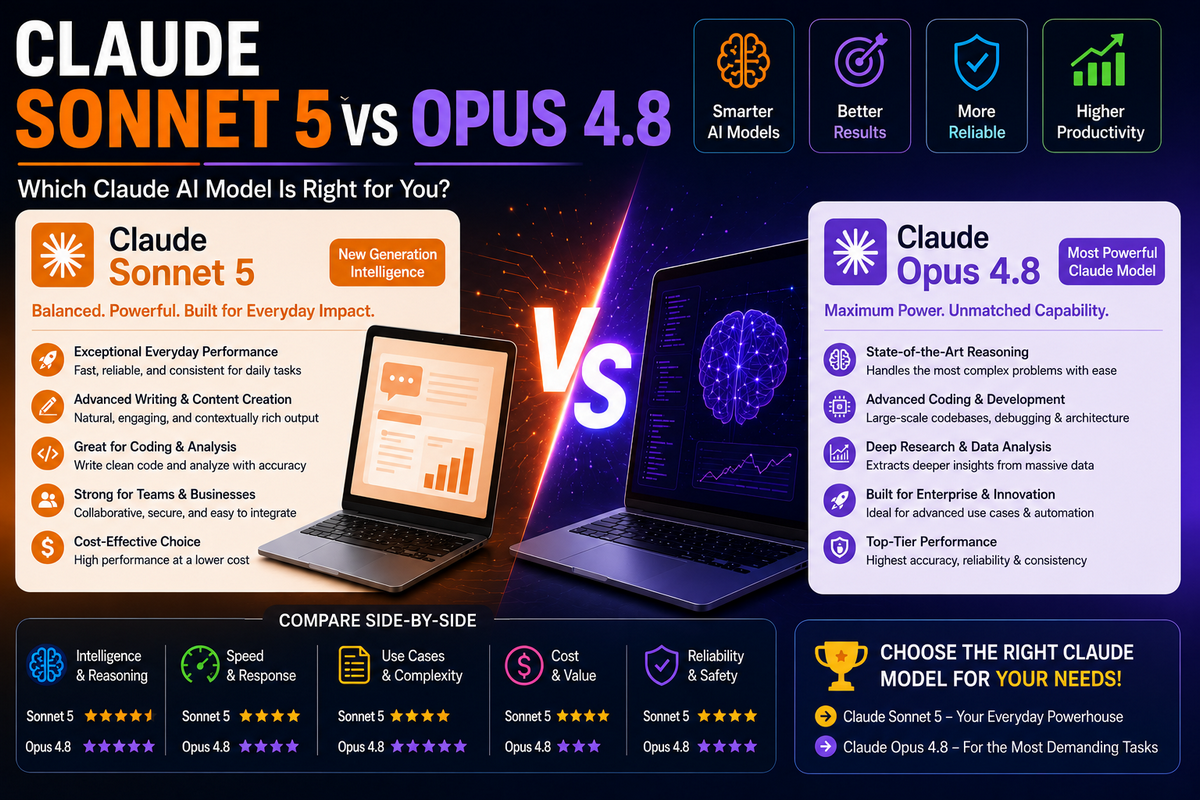
Claude AI Review 2026: Features, Pricing, Pros, Cons & Content Writing Test

Artificial intelligence has become an essential part of modern content creation.
From generating blog post ideas to writing articles, editing drafts, and creating social media content, AI tools are helping bloggers and digital creators save time and improve their workflows.
Among the growing number of AI assistants, Claude AI has attracted attention for its writing, reasoning, and document-processing capabilities.
Developed by Anthropic, Claude AI is an AI assistant designed to help users with writing, research, coding, brainstorming, and everyday productivity tasks.
It can assist content creators throughout the blogging process, from planning an article to refining the final draft.
But is Claude AI actually useful for bloggers, SEO professionals, and content creators? Does it produce high-quality content, and is a paid subscription worth considering?
In this Claude AI review 2026, we will explore its features, pricing, strengths, limitations, and practical applications for content creation.
We will also look at how Claude fits into an SEO and blogging workflow, including article outlining, content writing, editing, and content repurposing.
What You Will Learn in This Claude AI Review
This review is written for bloggers, freelance writers, SEO professionals, digital marketers, and anyone interested in using AI for content creation.
We will cover:
- What Claude AI is and how it works.
- The key Claude AI features are available to users.
- How Claude can help with blog writing, editing, and SEO content planning.
- Claude AI pricing and available subscription options.
- The advantages and limitations of using Claude for content creation.
- How Claude compares with ChatGPT and Google Gemini.
- Whether Claude AI is worth using for bloggers and content creators in 2026.
Our review approach: Rather than focusing only on feature descriptions, this article emphasizes practical content-creation workflows.
We will examine how Claude can be used for real blogging tasks and discuss the areas where human review, fact-checking, and SEO expertise remain important.
Whether you are a beginner blogger looking for an AI writing assistant or an experienced content creator exploring alternatives to ChatGPT, this Claude AI review will help you understand what the tool offers and how it may fit into your content strategy.
What Is Claude AI?
Claude AI is an artificial intelligence assistant developed by Anthropic, an AI company focused on building useful and reliable AI systems.
It is designed to help users with tasks such as writing, analyzing information, answering questions, coding, and working with documents.
You can access Claude through its web application, supported apps, and developer tools.
Depending on the available plan and features, users can use Claude for everyday questions, professional work, content creation, and more advanced workflows.
How Does Claude AI Work?
Claude uses large language models to understand user instructions and generate responses.
You can interact with it through natural language prompts, just as you would with other AI assistants.
For example, a blogger can ask Claude to:
- Generate blog post ideas for a specific niche.
- Create an SEO-friendly article outline.
- Rewrite an introduction to improve readability.
- Summarize a long research document.
- Suggest FAQs for a blog post.
- Repurpose an article into social media content.
- Review a draft for clarity, grammar, and structure.
Claude processes the instructions and available context to produce a response.
The quality of the output depends on the prompt, the information provided, the model being used, and the complexity of the task.
Who Developed Claude AI?
Claude AI was developed by Anthropic. The company focuses on AI research and the development of AI assistants designed to be helpful, reliable, and safer to use.
Claude is part of Anthropic’s broader AI product ecosystem, which includes the Claude assistant and developer-focused tools.
For content creators, the important point is that Claude is not limited to simple chatbot conversations. It can also support writing, document-based work, research, and other productivity tasks.
What Can You Use Claude AI For?
Claude can be useful in several areas:
- Content writing: Create drafts, introductions, conclusions, product descriptions, and other written content.
- Content editing: Improve grammar, sentence structure, readability, and tone while preserving the original meaning.
- Research assistance: Organize information, summarize documents, and help develop content ideas. Important facts should still be verified against reliable sources.
- SEO content planning: Generate topic ideas, content briefs, headings, FAQs, and keyword-related suggestions. Claude should support SEO decisions rather than replace keyword research and search performance data.
- Productivity: Help with brainstorming, organizing information, drafting emails, and working with documents.
- Coding and technical tasks: Assist with programming, debugging, and technical explanations, depending on the tools and capabilities available in your Claude environment.
Is Claude AI Only for Writers?
No. Although Claude is particularly relevant to bloggers and content creators, it can also be used by students, developers, researchers, professionals, and businesses.
For TechyDen readers, Claude is especially interesting because it can fit into multiple stages of a blogging workflow.
Instead of using AI only to generate an article, you can explore how it helps with planning, drafting, editing, and content repurposing.
In the next section, we will look at the key Claude AI features that content creators should know about in 2026.
Claude AI Features
Claude AI has evolved from a conversational AI assistant into a broader productivity tool for writing, research, coding, and working with documents.
For bloggers and content creators, its most useful capabilities include drafting articles, improving existing content, organizing project information, and supporting research workflows.
In this section of our Claude AI review 2026, we will explore the major Claude AI features and how they can help with blogging, SEO content creation, and everyday productivity.
1. Current Claude AI Model Options
One of the first things to understand when using Claude AI is that Anthropic offers different models for different types of work.
The available models and access options can change, so it is important to check the current model selector rather than relying on older Claude 2 or Claude 3 information.
Anthropic’s current model documentation lists model families such as Claude Opus, Claude Sonnet, and Claude Haiku, along with newer model releases.
These models are designed for different combinations of capability, speed, and cost.
For content creators, the model you choose can affect the quality, speed, and cost of your workflow.
1. Claude Opus
Claude Opus is designed for demanding tasks that require advanced reasoning and coding capabilities.
Anthropic’s model documentation includes Claude Opus 5 and newer Opus releases in its current model lineup.
Useful for bloggers:
- Complex content planning.
- Detailed research analysis.
- Long-form content development.
- Advanced technical explanations.
- More demanding knowledge-work tasks.
2. Claude Sonnet
Claude Sonnet is a model family designed to balance capability and efficiency.
Anthropic’s 2026 model documentation lists Claude Sonnet 5 and Claude Sonnet 4.6 among its models.
Useful for bloggers:
- Writing blog post drafts.
- Editing and improving articles.
- Creating SEO content briefs.
- Brainstorming content ideas.
- Everyday AI-assisted writing.
3. Claude Haiku
Claude Haiku is a model family intended for faster, more cost-effective AI tasks. Anthropic’s model documentation lists Claude Haiku 4.5 among its models.
Useful for bloggers:
- Short content revisions.
- Simple text transformations.
- Quick brainstorming.
- Routine writing assistance.
4. Claude Fable
Claude Fable 5.1 is designed for demanding coding, knowledge work, research, and long-running tasks.
It is available to Claude Pro, Max, Team, and Enterprise users, as well as developers through the Claude API and supported cloud platforms.
For content creators, Fable 5.1 is relevant for workflows that involve:
- Long-form content development.
- Deep research and analysis.
- Complex content projects.
- Document and PDF analysis.
- Writing and editing.
- Coding and technical projects.
- Multi-step AI workflows.
- Long-running agentic tasks.
Anthropic lists Fable 5.1 at $10 per million input tokens and $50 per million output tokens for API usage.
Cache reads are priced at $0.25 per million tokens. Anthropic says the lower cache-read pricing can reduce the cost of typical workloads by an estimated 25%.
5. Claude Mythos
Claude Mythos 5.1 is the same underlying model as Fable 5.1 but uses different safeguards designed for advanced cybersecurity and life sciences research.
Unlike Fable 5.1, Mythos 5.1 is not generally available to everyone. Anthropic currently provides access to vetted organizations through trusted access programs.
Mythos 5.1 is therefore more relevant to specialized researchers and organizations than to everyday bloggers or content creators.
Important: Model names, availability, and capabilities can change. Before publishing this review, verify the current Claude model selector and the official API documentation.
Fable 5.1 vs Mythos 5.1
| Feature | Claude Fable 5.1 | Claude Mythos 5.1 |
|---|---|---|
| Underlying model | Same | Same |
| General availability | Yes | No |
| Main focus | Coding and knowledge work | Cybersecurity and life sciences |
| Access | Pro, Max, Team, Enterprise, API | Vetted organizations |
| Safeguards | Production safeguards | Specialized research safeguards |
| Suitable for bloggers | Yes | Generally not necessary |
| API pricing | $10/M input, $50/M output | $10/M input, $50/M output |
Anthropic states that Fable 5.1 and Mythos 5.1 are the same underlying model, with the main difference being their safeguards and access programs.
What These New Models Mean for Bloggers
For bloggers and content creators, Claude Fable 5.1 is the more relevant model. Its long-running task capabilities, writing improvements, research abilities, document understanding, and coding support can be useful when managing larger content projects.
Mythos 5.1 is primarily intended for specialized research and is currently restricted to vetted organizations. Therefore, most bloggers do not need to consider Mythos when choosing a Claude plan.
2. Writing and Editing
Writing and editing are among the most relevant Claude AI features for bloggers and content creators. Claude can help create drafts, improve existing content, and refine the tone and structure of written material. Anthropic describes Claude as a tool for drafting, editing, and polishing writing while helping users maintain their voice.
For a blogger, this means Claude can support several stages of the content creation process.
Blog post writing
You can use Claude to generate a first draft from a detailed prompt. For example, you can provide a topic, target audience, article length, tone, and required headings.
Example prompt:
Write a 1500-word blog post about the best AI tools for bloggers. Use a helpful, beginner-friendly tone. Include an introduction, H2 headings, practical examples, pros and cons, and a conclusion.
Claude can generate a draft based on these instructions. However, the output should be reviewed for factual accuracy, originality, and alignment with search intent before publication.
Content editing
Claude can also help improve an existing article without completely changing its meaning.
You can ask it to:
- Correct grammar and spelling.
- Improve sentence clarity.
- Make paragraphs easier to read.
- Remove unnecessary repetition.
- Improve headings and transitions.
- Adapt the tone for a specific audience.
- Rewrite an introduction or conclusion.
For example, if you have written a technical paragraph about artificial intelligence, you can ask Claude to explain it in simpler language for beginners.
SEO content assistance
Claude can support SEO content planning by helping generate:
- Blog post outlines.
- Keyword-related topic ideas.
- Search-intent questions.
- FAQ suggestions.
- Meta title and meta description drafts.
- Content briefs.
However, Claude AI is not a replacement for keyword research tools or Google Search Console. Use tools such as Semrush, Ahrefs, and Google Search Console to validate search demand, competition, and actual search performance.
For TechyDen, a useful workflow is to use Claude for content planning and editing, then combine its output with your own SEO research and editorial expertise.
3. Web Search and Research
Another important Claude AI feature is web search. Anthropic’s official Claude product page lists web search as a capability for accessing current information beyond the model’s existing knowledge.
This is particularly useful for bloggers who need to research changing topics such as AI tools, software updates, WordPress plugins, hosting plans, and technology news.
How Claude web search can help content creators
You can use web search to assist with:
- Finding recent information about a product.
- Researching software updates.
- Exploring current technology topics.
- Gathering information for a blog post.
- Checking details from online sources.
- Creating research-based summaries.
For example, if you are writing a review of an AI writing tool, you can ask Claude to research its latest features, pricing, and official documentation.
Example prompt:
Research the latest features of Claude AI for content creators. Use official Anthropic sources where possible. Organize the findings into features, benefits, limitations, and information that needs verification.
Is Claude AI web search accurate?
Web search can help Claude access more current information, but it does not guarantee that every answer is correct. Search results can be incomplete, and AI-generated summaries may contain errors or misunderstandings.
For important information, always verify:
- Product prices.
- Model names.
- Technical specifications.
- Company announcements.
- Statistics and research findings.
- Claims about product capabilities.
For your TechyDen reviews, link to official product pages and include the date on which you checked pricing or features.
4. Projects and Memory
Projects are useful for organizing related conversations, files, and instructions around a particular topic. Anthropic introduced Projects to help users bring together relevant knowledge and chat activity in one place.
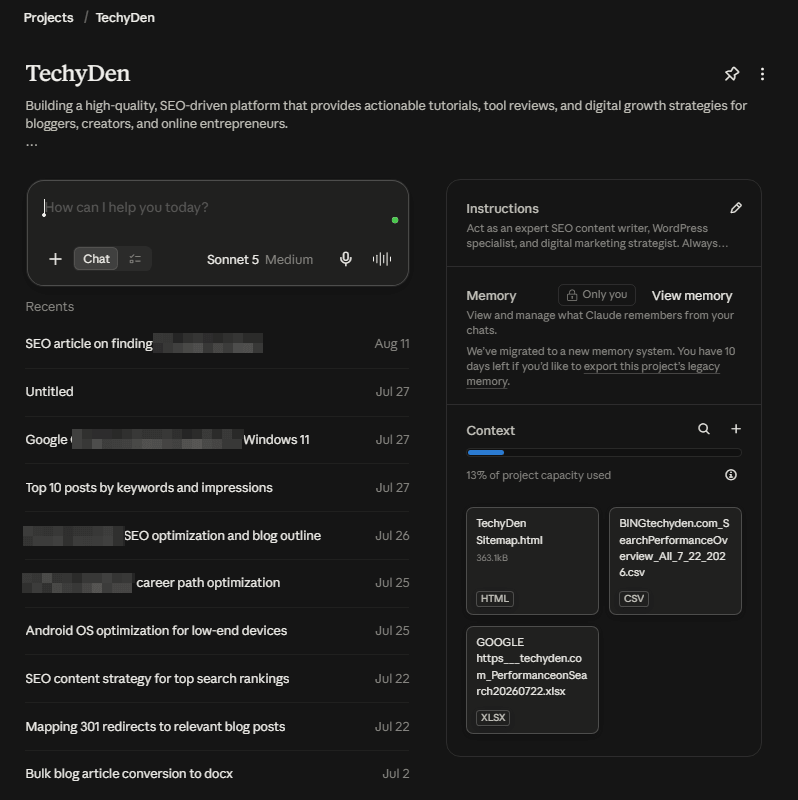
For content creators, projects can be useful when working on a long-term blog, website, or content campaign.
How Claude Projects can help bloggers
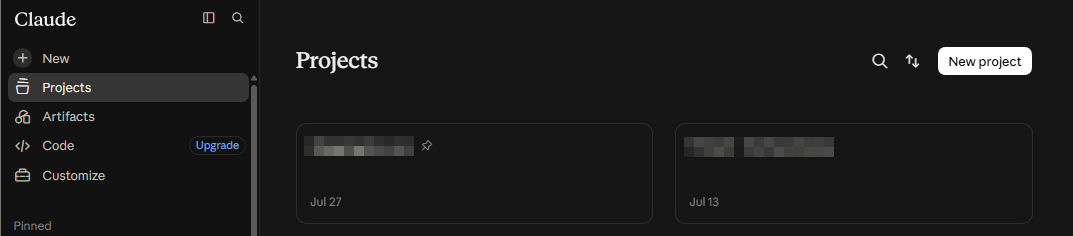
You could create a Claude Project for your TechyDen content workflow and use it for tasks such as:
- Planning a series of AI tool reviews.
- Storing brand voice guidelines.
- Organizing content briefs.
- Working with previous drafts.
- Maintaining consistent writing instructions.
- Developing a content cluster around AI tools.
For example, you could provide Claude with your preferred article structure, writing style, and content guidelines. This can help make future writing tasks more consistent.
Claude AI memory
Claude also offers memory-related capabilities. Anthropic’s product information describes Projects as a way to organize conversations and maintain context, while its product updates have introduced additional memory and workflow features.
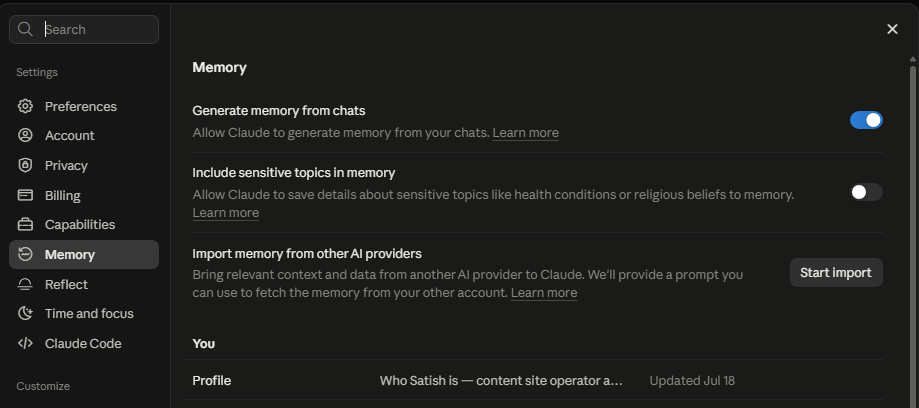
The exact memory functionality and availability may depend on the current plan and product settings.
For bloggers: Use project instructions and relevant source documents to help Claude understand your content workflow.
Do not assume that every past conversation or every detail about your website is automatically available in every new chat.
5. File and PDF Analysis
Claude can analyze uploaded documents and images, making it useful for content creators who work with research papers, reports, PDFs, spreadsheets, and existing articles.
Anthropic lists document and image analysis among Claude’s capabilities.
What can Claude do with uploaded files?
Depending on the supported file type and available features, Claude can help you:
- Summarize long documents.
- Extract important points.
- Explain technical information.
- Review an existing article.
- Analyze tables and data.
- Compare information across documents.
- Generate content ideas from research material.
Example: Using Claude for a research-based blog post
Suppose you are writing an article about AI agents. You can upload a relevant research paper or report and ask Claude to:
Summarize this PDF in simple language. Extract the key concepts, important statistics, and practical examples. Create a blog post outline based on the information, and identify any claims that need further verification.
This can save time when you are working with lengthy source material.
Important limitations
AI-generated summaries should not be treated as a substitute for reading important source documents.
Always check whether Claude has correctly interpreted the information, especially when working with scientific papers, technical documentation, or statistics.
For biochemistry and educational content, this is especially important because small errors in scientific terminology or explanations can change the meaning of a concept.
6. Artifacts
Claude AI Artifacts is a feature that allows Claude to create substantial, standalone content in a dedicated workspace alongside the conversation.
Anthropic’s official documentation describes Artifacts as useful for creating and editing documents, code, websites, diagrams, visualizations, and interactive content.
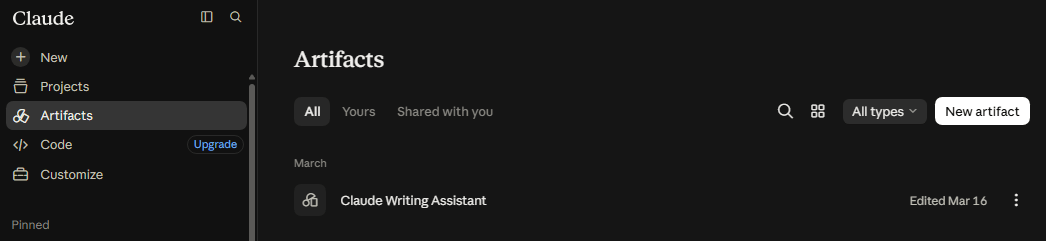
This is one of the more interesting features for bloggers and tech creators because it goes beyond generating plain text in a chat window.
What can you create with Claude Artifacts?
Examples include:
- Documents and Markdown content.
- Code snippets.
- Simple websites.
- SVG graphics.
- Diagrams and flowcharts.
- Interactive visualizations.
- Other shareable creations.
How bloggers can use Artifacts
You can ask Claude to create a simple content-related tool or visual.
For example:
Create an interactive SEO checklist for beginner bloggers. Include keyword research, content structure, on-page SEO, internal linking, and content promotion.
Claude can generate an artifact that you can inspect and refine.
Depending on the type of artifact, you may be able to edit it, view the underlying code, and export or share the result.
Why Artifacts matter for TechyDen
Artifacts may be useful for creating:
- SEO checklists.
- Blogging calculators.
- Simple HTML tools.
- Content planning templates.
- Interactive diagrams.
- Small educational resources.
However, you should not assume that every artifact is ready for production use. Test generated code, check accessibility, and review security before embedding tools on a public website.
7. Claude Code
Claude Code is Anthropic’s coding-focused tool for developers.
It is designed to assist with software engineering tasks such as writing code, debugging, and working with codebases.
Anthropic also describes Claude Code as part of its developer-focused AI tooling.
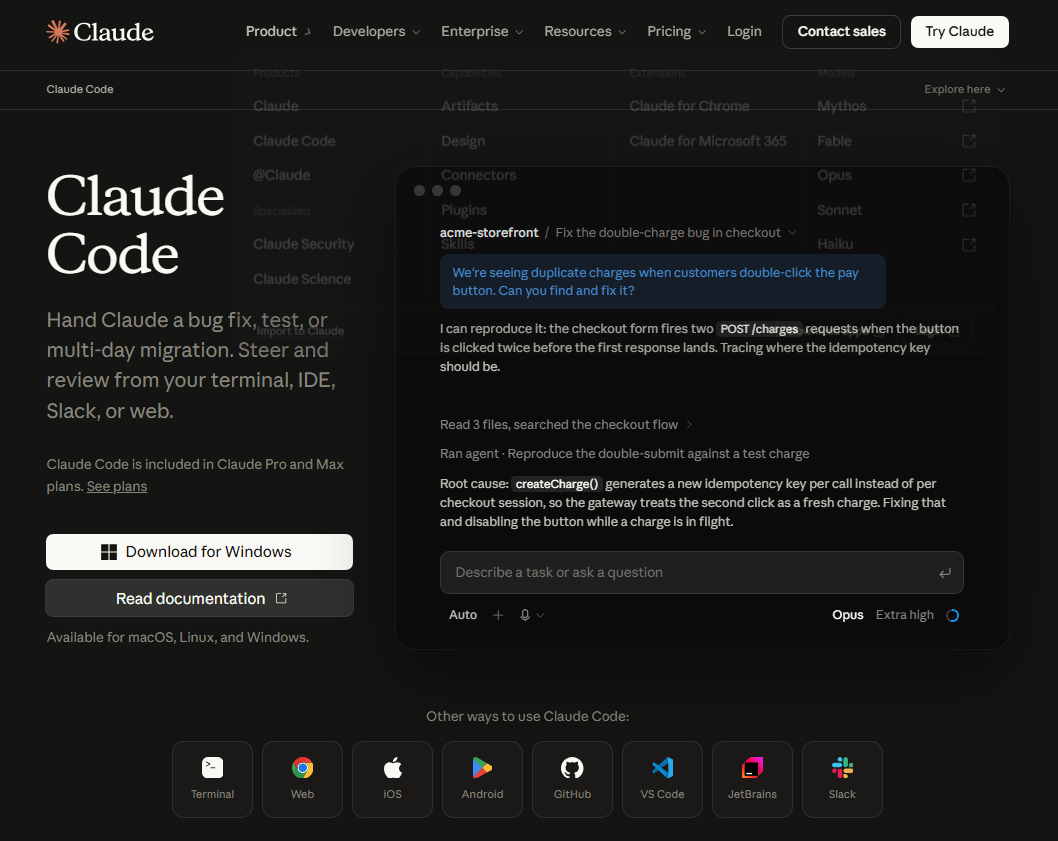
Although Claude Code is not primarily a blogging tool, it can be useful for bloggers who manage WordPress websites or create technical projects.
How Claude Code can help WordPress users
Potential use cases include:
- Understanding WordPress theme files.
- Reviewing PHP, HTML, CSS, and JavaScript.
- Debugging website code.
- Creating small scripts.
- Explaining technical errors.
- Assisting with plugin development.
- Working with website-related codebases.
For example, a developer could ask Claude Code to explain a PHP function or help investigate a bug in a WordPress plugin.
Claude Code for technical bloggers
If you publish tutorials about WordPress, coding, or AI tools, Claude Code can help you understand technical concepts and prepare examples.
However, generated code should always be reviewed and tested before using it on a live website. Make backups before making changes to important WordPress files.
8. Document and Presentation Tools
Claude has expanded beyond text chat into document and presentation workflows. Anthropic’s product announcements describe Claude’s ability to create files and work with documents, spreadsheets, and slides.
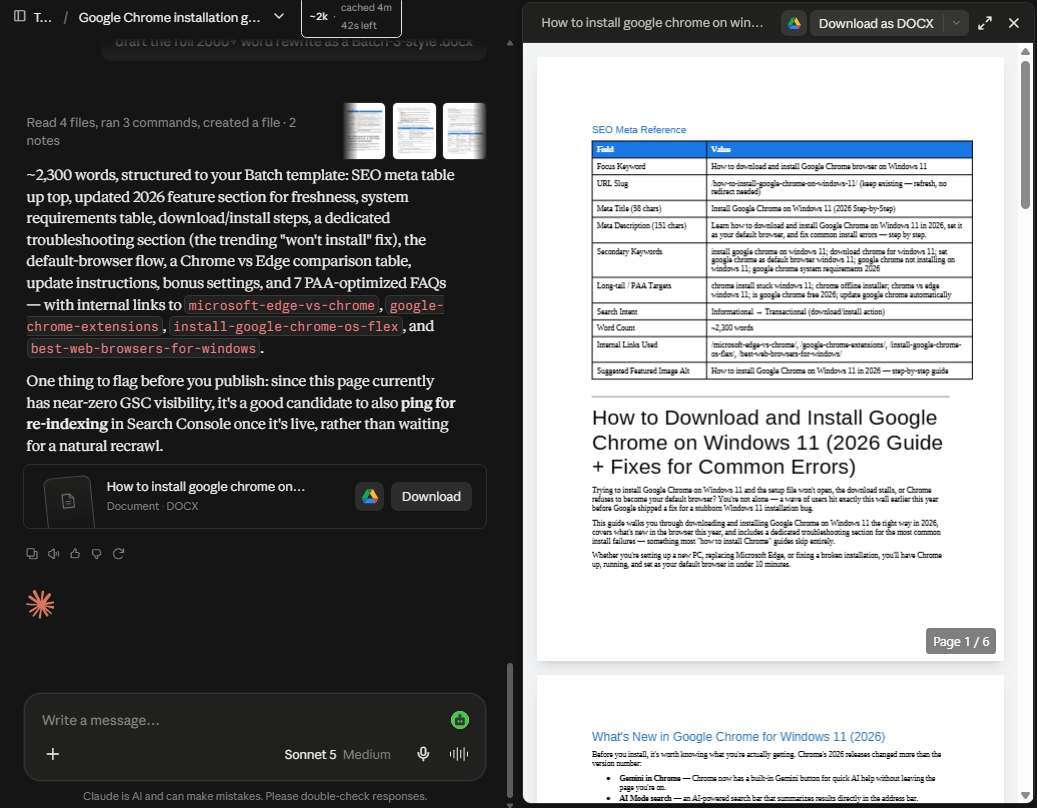
Anthropic also announced Claude Docs and Claude Slides in September 2026, introducing dedicated document and presentation creation and editing capabilities. Availability and supported plans should be checked before publishing because these features may change during rollout.
What can content creators do with these tools?
Potential uses include:
- Drafting articles in document format.
- Creating presentation outlines.
- Preparing slide content.
- Developing content briefs.
- Turning research into structured documents.
- Creating presentation material for tutorials or webinars.
For example, a blogger can ask Claude to transform an article about AI agents into a presentation outline containing:
- What are AI agents?
- How agentic AI works.
- Examples of AI agent tools.
- Benefits for bloggers.
- Limitations and future considerations.
Are Claude’s document and presentation tools useful?
They can be useful for creators who regularly prepare reports, presentations, and structured documents. The practical value depends on the quality of the generated content, available export formats, and whether the tools meet your workflow requirements.
For TechyDen, this feature area is worth testing because it can connect blog writing with presentation creation and content repurposing.
Quick Summary of Claude AI Features
| Feature | Use for content creators |
|---|---|
| Current model options | Choose models for different writing, reasoning, and coding tasks. |
| Writing and editing | Draft articles, improve readability, and refine content. |
| Web search and research | Research current information and gather source material. |
| Projects and memory | Organize content work and maintain relevant context. |
| File and PDF analysis | Summarize documents and extract useful information. |
| Artifacts | Create documents, tools, diagrams, and interactive content. |
| Claude Code | Assist with WordPress and other technical coding tasks. |
| Document and presentation tools | Create structured documents and presentation content. |
Our Take on Claude AI Features
Claude AI offers more than basic text generation. Its writing, research, file analysis, Projects, Artifacts, and coding capabilities make it relevant to bloggers, SEO professionals, and technical content creators.
However, the best way to judge these features is through practical testing. In the next section, we will explore how to use Claude AI for blogging and content creation, including blog post writing, SEO content planning, editing, and content repurposing.
Claude AI for Bloggers and Content Creators: Keyword research assistance, outlines, blog writing, editing, SEO briefs, content repurposing, and social media content.
Claude AI for Bloggers and Content Creators
Creating high-quality content requires more than simply writing paragraphs. Bloggers need to research topics, understand search intent, plan article structures, write engaging content, optimize for SEO, and promote their work across different platforms.
This is where Claude AI for bloggers and content creators can become a useful writing and productivity assistant. Instead of using AI only to generate a complete article, you can use Claude throughout your content workflow—from brainstorming ideas to editing a finished blog post.
Whether you run a technology blog, SEO website, affiliate marketing blog, or educational website, Claude can help with several content creation tasks. However, it works best when you combine AI assistance with your own expertise, keyword research, and editorial judgment.
Let’s explore how to use Claude AI for blogging and content creation.
1. Keyword Research Assistance
Keyword research is one of the first steps in creating an SEO-friendly blog post. It helps you understand what people are searching for and what information they expect to find.
Claude AI can assist with keyword research by generating related topic ideas, identifying potential long-tail keywords, and organizing keyword lists based on search intent.
For example, if you want to write about AI writing tools, you can ask Claude to suggest related keywords and content angles.
Example Claude AI prompt for keyword research:
I want to write a blog post about AI writing tools for bloggers. Suggest relevant primary keywords, secondary keywords, long-tail keywords, and related questions. Group them according to informational, commercial, and comparison search intent. Do not invent search volume or keyword difficulty data.
Claude can help you build an initial keyword list. You can then validate those keywords using SEO tools such as Semrush, Ahrefs, or Google Keyword Planner.
How Claude helps with keyword research
- Generates related keyword ideas.
- Suggests long-tail keyword variations.
- Groups keywords by search intent.
- Identifies possible content gaps.
- Suggests questions readers may ask.
- Helps organize keywords into content clusters.
Important: Claude AI does not automatically provide reliable search volume, keyword difficulty, or ranking data for every keyword. Use dedicated SEO tools to check actual metrics before choosing your target keyword.
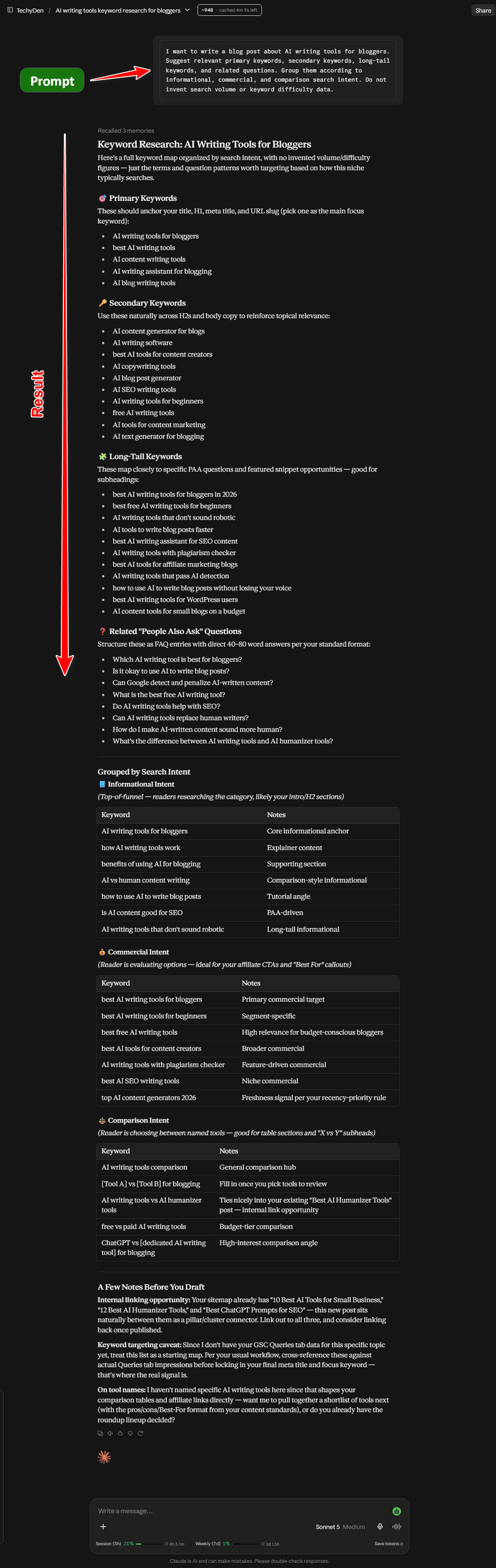
For example, when planning this Claude AI review, you could use the primary keyword “Claude AI review” and ask Claude to suggest supporting terms such as “Claude AI pricing,” “Claude AI features,” and “Claude AI for content creators.”
This makes Claude useful for brainstorming and organizing SEO research, but not a replacement for professional keyword research tools.
2. Creating Blog Post Outlines
A well-organized outline helps you write a comprehensive article without missing important topics. It also makes it easier to cover search intent and maintain a logical reading flow.
Claude AI can generate detailed blog post outlines based on your topic, audience, and SEO requirements.
For example, if you are writing an article about the best AI tools for bloggers, you can ask Claude to create an outline with an introduction, feature sections, comparisons, FAQs, and a conclusion.
Example Claude AI blog outline prompt:
Create a detailed SEO-friendly outline for a blog post titled "Best AI Tools for Bloggers." The target audience is beginner and experienced bloggers. Include H2 and H3 headings, search intent, practical examples, and FAQs. Avoid unnecessary sections and keep the structure easy to follow.
Claude can generate an outline that you can review and customize before writing the article.
Benefits of using Claude for blog outlines
- Saves time during content planning.
- Helps organize complex topics.
- Suggests useful H2 and H3 headings.
- Identifies missing subtopics.
- Makes long-form articles easier to structure.
- Helps maintain a consistent content format.
For TechyDen, Claude can be useful when creating pillar articles and supporting posts around topics such as AI agents, WordPress, blogging tools, and SEO.
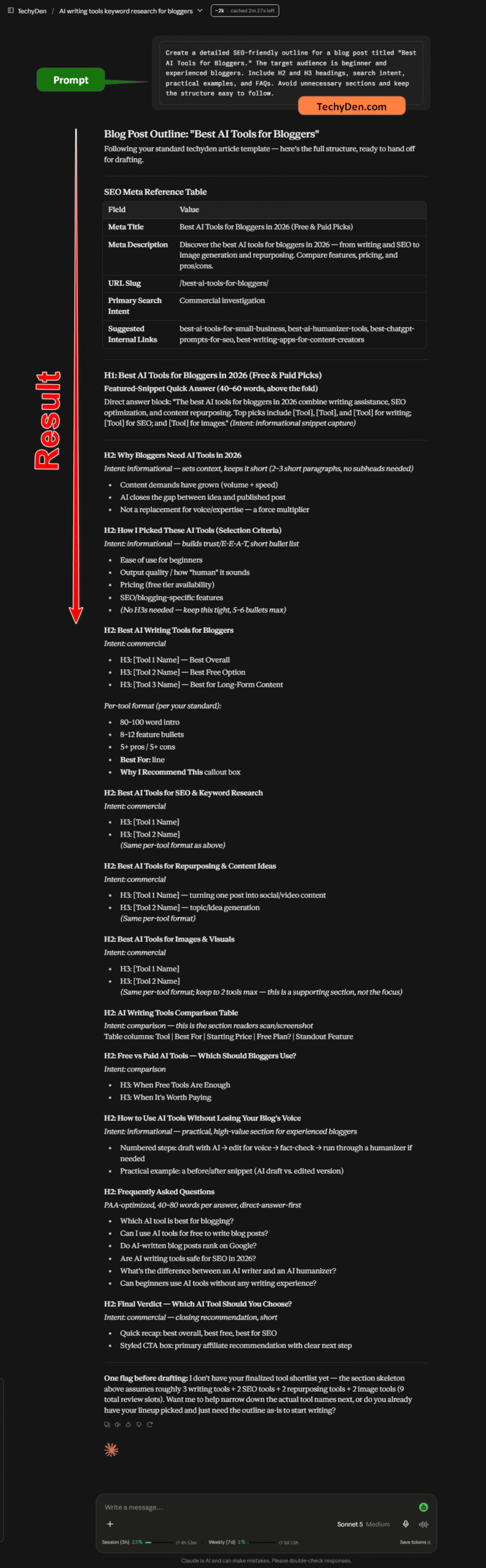
However, a good outline should not be accepted without review. Compare it with the search results, competing articles, and the questions your audience actually needs answered.
3. Blog Writing with Claude AI
One of the main reasons content creators explore Claude AI is its ability to generate written content. Claude can help draft blog introductions, individual sections, product descriptions, explanations, and conclusions.
It can also help transform rough notes into a more readable article.
For example, you can provide Claude with a topic, target audience, article structure, and writing instructions.
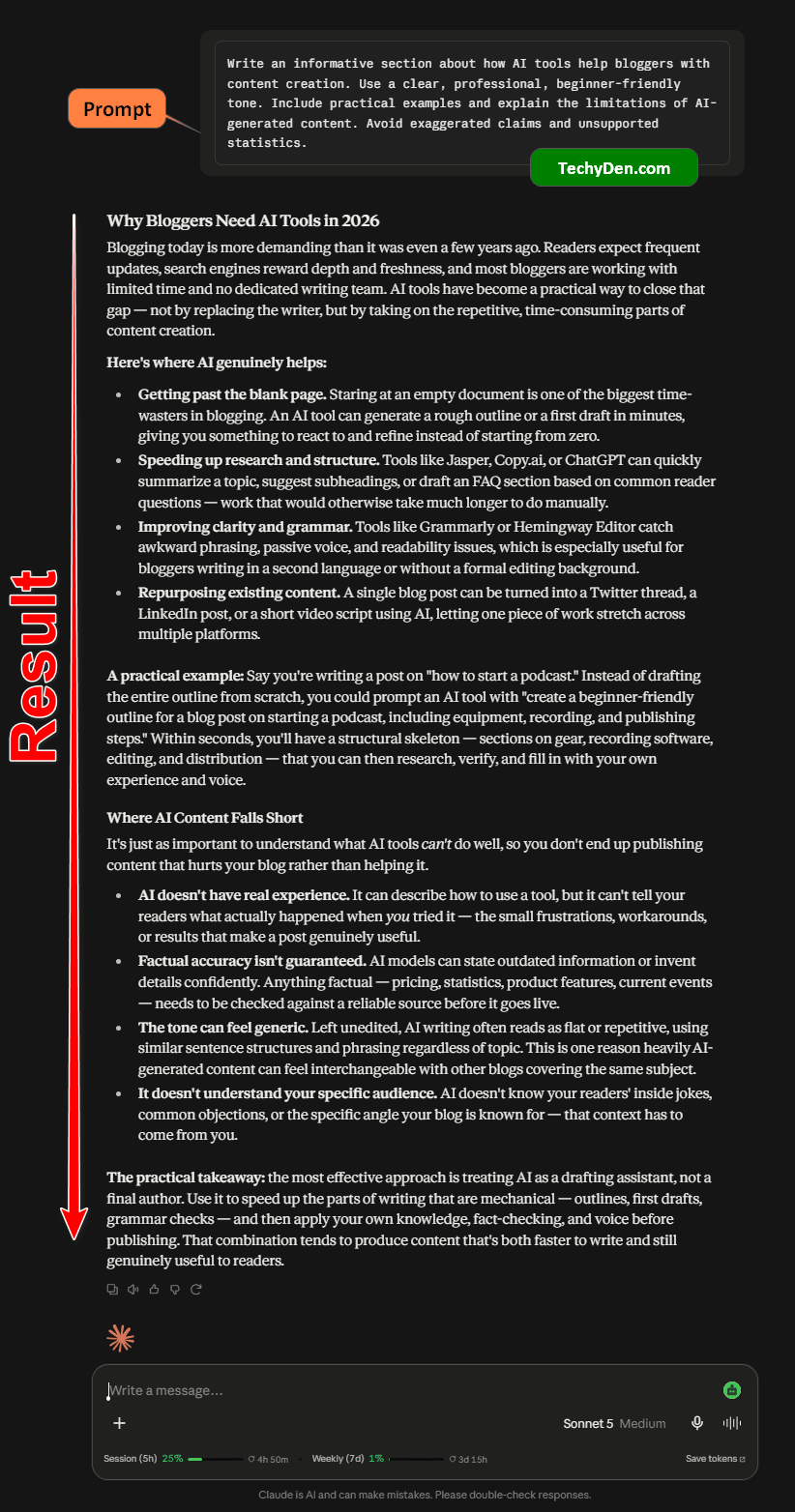
Example Claude AI blog writing prompt:
Write an informative section about how AI tools help bloggers with content creation. Use a clear, professional, beginner-friendly tone. Include practical examples and explain the limitations of AI-generated content. Avoid exaggerated claims and unsupported statistics.
Claude can generate a draft based on your instructions. You can then edit the output to match your writing style and the needs of your audience.
What Claude can help write
- Blog post introductions.
- Complete article drafts.
- Product review sections.
- How-to tutorials.
- Listicle content.
- FAQs.
- Meta descriptions.
- Social media captions.
- Email newsletter drafts.
- Content summaries.
Is Claude AI good for long-form content?
Claude can assist with long-form content, particularly when you provide a clear structure and relevant source material. However, generating a lengthy article in one prompt is not always the best workflow.
A better approach is to divide the article into sections.
For example:
- Create the article outline.
- Draft the introduction.
- Write each major section separately.
- Review the content for accuracy.
- Improve transitions and readability.
- Add original examples and practical insights.
- Edit the complete article before publishing.
This approach gives you more control over the final result.
My recommendation: Use Claude as a writing assistant rather than publishing its output without editing. Your own experience, examples, and expertise are what make a blog post more useful and trustworthy.
4. Content Editing and Rewriting
Content editing is another area where Claude AI can help bloggers. Even when you write an article yourself, you may need to improve its readability, remove repetition, or make the explanations easier to understand.
Claude can review existing content and suggest improvements based on your instructions.
For example, you can paste a paragraph from your blog and ask Claude to rewrite it in a clearer and more engaging style.
Example Claude AI editing prompt:
Edit the following blog post section for grammar, readability, and clarity. Preserve the original meaning and important technical details. Remove unnecessary repetition. Use short paragraphs and a professional, friendly tone. Do not add unsupported facts.
Claude can help with several editing tasks.
Common editing tasks
- Grammar and spelling: Identify grammatical errors, spelling mistakes, and awkward sentences.
- Readability improvement: Simplify complicated explanations and improve sentence flow.
- Tone adjustment: Rewrite content for beginners, professionals, or a specific audience.
- Content shortening: Remove unnecessary words and make lengthy paragraphs more concise.
- Content expansion: Add explanations and examples where a section needs more depth.
- Headline improvement: Suggest clearer and more engaging headings.
Example: Editing a technical blog
Suppose you have written an explanation of how AI agents work. The content may be technically accurate but difficult for beginners to understand.
You can ask Claude to rewrite it using simple language while preserving the technical meaning.
This can be useful for TechyDen articles about AI, WordPress, SEO, and other technical subjects.
However, you should always review the rewritten content to ensure that Claude has not changed the meaning or introduced incorrect information.
5. Creating SEO Content Briefs
A content brief is a useful document that explains what a blog post should cover. It helps writers understand the target keyword, audience, search intent, article structure, and important topics.
Claude AI can help create SEO content briefs from your keyword research and content strategy.
For example, if your target keyword is “Claude AI review,” you can ask Claude to prepare a content brief for a technology review article.
Example SEO content brief prompt:
Create an SEO content brief for the keyword "Claude AI review." The target audience is bloggers and content creators. Include search intent, suggested title, introduction angle, H2 and H3 headings, related keywords, FAQs, and a recommended article structure. Do not invent search volume or ranking data.
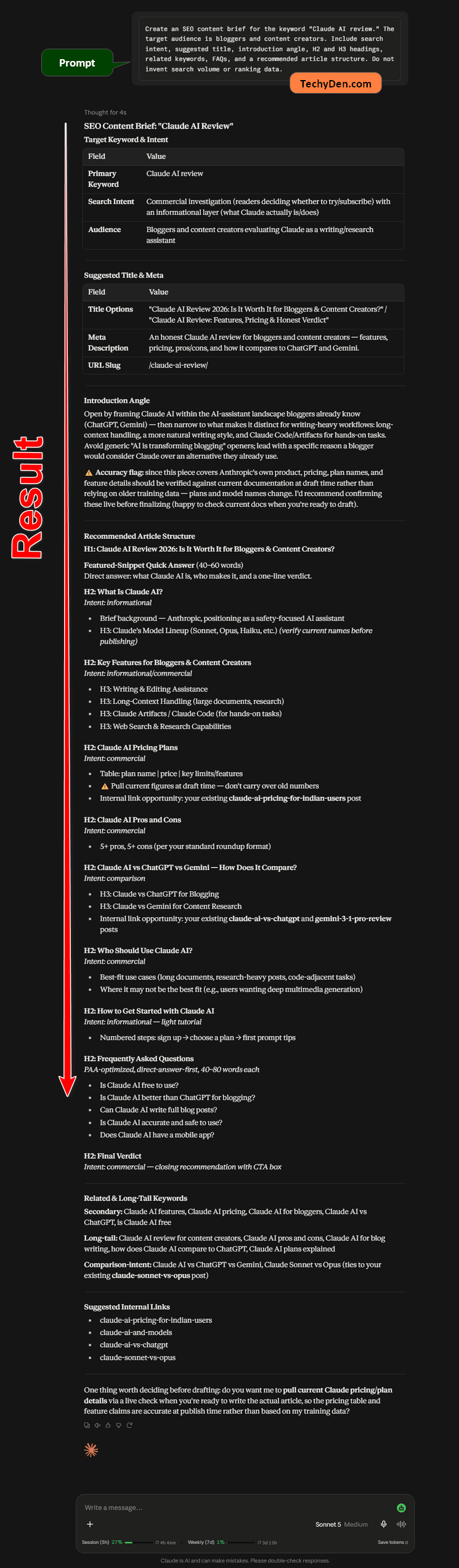
A content brief generated by Claude can include the following:
| Content brief element | What Claude can help with |
|---|---|
| Primary keyword | Organize the main target keyword. |
| Search intent | Explain what readers may want to know. |
| Target audience | Define the intended readers. |
| Article title | Suggest SEO-friendly title ideas. |
| H2 and H3 headings | Build a logical content structure. |
| Related keywords | Suggest relevant supporting terms. |
| FAQs | Generate potential reader questions. |
| Content angle | Suggest ways to make the article useful. |
How to improve the brief
After Claude generates the brief, compare it with:
- Google search results.
- People also ask questions.
- Competitor article structures.
- Your own Google Search Console data.
- Relevant product documentation.
- Your audience’s needs.
This helps turn a generic AI-generated outline into a more useful SEO content plan.
For your TechyDen website, Claude can be particularly useful for creating briefs for product reviews, AI tool comparisons, WordPress tutorials, and blogging guides.
6. Content Repurposing
Creating content for multiple platforms can take a lot of time. A single blog post can often be adapted into social media posts, email newsletters, video scripts, and short-form content.
Claude AI can help repurpose existing content into different formats while keeping the main message consistent.
For example, you can provide Claude with a published blog post and ask it to create a LinkedIn post, Facebook caption, or short video script.
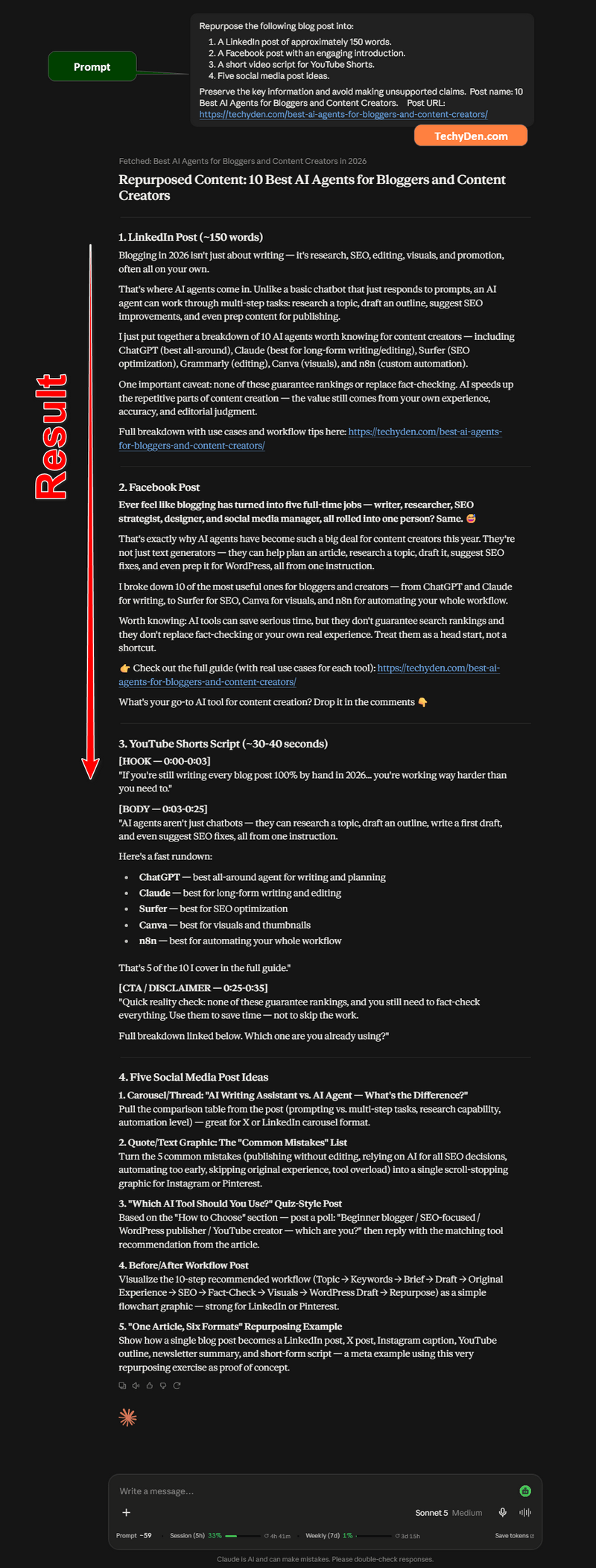
Example content repurposing prompt:
Repurpose the following blog post into:
- A LinkedIn post of approximately 150 words.
- A Facebook post with an engaging introduction.
- A short video script for YouTube Shorts.
- Five social media post ideas.
Preserve the key information and avoid making unsupported claims.
Claude can help you transform one piece of content into several formats.
Content formats you can create
- LinkedIn posts.
- Facebook captions.
- Instagram captions.
- YouTube video scripts.
- Short-form video ideas.
- Email newsletters.
- Content summaries.
- Blog post teasers.
- Social media carousel text.
Example for TechyDen
Suppose you publish an article titled “Best AI Tools for Blogging.”
You can ask Claude to create:
- A Facebook post introducing the article.
- A LinkedIn post explaining the benefits of AI for bloggers.
- A short video script covering three useful AI tools.
- An email newsletter promoting the article.
- Five social media posts based on the article’s key points.
This can help you maintain a consistent content publishing workflow across different platforms.
However, avoid copying the same content word-for-word everywhere. Each platform has a different audience and content format, so you should edit the output to match the platform.
7. Social Media Content Creation
Social media promotion is an important part of content marketing. Publishing a blog post is only the beginning; you also need to share it with your audience.
Claude AI can help create social media content based on your blog posts, products, and content campaigns.
For bloggers, this can reduce the time spent writing captions and promotional messages.
Example social media prompt:
Create five Facebook post ideas to promote a blog post about Claude AI for content creators. Use a friendly and informative tone. Include one question-based post, one educational post, one short promotional post, one practical tip, and one discussion prompt. Avoid exaggerated claims.
Claude can generate different content angles that you can review and adapt.
Social media tasks Claude can assist with
- Facebook content: Create educational posts, discussion prompts, and article promotion captions.
- LinkedIn content: Write professional posts about AI tools, blogging, SEO, and productivity.
- Instagram content: Suggest captions, carousel text, and short educational content ideas.
- YouTube content: Create video titles, descriptions, outlines, and scripts.
- Email marketing: Draft newsletter introductions and article promotion emails.
For TechyDen, this can be useful when promoting articles about AI tools, WordPress themes, hosting services, and blogging tips.
8. Claude AI for a Complete Blogging Workflow
The real value of Claude AI for content creators comes from combining multiple features into one workflow.
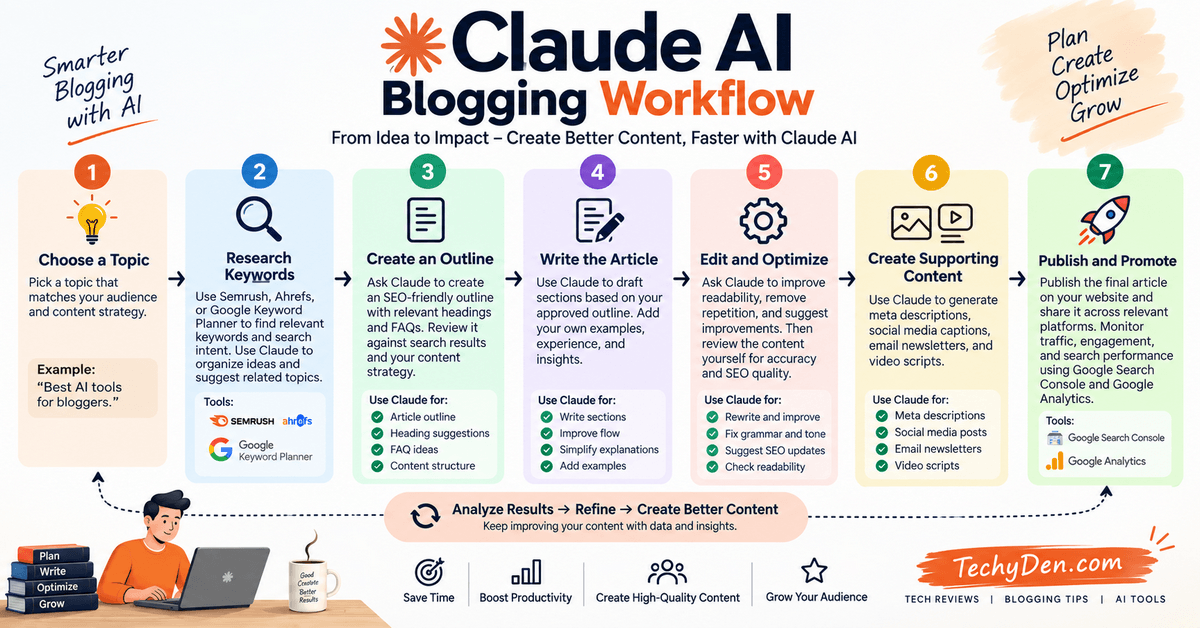
Instead of using Claude only for writing, you can use it across the entire content creation process.
- Step 1: Choose a topic: Start with a topic that matches your audience and content strategy. Example: “Best AI tools for bloggers.”
- Step 2: Research keywords: Use Semrush, Ahrefs, or Google Keyword Planner to identify relevant keywords and search intent. Use Claude to organize your keyword ideas and suggest related topics.
- Step 3: Create an outline: Ask Claude to create an SEO-friendly outline with relevant headings and FAQs. Review the outline against the search results and your own content strategy.
- Step 4: Write the article: Use Claude to draft sections based on your approved outline. Add your own examples, experience, and insights.
- Step 5: Edit and optimize: Ask Claude to improve readability, remove repetition, and suggest improvements. Then review the content yourself for accuracy and SEO quality.
- Step 6: Create supporting content: Use Claude to generate meta descriptions, social media captions, email newsletters, and video scripts.
- Step 7: Publish and promote: Publish the final article on your website and share it across relevant platforms. Monitor traffic, engagement, and search performance using Google Search Console and Google Analytics.
Claude AI for Bloggers: Pros and Limitations
| Benefits | Limitations |
|---|---|
| Helps generate content ideas. | Does not replace keyword research tools. |
| Creates article outlines quickly. | May produce inaccurate information. |
| Assists with blog writing. | Requires human editing and fact-checking. |
| Improves readability and tone. | May not match your writing style automatically. |
| Helps repurpose content. | Social media output needs platform-specific editing. |
| Supports content planning. | Current features and usage limits depend on the available plan. |
Our Take: Is Claude AI Useful for Bloggers?
Claude AI can be a useful assistant for bloggers and content creators who want to speed up content planning, writing, editing, and promotion.
Its biggest advantage is that you can use it for multiple content tasks instead of relying on it only for article generation. It can help turn a topic idea into an outline, transform notes into a draft, improve existing content, and create promotional material.
However, Claude should not replace your own editorial judgment. Keyword research, fact-checking, originality, and content quality still depend on the creator.
For TechyDen, Claude is worth exploring as part of an AI-assisted blogging workflow. The next step is to test how it performs on real content creation tasks and compare the results with other AI tools.
Claude AI Hands-on Content Writing Test
A feature list can tell you what Claude AI is designed to do, but it does not always show how useful it is in real content creation. For bloggers and SEO professionals, the important questions are
- Can Claude write a helpful article? Does it follow instructions?
- How much editing does the output require? And
- How does it compare with other AI writing tools?
In this section of our Claude AI review 2026, we will look at a practical content writing test designed for bloggers and content creators. The goal is to evaluate Claude using the same prompts and compare its output with competing AI tools.
Testing note: This is a hands-on testing framework and review methodology. The actual output samples, editing times, and accuracy scores should be recorded from your own tests before publication. The observations below explain what to measure rather than presenting unverified test results as completed experiments.
How We Tested Claude AI for Content Creation
To evaluate Claude fairly, use the same topic, instructions, source material, and content requirements across Claude and competing AI tools.
For example, you can compare Claude with ChatGPT and Google Gemini on a blog post about AI tools for bloggers.
The test should include:
- The same topic and primary keyword.
- The same target audience.
- The same article length.
- The same content structure.
- The same source material.
- The same writing tone.
- The same instructions for accuracy and originality.
This approach helps reduce differences caused by the prompt rather than the AI tool itself.
Tools Included in the Comparison
For this review, you can compare the following AI assistants:
| AI tool | Main purpose in the test |
|---|---|
| Claude AI | Content writing, editing, and research assistance. |
| ChatGPT | Blog writing, SEO planning, and content editing. |
| Google Gemini | Content drafting and research-related tasks. |
Use the same model tier and comparable settings where possible. Record the model name, plan, and test date because AI tools and their capabilities change over time.
Test 1: Blog Post Outline Creation
The first test evaluates how well each AI tool creates a structured blog post outline.
A good outline should cover the main topic, address the reader’s search intent, and provide a logical flow between sections.
Prompt used for the test:
Create an SEO-friendly blog post outline for the keyword "best AI tools for bloggers." The target audience is beginner and experienced bloggers. Include H2 and H3 headings, practical examples, pros and cons, and FAQs. Avoid unnecessary sections and do not invent keyword search volume or ranking data.
What to evaluate
- Does the outline match the primary keyword?
- Does it cover the reader’s likely questions?
- Are the headings organized logically?
- Does it include useful supporting topics?
- Are there unnecessary or repetitive sections?
- Can the outline be used to write a comprehensive article?
Quality observation
Claude’s outline should be judged by how well it supports the complete article, not simply by the number of headings it generates.
A shorter, well-organized outline may be more useful than a long outline filled with repetitive topics.
Test 2: Blog Writing
The second test focuses on the actual writing quality of the AI-generated article.
For this test, choose a topic that is relevant to your website and provide the same instructions to all tools.
Example prompt:
Write a 1,500-word blog post about the best AI tools for bloggers. Use a clear, professional, beginner-friendly tone. Include an introduction, H2 headings, practical examples, pros and cons, and a conclusion. Avoid exaggerated claims and unsupported statistics. Make the article useful for bloggers who want to improve their content creation workflow.
After generating the content, compare the results manually.
What to evaluate
- Writing quality: Does the article read naturally, or does it sound repetitive and generic?
- Structure: Does the content follow the requested headings and maintain a logical flow?
- Usefulness: Does the article provide practical information, examples, and actionable advice?
- Originality: Does the content offer meaningful insights, or does it rely on common AI-generated statements?
- Accuracy: Are the product names, features, and factual claims correct?
- Editing requirements: How much work is needed before the article is ready for publication?
Test 3: Content Editing
Many bloggers already have existing articles that need improvement. An AI writing assistant should be useful not only for generating new content but also for improving existing drafts.
For this test, provide each AI tool with the same paragraph from your blog.
Example editing prompt:
Edit the following blog post section for grammar, readability, and clarity. Preserve the original meaning and important technical details. Remove unnecessary repetition and use a professional, friendly tone. Do not add unsupported facts.
What to evaluate
- Grammar and spelling corrections.
- Sentence clarity.
- Paragraph structure.
- Preservation of the original meaning.
- Tone and readability.
- Unnecessary changes or invented information.
A useful editing tool should improve the content without removing important details or changing the author’s intended message.
For TechyDen, this test can be performed on articles about AI tools, WordPress, SEO, and blogging.
Test 4: SEO Content Brief
The next test evaluates how well Claude and competing AI tools assist with SEO content planning.
A good content brief should help a writer understand the target keyword, audience, search intent, article structure, and important topics to cover.
Example prompt:
Create an SEO content brief for the keyword "Claude AI review." The target audience is bloggers and content creators. Include the search intent, suggested title, introduction angle, H2 and H3 headings, related keywords, FAQs, and a recommended article structure. Do not invent search volume or keyword difficulty data.
What to evaluate
| Evaluation area | What to look for |
|---|---|
| Search intent | Does the brief address what readers want to know? |
| Keyword relevance | Are the suggested keywords related to the topic? |
| Article structure | Are the headings useful and logically organized? |
| Content depth | Does the brief cover important review topics? |
| Originality | Does it suggest a useful angle beyond generic AI content? |
| SEO accuracy | Does it avoid unsupported keyword metrics and claims? |
Claude can help create an initial content brief, but actual keyword research should be validated with tools such as Semrush, Ahrefs, and Google Search Console.
Test 5: Content Repurposing
A blog post can be transformed into several different content formats. This test evaluates how well each AI tool repurposes an existing article without losing its main message.
Example prompt:
Repurpose the following blog post into a LinkedIn post of approximately 150 words, a Facebook post, five social media post ideas, and a short YouTube video script. Preserve the key information and avoid unsupported claims. Adapt the tone and structure for each platform.
What to evaluate
- Does the repurposed content preserve the original meaning?
- Are the posts suitable for their intended platforms?
- Does each version have a useful opening?
- Is the content engaging without exaggerated claims?
- Does the AI avoid repeating the same wording across formats?
For TechyDen, this can be useful when promoting articles about AI tools, WordPress plugins, hosting services, and blogging tips.
Editing Time and Accuracy
Writing quality is only one part of an AI content writing test. The amount of editing required is also important.
An AI tool that generates a quick draft but requires extensive corrections may not save as much time as expected.
How to measure editing time
Use the following process for each tool:
- Generate the article using the same prompt.
- Record the time taken to generate the draft.
- Read the article and identify factual or structural issues.
- Edit the article for clarity, accuracy, and usefulness.
- Record the total editing time.
- Note the major changes made before publication.
You can use a simple table to record your results.
| Metric | Claude AI | ChatGPT | Google Gemini |
|---|---|---|---|
| Draft generation time | Record test result | Record test result | Record test result |
| Editing time | Record test result | Record test result | Record test result |
| Factual corrections | Count corrections | Count corrections | Count corrections |
| Structure changes | Note changes | Note changes | Note changes |
| Final quality | Describe observations | Describe observations | Describe observations |
Important: Do not assign ratings or claim one tool is better based on a test unless you have actually performed the same evaluation across all tools. Different topics, prompts, models, and editing standards can produce different results.
Accuracy and Fact-Checking
AI-generated content should always be fact-checked before publication, especially for product reviews and technical articles.
For example, while testing Claude AI, you may ask it to explain the latest features of an AI writing tool. The output may contain outdated pricing, incorrect model names, or features that are available only on certain plans.
Check important claims against:
- Official product documentation.
- Official pricing pages.
- Company announcements.
- Reliable research sources.
- Your own hands-on testing.
For a Claude AI review, verify all claims about Claude’s models, pricing, usage limits, web search, Projects, Artifacts, and other capabilities before publishing.
What Makes a Good AI Content Writing Tool?
Based on the testing framework above, a useful AI writing assistant should be evaluated across several areas.
- Writing quality: Does it produce readable and useful content?
- Instruction following: Does it follow the requested tone, structure, and length?
- Editing efficiency: How much time is needed to improve the draft?
- Factual accuracy: Does it provide reliable information?
- SEO usefulness: Does it help with content planning without inventing keyword metrics?
- Workflow flexibility: Can it assist with outlines, drafts, editing, and repurposing?
- Human control: Can the writer easily review, revise, and improve the output?
These factors matter more than simply counting the number of features an AI tool offers.
Our Hands-on Testing Approach for TechyDen
For TechyDen, the most useful test would be based on a real article topic from your blogging and AI tools content cluster.
For example, you could test Claude on:
- A blog post about AI tools for bloggers.
- A review of an AI writing assistant.
- An SEO content brief.
- A WordPress tutorial.
- A content repurposing workflow.
Use the same prompt across Claude, ChatGPT, and Gemini, then compare the drafts and editing requirements.
This approach can produce original observations that make your review more valuable to readers.
Claude AI Content Writing Test
Claude AI has several capabilities that make it relevant to bloggers and content creators, including writing, editing, research assistance, and content planning.
However, the best way to understand its value is through practical testing. A feature list alone cannot tell you how much editing a draft requires or whether the generated content is accurate and useful.
For this reason, your Claude AI review should include real examples, screenshots, test dates, and clear observations from your own workflow.
In the next section, we will explore Claude AI pricing and plans, including the available subscription options and what content creators should consider before choosing a paid plan.
Claude AI Pricing and Plans
Claude AI offers several subscription options for individual users, teams, and large organizations. You can start with the free plan and upgrade when you need higher usage limits, advanced features, collaboration tools, or API access.
Pricing note: Claude pricing may vary by country, billing cycle, applicable taxes, and platform. The following prices are based on Anthropic’s listed plans and India-specific pricing information available at the time of writing.
Claude AI Pricing Overview
| Claude Plan | Pricing | Best For |
|---|---|---|
| Free | $0 / ₹0 | Casual users and beginners |
| Pro | $20/month or $200/year in the US | Bloggers, creators, and regular users |
| Max 5x | From $100/month | Heavy Claude users |
| Max 20x | From $200/month | Professionals with very high usage |
| Team Standard | $20/user/month annually | Small and medium-sized teams |
| Team Premium | $100/user/month annually | Teams needing higher usage |
| Enterprise | Custom usage-based pricing | Large organizations |
| API | Pay-as-you-go | Developers and AI-powered applications |
1. Claude Free Plan
The Claude Free plan costs nothing and is suitable for users who want to try Claude AI before paying for a subscription.
With the free plan, you can generally use Claude for:
- Writing and editing blog content.
- Brainstorming article ideas.
- Summarizing documents.
- Asking questions and researching topics.
- Generating and explaining code.
- Creating files and working with supported tools.
- Using Claude through the web, desktop, and mobile apps.
The main limitation is usage capacity. Free users may reach message or feature limits sooner during busy periods or when working with long documents.
Best for: Beginners, occasional users, students, and bloggers who publish only a few articles each month.
2. Claude Individual Plans
Claude’s pricing spans four categories: Individual, Developer, Team & Enterprise, and pay-as-you-go API.
| Plan | Price | Best For |
|---|---|---|
| Free | $0 | Trying Claude — web/desktop/mobile chat, web search, Artifacts |
| Pro | $17/month (annual) or $20/month (billed monthly) | Everyday use — more usage, Claude Code, Projects, Claude in Chrome & Microsoft 365 |
| Max | From $100/month | Heavy daily use — choose 5x or 20x Pro’s usage, higher output limits |
3. Developer Plans
(for those building with Claude via the Developer Platform)
| Plan | Price | Best For |
|---|---|---|
| Pro | $17/month (annual) or $20/month (billed monthly) | Developers wanting more usage plus Claude Design, Slides, Docs, and Claude Code |
| Max 5x | $100/month | 5x Pro’s usage, higher output limits, early feature access |
| Max 20x | $200/month | 20x Pro’s usage, priority access at high-traffic times |
4. Team & Enterprise
- Team (2–150 seats): Standard seat $20/month, Premium seat $100/month (billed annually)—adds SSO and centralized admin
- Enterprise: Seat price plus usage at API rates—adds SCIM, audit logs, IP allowlisting, and a HIPAA-ready offering
API Pricing (per million tokens)
| Model | Input | Output |
|---|---|---|
| Haiku 4.5 | $1 | $5 |
| Sonnet 5 | $2 | $10 |
| Opus 5 | $5 | $25 |
| Fable 5.1 | $10 | $50 |
Batch processing cuts API costs by 50%, and prompt caching reduces repeated-context costs.
Note: Pricing and features can change at Anthropic’s discretion—verify current rates on Claude’s official pricing page before publishing.
Claude AI India Pricing
Anthropic has introduced India-specific rupee pricing for selected Claude plans. Reported India prices include:
| Plan | Approximate India Pricing |
|---|---|
| Free | ₹0 |
| Pro annual billing | Around ₹2,000/month |
| Pro monthly billing | Around ₹2,399/month |
| Max 5x | Around ₹11,999/month |
| Max 20x | Around ₹23,999/month |
| Team Standard annual billing | Around ₹2,399/user/month |
| Team Standard monthly billing | Around ₹2,999/user/month |
| Team Premium annual billing | Around ₹11,999/user/month |
| Team Premium monthly billing | Around ₹14,999/user/month |
Prices may change and can differ between the Claude website and mobile app billing. Always confirm the final amount shown during checkout, including taxes and payment-method charges.
For a detailed breakdown, see our guide: Claude AI Pricing in India: Plans, Features, and Subscription Costs .
Which Claude Plan Should You Choose?
- Choose Claude Free if you are trying Claude for the first time.
- Choose Claude Pro if you write articles, research topics, or use Claude regularly.
- Choose Claude Max 5x if you frequently reach Pro usage limits.
- Choose Claude Max 20x if Claude is part of your daily professional workflow.
- Choose Claude Team if several people need to collaborate using Claude.
- Choose Claude Enterprise if your organization requires advanced administration and security.
- Choose the Claude API if you want to integrate Claude into a website, software product, chatbot, or automated workflow.
For most individual bloggers and content creators, Claude Pro is the most practical starting point because it offers more usage and advanced features without the higher cost of the Max plans.
Claude AI Pros and Cons
Claude AI is a useful writing and research assistant for bloggers and content creators. However, it also has some limitations that you should understand before using it for your complete content workflow.
Pros of Claude AI
- Produces natural-sounding and well-structured content.
- Useful for writing blog posts, outlines, introductions, and conclusions.
- Provides clear explanations for complex topics.
- Works well for rewriting and improving existing content.
- Can summarize long documents and research material.
- Helps generate fresh content ideas and headlines.
- Useful for proofreading grammar, tone, and readability.
- Supports coding and technical content creation.
- Projects help organize related chats and files.
- Offers advanced features for professional users and teams.
Cons of Claude AI
- The free plan has limited usage during busy periods.
- Claude can sometimes provide inaccurate or outdated information.
- It may generate content that requires fact-checking.
- It does not automatically guarantee SEO-optimized content.
- Keyword research and search-volume data require separate SEO tools.
- Some advanced features are available only on paid plans.
- Higher usage limits can be expensive for individual creators.
- Long responses may still require editing for accuracy and originality.
- Claude’s writing style may sound similar across multiple articles.
- API usage requires separate payment based on token consumption.
Is Claude AI Worth It for Content Creators?
Claude AI can save time during research, writing, editing, and content planning. It is especially useful for bloggers who want help creating structured drafts and improving readability.
However, content creators should still verify facts, add personal experience, include original examples, and optimize articles using dedicated SEO tools. Claude works best as a content assistant rather than a complete replacement for human judgment and editorial review.
Claude AI vs ChatGPT vs Gemini
Claude AI, ChatGPT, and Google Gemini are popular AI assistants for writing, research, coding, and productivity. Each tool offers different features, integrations, and pricing options. The right choice depends on your content workflow, preferred tools, and daily usage.
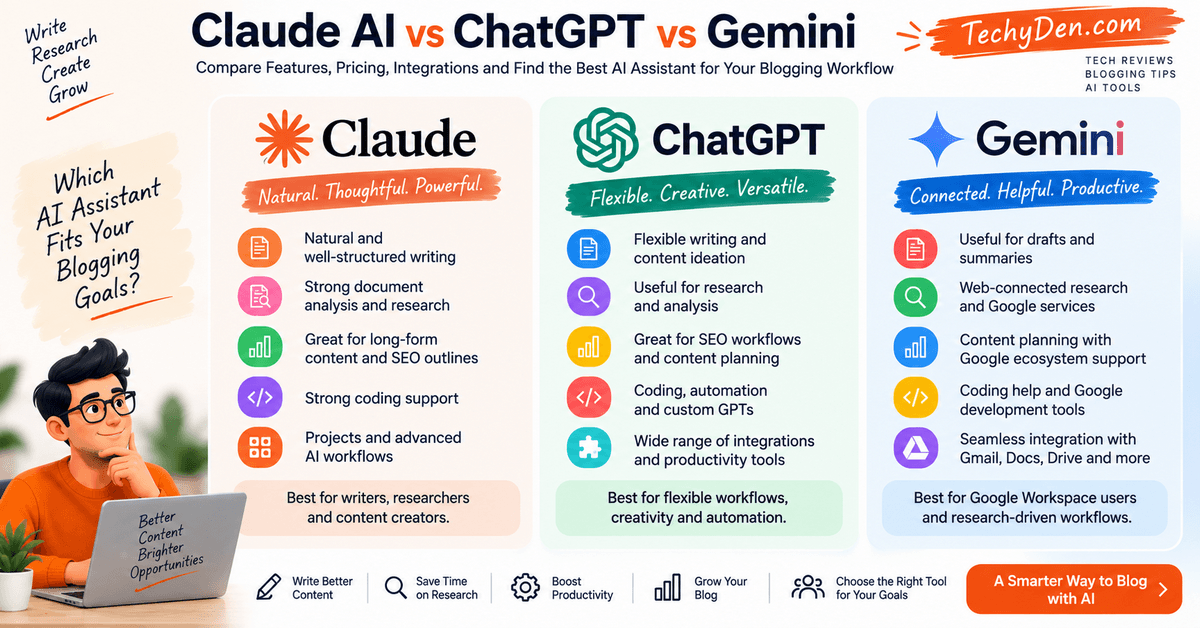
Claude AI vs ChatGPT vs Gemini: Quick Comparison
| Feature | Claude AI | ChatGPT | Google Gemini |
|---|---|---|---|
| Writing | Natural, clear, and well-structured writing | Flexible writing, editing, and content ideation | Useful for drafts, summaries, and Google-based content |
| Research | Strong document analysis and detailed explanations | Useful for research, analysis, and structured answers | Useful for web-connected research and Google services |
| SEO Content | Outlines, briefs, content editing, and topical coverage | Keyword ideas, content planning, and SEO workflows | Content planning and research with Google ecosystem support |
| Integrations | Claude apps, projects, coding tools, and business features | Custom GPTs, connected apps, files, and automation features | Gmail, Google Docs, Drive, Sheets, and other Google services |
| Coding | Strong coding and code explanation capabilities | Coding, debugging, and development assistance | Coding help and Google development ecosystem support |
| Free Plan | Available with usage limits | Available with usage limits | Available with usage limits |
| Paid Plans | Pro, Max, Team, and Enterprise | Plus, Pro, Business, and Enterprise options | Google AI subscription options and business plans |
| API | Available with usage-based pricing | Available with usage-based pricing | Available through Google’s Gemini API and related platforms |
1. Writing and Editing
- Claude AI is useful for producing natural-sounding articles, rewriting paragraphs, improving readability, and maintaining a consistent tone across long-form content.
- ChatGPT offers a broad writing workflow, including brainstorming, outlining, drafting, editing, headline generation, and creating different writing styles.
- Gemini is useful for drafting content, summarizing information, and working with documents inside the Google ecosystem.
For bloggers, the practical difference often depends on the type of content being created. Claude may be preferred for polished long-form writing, ChatGPT for flexible content workflows, and Gemini for users who already work heavily with Google tools.
2. Research and Information Gathering
- Claude AI can help summarize documents, compare information, explain difficult subjects, and organize research notes. It is useful when a creator already has source material to analyze.
- ChatGPT can support research planning, explanations, structured comparisons, data analysis, and content briefs. Depending on the available tools and settings, it can also assist with web-based research.
- Gemini is useful for users who want research assistance connected with Google services and search-related workflows.
Regardless of the platform, AI-generated research should be fact-checked before publishing. AI tools can misunderstand sources, miss context, or provide outdated information.
3. SEO and Content Workflows
All three tools can support different stages of an SEO content workflow.
Claude AI Workflow
- Generate topic ideas.
- Create detailed article outlines.
- Develop topic clusters.
- Draft introductions and sections.
- Improve readability and content flow.
- Rewrite outdated content.
- Create FAQs and meta descriptions.
- Review content for missing subtopics.
ChatGPT Workflow
- Generate keyword-based content ideas.
- Create SEO briefs.
- Build content calendars.
- Draft blog posts and social media content.
- Create title and meta description variations.
- Analyze content structure.
- Prepare email and promotional copy.
- Assist with automation and custom workflows.
Gemini Workflow
- Research topics using Google-related tools.
- Summarize documents from Google Drive.
- Draft content in Google Docs.
- Assist with spreadsheets and data-based tasks.
- Create content ideas from existing Google Workspace materials.
- Support research and productivity workflows.
AI tools can assist with SEO content creation, but they do not replace tools such as Google Search Console, Google Analytics, Semrush, Ahrefs, or dedicated keyword research platforms.
4. Integrations and Productivity
Claude AI is suitable for users who want projects, document analysis, coding assistance, and professional AI workflows.
ChatGPT provides a wide range of productivity features, including file analysis, custom GPTs, connected applications, image-related tools, and automation options depending on the plan.
Gemini is particularly relevant for users who already use:
- Gmail.
- Google Docs.
- Google Drive.
- Google Sheets.
- Google Meet.
- Other Google Workspace products.
For example, a blogger working primarily in Google Docs and Drive may prefer Gemini for convenience, while a creator who wants a broader collection of AI writing and productivity tools may consider ChatGPT or Claude.
5. Pricing and Subscription Options
The pricing of Claude AI, ChatGPT, and Gemini can change based on region, billing cycle, taxes, and product updates.
Generally, each platform offers:
- A free plan with usage limits.
- One or more paid plans for individual users.
- Higher-priced plans for power users or professionals.
- Business or enterprise subscriptions.
- Separate API pricing for developers.
Claude offers individual Pro and Max plans, along with Team and Enterprise options.
ChatGPT offers individual subscriptions and business-focused plans, with pricing depending on the selected tier.
Gemini is connected to Google’s AI subscription options, while business users can access additional capabilities through Google Workspace and Google Cloud offerings.
Before subscribing, compare the actual features included in your country rather than comparing only the monthly price.
6. Which Tool Fits Your Content Workflow?
| Content Requirement | Tool Features to Consider |
|---|---|
| Long-form blog writing | Natural writing, context handling, and editing |
| SEO content planning | Outlines, keyword organization, and content briefs |
| Google Workspace workflow | Gmail, Docs, Drive, and Sheets integration |
| Coding and technical writing | Code generation, debugging, and explanations |
| Content repurposing | Social posts, emails, scripts, and summaries |
| Document analysis | File uploads, summaries, and source comparison |
| Advanced automation | APIs, connected apps, and workflow tools |
| Team collaboration | Shared workspaces, administration, and security |
Claude AI vs ChatGPT vs Gemini: Which One Should You Use?
There is no single tool that is ideal for every blogger or content creator.
- Choose Claude AI if you want help with polished writing, long-form editing, document analysis, and structured content development.
- Choose ChatGPT if you want a flexible assistant for writing, research, coding, content planning, and a broad range of AI workflows.
- Choose Gemini if you work extensively with Google Search, Google Docs, Gmail, Drive, and other Google Workspace tools.
Many professional creators use more than one AI assistant. For example, you can use one tool for research, another for drafting, and a third for editing or content repurposing. The most useful choice depends on your workflow, budget, preferred integrations, and the type of content you publish.
Who Should Use Claude AI?

Claude AI is useful for people who need help with writing, research, coding, learning, or everyday business tasks. Its features can support different workflows depending on the user’s goals.
- Bloggers: Bloggers can use Claude AI to create article outlines, draft blog posts, generate headlines, and improve existing content.
- Freelance Writers: Freelance writers can use Claude AI to prepare drafts, rewrite paragraphs, adjust tone, and complete writing projects faster.
- SEO Professionals: SEO professionals can use Claude AI to create keyword-based content briefs, suggest topic clusters, write meta descriptions, and improve content structure.
- Students: Students can use Claude AI to understand difficult subjects, summarize study materials, create notes, and practice questions.
- Developers: Developers can use Claude AI to write code, explain programming concepts, find bugs, and document software projects.
- Content Creators: Content creators can use Claude AI to generate video ideas, social media captions, scripts, and content calendars.
- Digital Marketers: Digital marketers can use Claude AI to create campaign ideas, email copy, product descriptions, and promotional content.
- Researchers: Researchers can use Claude AI to summarize documents, compare information, organize ideas, and explain complex topics.
- Small Businesses: Small businesses can use Claude AI for customer-support drafts, business emails, website content, marketing plans, and internal documentation.
- Large Teams and Enterprises: Businesses with multiple employees can use Claude Team or Enterprise plans for collaboration, administration, security, and centralized AI workflows.
Who May Not Need Claude AI?
Users who only need occasional answers may find the Free plan sufficient. People who require real-time search data, advanced SEO metrics, or guaranteed factual accuracy should combine Claude AI with reliable research and professional tools.
Overall, Claude AI is most useful for anyone who wants to save time, improve written content, organize information, or assist with technical and creative tasks.
Is Claude AI Worth It in 2026?
Claude AI is worth considering in 2026 if you regularly create content, research topics, edit articles, or work with documents and code. It can reduce the time spent on repetitive tasks, but it should be used as an assistant rather than a complete replacement for human creativity and fact-checking.
When Claude AI Is Worth It
Claude AI can be a useful choice for:
- Writing detailed blog post outlines.
- Creating first drafts of articles.
- Rewriting and improving existing content.
- Simplifying complex explanations.
- Generating headlines and content ideas.
- Summarizing long documents.
- Preparing FAQs and meta descriptions.
- Creating social media captions.
- Reviewing grammar, tone, and readability.
- Assisting with coding and technical content.
For bloggers, one of its main advantages is the ability to work through several stages of the content process in one conversation. You can start with a topic idea, create an outline, draft sections, improve the writing, and prepare promotional content.
When Claude AI May Not Be Worth It
A paid Claude plan may not be necessary if you only use AI occasionally. The Free plan may be enough for simple questions, short writing tasks, and basic brainstorming.
Claude may also not be the right choice if you need:
- Guaranteed factual accuracy.
- Complete keyword research data.
- Live SEO performance reports.
- Automatic publishing without review.
- Unlimited usage.
- A replacement for professional editing.
- All your preferred integrations in one platform.
For SEO work, Claude should be combined with tools such as Google Search Console, Google Analytics, Semrush, Ahrefs, or Google Keyword Planner. These tools provide data that an AI writing assistant cannot reliably replace.
Is Claude Pro Worth the Price for Bloggers?
Claude Pro can be worth the subscription cost for bloggers who use it frequently for writing, research, editing, and content planning. It becomes more useful when you publish regularly or manage multiple websites and content projects.
However, the value depends on how often you use the service. Before upgrading, consider:
- How many articles you create each month.
- How often you reach the free plan limits.
- Whether you need advanced Claude features.
- How much time Claude saves during your workflow.
- Whether the subscription fits your content budget.
Frequently Asked Questions About Claude AI
Is Claude AI free to use?
Yes, Claude AI offers a Free plan for users who want to try its writing, research, summarization, and coding features. The Free plan does not require a subscription, but usage limits apply. Message availability may change depending on demand, task length, and the features being used.
How much does Claude Pro cost?
Claude Pro is generally listed at $20 per month or $200 per year in the United States. India pricing may be displayed in rupees and can vary because of taxes, billing methods, and regional pricing updates. Always check the final price on the official Claude checkout page.
Is Claude AI good for content writing?
Yes, Claude AI is useful for content writing because it can create outlines, introductions, blog sections, conclusions, FAQs, and social media posts. It can also rewrite existing content and improve readability. Writers should add original examples, verify facts, and edit the final draft before publishing.
Can Claude AI write SEO-friendly blog posts?
Claude AI can help create SEO-friendly blog posts by suggesting titles, headings, keyword placements, FAQs, and content structures. However, it does not automatically guarantee search rankings. Use keyword research tools, analyze search intent, add useful information, and review the article for accuracy and originality.
Is Claude AI better than ChatGPT for bloggers?
Claude AI and ChatGPT support different content workflows, so there is no universal winner. Claude is useful for natural writing, long-form editing, and document analysis. ChatGPT offers broad writing, research, coding, and productivity features. Bloggers should test both tools with their own content requirements.
Can Claude AI help with keyword research?
Claude AI can suggest keyword ideas, related topics, search-intent categories, and content clusters. However, it may not provide reliable search volume, keyword difficulty, or traffic data by itself. For accurate SEO research, combine Claude with tools such as Semrush, Ahrefs, Google Keyword Planner, or Google Search Console.
Can Claude AI rewrite or update old blog posts?
Yes, Claude AI can help update old blog posts by improving headings, rewriting outdated paragraphs, creating new FAQs, and making the content easier to read. You should verify all current facts, links, statistics, and product details before publishing the updated article.
Is Claude AI safe for private documents?
Claude AI includes privacy and security controls, but users should still review the current privacy policy and account settings before uploading sensitive documents. Avoid sharing passwords, financial details, confidential business information, or personal data unless you understand how the information is handled.
Does Claude AI use my conversations to train its models?
Claude’s data-use practices depend on the account type, settings, and applicable policies. Individual users should review the available privacy controls, while business and enterprise customers may receive additional data protections. Check Anthropic’s latest privacy documentation before using Claude for confidential work.
What are the best alternatives to Claude AI?
Popular Claude AI alternatives include ChatGPT, Google Gemini, Microsoft Copilot, Perplexity, and Google AI Studio. Each platform offers different writing, research, coding, integration, and pricing features. The best alternative depends on whether you prioritize content creation, web research, Google Workspace, coding, or automation.
Can Claude AI create content for social media?
Yes, Claude AI can create social media captions, post ideas, short scripts, promotional messages, and content calendars. You can provide the platform, audience, topic, and preferred tone to improve the result. Always review the content to ensure that it matches your brand voice.
Is Claude AI worth paying for?
Claude AI may be worth paying for if you use it frequently for writing, research, editing, coding, or document analysis. The paid plans offer higher usage limits and additional features. Occasional users may find the Free plan sufficient, while regular creators should compare the time saved with the subscription.
Final Words
If Claude helps you save several hours every month, the paid plan may provide practical value. If you only need occasional ideas or short answers, the free plan may be sufficient.
Claude AI is a capable tool for bloggers, freelance writers, SEO professionals, students, developers, and businesses. Its strengths include natural writing, document analysis, content editing, brainstorming, and structured explanations.
It is not a complete SEO platform, a guaranteed fact-checker, or a replacement for original experience. The best results come when you use Claude to speed up research and drafting while adding your own insights, examples, opinions, and editorial judgment.
For most content creators, Claude AI is worth trying in 2026. Start with the Free plan, test it with your regular content workflow, and upgrade only if the additional usage and features provide enough value for your needs.