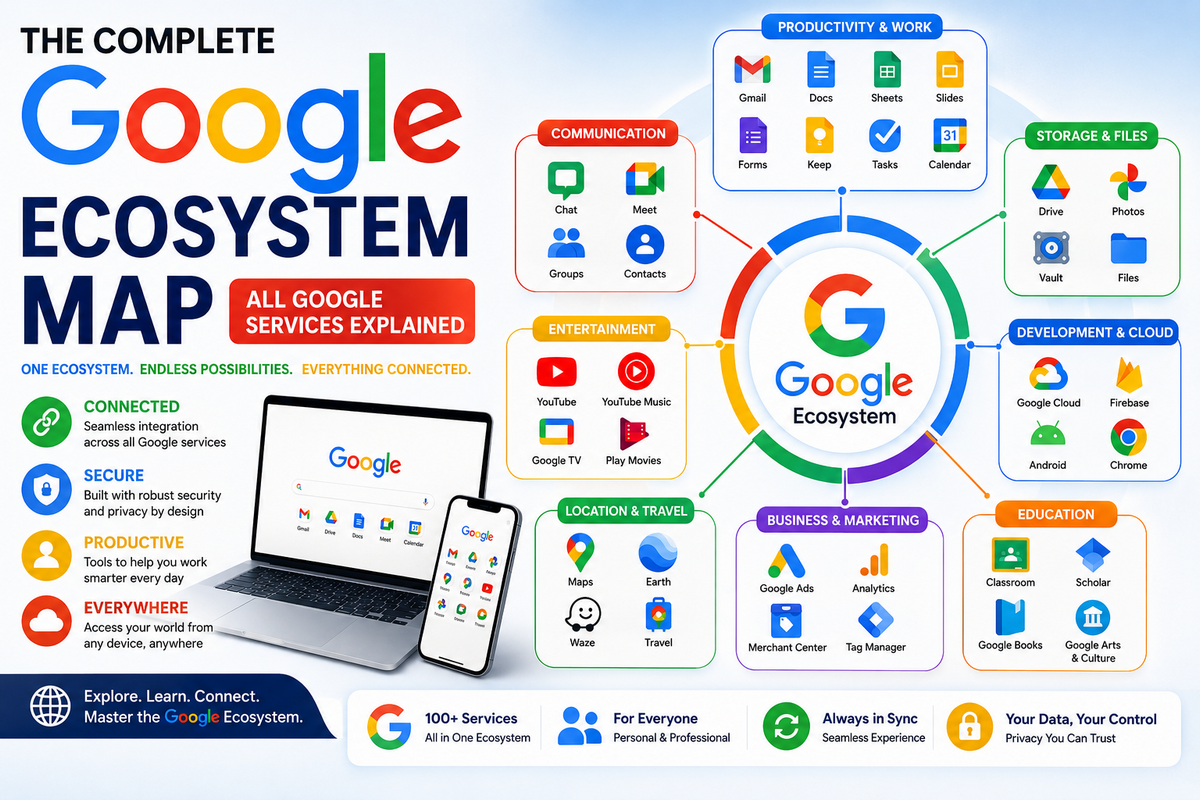
The Google ecosystem is an extensive network of interconnected products, services, and platforms. It is designed to make our digital lives smarter, faster, and more efficient.
Google began as a basic search engine in 1998. It has since developed into an AI-driven ecosystem. This ecosystem influences nearly every aspect of online activity—from search and communication to cloud computing, business analytics, and smart devices.
At the heart of Google’s success is the seamless integration among its services. Whether you’re using Gmail, Google Drive, or Google Maps, every interaction benefits from shared data.
Intelligent personalization and advanced artificial intelligence tools, like Gemini (formerly Bard), also enhance these interactions. This synergy allows users to move effortlessly across devices and services, enhancing productivity, collaboration, and convenience.
By 2026, the Google ecosystem extends well beyond web search, encompassing AI, cloud technology, advertising platforms, and smart home devices. Understanding how these components interconnect empowers individuals, creators, and businesses to unlock new levels of efficiency and growth.
Why the Google Ecosystem Matters in 2026
In 2026, the Google ecosystem stands at the forefront of digital innovation, shaping how we work, learn, and interact. The integration of AI, led by Gemini, has made Google’s tools more intelligent and personalized than ever before.
Every product—from Search to Workspace and Cloud—works in harmony to provide unified, seamless experiences across all devices and platforms.
For individuals, this means quicker access to relevant information and smarter productivity solutions. For businesses, it translates into powerful analytics, advanced advertising capabilities, and scalable cloud infrastructure. The tightly interconnected design of Google’s services ensures most digital activities can be handled within one secure, data-driven environment.
As technology advances, Google’s ecosystem distinguishes itself with its focus on AI. It also emphasizes robust security and an outstanding user experience. This focus solidifies Google’s role as an indispensable part of daily life and business in the digital age.
The Core Pillars of the Google Ecosystem?
The Google ecosystem is anchored by seven core pillars. These pillars intertwine to cover every facet of our digital lives.
They range from search and productivity to cloud computing, consumer AI, media, and smart devices. Each pillar has a unique role but collectively delivers a seamless, integrated user experience.
In 2026, Google’s ecosystem is an AI‑first platform, with Gemini woven through Search, Workspace, Android, Chrome, Maps, Photos, YouTube, and Google Cloud.
Gemini now acts as the connective and agentic layer across Google’s ecosystem, helping people search, write, plan, summarize, and automate tasks in apps like Search, Docs, Sheets, Gmail, Meet, and more.
| Category | Products |
|---|---|
| Core identity and accounts | Google Account, Google One, and Family Link cloud. |
| Consumer AI | Gemini app, Gemini in Chrome, Gemini in Drive, Gemini in Gmail, Gemini in Workspace |
| Search and discovery | Google Search, AI Overviews, generative search experiences, Maps, Waze, Shopping |
| Productivity | Gmail, Calendar, Docs, Sheets, Slides, Meet, Drive, Workspace Studio |
| Devices and platforms | Android, ChromeOS, Android for PC direction, Pixel, Wear OS, Android Auto, Android XR |
| Media and entertainment | YouTube, Google Photos, Google TV |
| Cloud and developer stack | Google Cloud, Vertex AI, Gemini API, Workspace MCP server, and Play Services Cloud. |
1. Core identity and accounts
This pillar covers your main Google login, storage, and family controls. It keeps your data, subscriptions, and security settings connected across all Google services.
1. Google Account
Google Account is the central identity layer that connects all Google services, from Gmail and YouTube to Android, Chrome, and Workspace. It stores your profile, security settings, payment methods, and privacy controls, and is also the base for AI personalization in Gemini and Search.
2. Google One
Google One is Google’s paid storage and membership plan that expands Drive, Photos, and Gmail storage across all your devices. In 2026 it also bundles Gemini Advanced access for many regions, making it an easy way for consumers to upgrade both storage and AI features in one subscription.
3. Family Link
Family Link lets parents manage their children’s Google Accounts and Android devices with screen time limits, app approvals, and content restrictions. It ties into Google Play, YouTube, and Search to help families maintain safer experiences while still using the broader ecosystem.
2. Consumer AI
This is where Gemini lives—the AI tools that help you chat, write, summarize, and automate tasks inside apps like Chrome, Drive, Gmail, and Workspace.
1. Gemini App
The Gemini app is Google’s main consumer AI assistant, available on web and mobile, and designed to handle chat, multimodal inputs, and agentic tasks. Workspace plans include Gemini access by default in many regions, so personal and work accounts can use the same AI for writing, planning, and analysis.
2. Gemini in Chrome
Gemini in Chrome brings AI assistance directly into the browser, helping users summarize pages, generate content, and perform tasks without leaving the tab. As of 2026 it is rolling out to more languages and markets, becoming a key part of Google’s AI-first browsing experience.
3. Gemini in Drive
Gemini in Drive can search across documents, presentations, and spreadsheets, then summarize and surface relevant information from your files. Recent updates allow it to use Gmail as a source, so it can answer questions using both email threads and Drive documents with appropriate access controls.
4. Gemini in Gmail
Gemini in Gmail helps you draft, rewrite, and refine emails directly from the compose box. The June 2026 feature drops focus on improving draft quality and context awareness, making suggestions that better reflect earlier threads and attached documents
5. Gemini in Workspace
Gemini in Drive can search across documents, presentations, and spreadsheets, then summarize and surface relevant information from your files. Recent updates allow it to use Gmail as a source, so it can answer questions using both email threads and Drive documents with appropriate access controls.
3. Search and discovery
These products help you find information, places, and things to buy. Google Search, AI Overviews, Maps, Waze, and Shopping work together to answer questions and guide you in the real world.
1. Google Search
The core of Google’s ecosystem, Google Search powers billions of daily queries. It combines web, image, and video results with AI-driven relevance to deliver the most accurate and helpful information instantly.

2. AI Overviews
AI Overviews are generative summaries at the top of search results that synthesize information from multiple sources into a single, structured answer. They cover a growing range of tasks, including local experiences, services, and how‑to queries, and are becoming a key SEO target for publishers.
3. Search Generative Experiences
Beyond AI Overviews, Google is rolling out broader generative search experiences that help users compare options, plan trips, and explore topics in richer interfaces. These experiences often mix text, links, and interactive modules, aiming to reduce the number of separate searches needed for a complex task.

4. Maps
Google Maps continues to be the main navigation and local discovery app, now enhanced with more AI-powered suggestions and immersive views. In 2026, Google is expanding features that help users understand neighborhoods, services, and routes with richer visual and contextual information.

5. Waze
Waze remains focused on crowdsourced driving information, offering real-time traffic updates, hazards, and routing based on community input. It complements Maps for drivers who want more granular, incident-based guidance while still being part of Google’s broader location stack.

6. Google Shopping
Google Shopping surfaces product listings, prices, and reviews from across the web inside Search and dedicated Shopping interfaces. Generative capabilities are increasingly used to compare products and highlight key differences, helping users make faster purchase decisions.
4. Productivity
Gmail, Calendar, Docs, Sheets, Slides, Meet, Drive, and Workspace Studio help you communicate, organize, and collaborate at work or school. With Gemini, they’re becoming smarter and more automated.
1. Gmail
Gmail is the central email service in Google’s ecosystem, integrated with Calendar, Drive, Meet, and Gemini. Recent AI features focus on smarter drafting, reply suggestions, and using email content as context for Gemini’s answers in Drive and Workspace.
2. Google Drive
Google Drive is the central cloud storage service for files, backing Docs, Sheets, Slides, and other formats. With Gemini and improved search, Drive increasingly acts as a knowledge base where users can ask questions and get synthesized answers from their own content.
3. Google Docs
Google Docs is the collaborative word processor in Workspace. With Gemini, Docs can now help you outline, draft, and rewrite content, as well as summarize long documents and extract key action items.

4. Google Sheets
Google Sheets is the cloud spreadsheet tool used for data, budgets, and analysis. Gemini in Sheets can generate formulas, fix errors, and create dashboards or visualizations, making complex data work more approachable.

5. Google Slides
Google Slides powers presentations across business and education. Gemini can draft slide outlines, suggest visuals, and convert documents into slide decks, speeding up the process of turning ideas into presentations.
6. Google Meet
Google Meet handles video meetings integrated with Calendar and Gmail. AI features now help with automatic note-taking, summaries, and action item extraction, so teams can review meetings more efficiently even if they couldn’t attend live.

7. Google Calendar
Google Calendar helps schedule meetings, events, and reminders, with deep integration into Gmail, Meet, and Android notifications. AI enhancements support automatic time suggestions, smarter event descriptions, and better coordination across teams using Workspace.

8. Google Forms
A versatile survey and form builder, Google Forms helps collect feedback. It conducts quizzes and analyzes responses automatically through linked Google Sheets.
5. Devices and platforms
Android, ChromeOS, Pixel, Wear OS, Android Auto, and Android XR are the operating systems and hardware that run Google software. They bring Google’s apps and AI features to phones, laptops, cars, wearables, and future XR devices.

1. Android
Android remains Google’s primary mobile operating system, powering phones, tablets, and many wearables. Gemini and Google services are deeply integrated into Android, from system-level search and suggestions to direct access to Workspace and consumer AI features.

2. ChromeOS / Android for PC direction
ChromeOS is Google’s lightweight laptop operating system, closely tied to Chrome and Workspace. In 2026 Google is pushing a more unified AI-first direction across Android and ChromeOS to bring Gemini and Workspace capabilities consistently to PCs and laptops.
3. Google Pixel
Pixel devices are Google’s flagship phones and hardware, designed to showcase the latest Android and AI features. Recent generations emphasize on‑device intelligence, better camera processing with AI, and tight integration with Gemini and Google Photos.

4. Wear OS
Wear OS powers Google’s and partners’ smartwatches, integrating notifications, health tracking, and Assistant-style interactions. It connects closely to Android phones and Google services, ensuring that calendar events, map directions, and health insights are available on the wrist.
5. Android Auto
Android Auto brings Android apps and services to car displays, focusing on navigation, media, and communication. Google is gradually adding more Meet and voice features, aligning in‑car experiences with the broader AI and productivity ecosystem.

6. Android XR
Android XR is Google’s extended reality platform aimed at powering future smart glasses and immersive devices. It connects to Gemini and other services to support hands‑free, context-aware experiences built around the user’s environment.
6. Media and entertainment
YouTube, Google Photos, and Google TV let you watch, create, and organize media. They connect search, recommendations, and cloud storage so you can easily discover and enjoy content.

1. YouTube
YouTube is the primary video platform in Google’s ecosystem, spanning entertainment, education, and creator content. AI is increasingly used for features like automatic chapters, recommendations, and creative tools, while Gemini and other models support new creation workflows.
2. Google Photos
Google Photos stores and organizes images and videos, offering powerful search and automatic albums. AI enhancements include better face recognition, object search, and editing tools, helping users find and enhance memories across devices.

3. Google TV
Google TV organizes streaming apps, live TV, and recommendations into a single interface on supported devices. It uses Google’s recommendation systems and search to surface relevant shows and films, tying media consumption back to the broader Google Account and device ecosystem
7. Cloud and developer stack
Google Cloud, Vertex AI, Gemini API, Workspace MCP server, and Play services power the backend for businesses and developers. They provide infrastructure and AI tools to build apps and connect external software to Google’s ecosystem.
1. Google Cloud
Google Cloud is Google’s enterprise infrastructure and platform services offering compute, storage, databases, and managed AI. It provides access to Vertex AI and Gemini models, enabling businesses to build custom AI applications that connect to Workspace and other Google services.
2. Vertex AI
Vertex AI is the managed AI platform within Google Cloud for training, tuning, and deploying models. In 2026 it offers access to Gemini models, evaluation tools, and pipelines so enterprises can embed advanced AI into their products and workflows.
3. Gemini API
The Gemini API exposes Gemini models to developers via Google Cloud and Google AI Studio. It supports text, code, image, and multimodal use cases, making it easier to add conversational and agentic capabilities to apps without building models from scratch.
4. Workspace MCP server
The Google Workspace MCP server allows AI agents to securely interact with Gmail, Drive, Calendar, Chat, and People data via the Model Context Protocol. This creates a bridge between external AI tools and Workspace, enabling more powerful automations while respecting admin controls and data policies.
5. Play services
Google Play services provide core APIs for Android apps, including location, sign‑in, updates, and safety features. They tie third‑party apps into key Google capabilities, helping developers leverage the wider ecosystem on Android devices.
How Google Integrates AI Across Its Ecosystem (2026 Edition)
Artificial Intelligence (AI) is now the foundation of the Google ecosystem, connecting almost every product, platform, and service into one intelligent, agentic network. Google’s AI tools like Gemini, Vertex AI, and Google Cloud’s Gemini Enterprise platform make search, work, and everyday interaction smarter and faster. Below is a clear point‑by‑point look at how AI powers Google’s ecosystem in 2026.
1. Gemini AI across Google products
Gemini is Google’s flagship generative AI, now embedded directly into Workspace apps like Gmail, Docs, Sheets, Slides, Drive, Meet, Chat, and Vids, as well as the standalone Gemini app and Search. It helps users write, summarize, analyze data, create presentations, and answer questions using natural language, often with direct context from emails, documents, and calendars. This deep integration turns Workspace tools into conversational, context‑aware assistants instead of separate static apps.
2. AI in Google Search and Lens
AI models power new experiences in Google Search, including AI Overviews and emerging “information agents” that monitor topics and surface relevant updates. Search uses Gemini to better understand questions, build richer generative summaries, and even generate custom layouts and dashboards for complex queries. Google Lens applies visual AI to recognize objects, translate text, and connect the physical world to online information in real time.
3. Google Assistant and agentic experiences
Google Assistant still provides voice‑based help on phones, smart speakers, Wear OS watches, and Nest devices, handling tasks like reminders, controls, and quick answers. At the same time, Google is shifting toward Gemini‑powered “agents” that can run background tasks, coordinate across apps, and offer more proactive, cross‑product assistance.
4. AI‑powered productivity in Google Workspace
Across Workspace, Gemini adds AI drafting, rewriting, data analysis, and meeting assistance. It can generate emails, fix formulas, create tables and charts in Sheets, build slide decks, find information in Drive, and capture meeting notes and summaries in Meet automatically. For many Workspace plans in 2026, these Gemini features are included by default, making AI a core part of everyday collaboration.
5. AI for developers: Gemini APIs, Vertex AI, and Firebase
Developers can access Gemini models through the Gemini API and via Vertex AI on Google Cloud, using a unified GenAI SDK to prototype and then scale apps. Vertex AI (and its evolution into Gemini‑branded enterprise platforms) provides tools to build, tune, and deploy AI agents and models at scale, while Firebase adds analytics, messaging, and performance monitoring that increasingly use machine learning signals.
6. AI in cloud computing and data analytics
Google Cloud Platform services like BigQuery and Cloud Storage work closely with Vertex AI and Gemini to analyze large datasets and power data‑driven applications. Enterprises use these AI capabilities to automate operations, detect threats, personalize services, and integrate AI agents into existing workflows.
7. Personalized advertising and recommendations
Machine learning remains central to Google Ads, AdSense, YouTube recommendations, and shopping results. AI optimizes ad targeting and delivery, improves click‑through rates, and surfaces more relevant videos, products, and content based on user behavior and context.cloud.
8. AI on Android, ChromeOS, and Pixel devices
On Android and Pixel hardware, AI powers context. like call screening, live translation, magic eraser, and on‑device suggestions. Chrome and ChromeOS use AI to assist with writing, summarizing pages, enhancing security, and optimizing performance, increasingly via Gemini in Chrome and cloud‑backed protections.
9. Continuous learning and adaptation
Google’s AI systems continually learn from interactions (within privacy and policy limits) to improve predictions, personalization, and agent behavior. This makes the ecosystem more dynamic, allowing Gemini‑powered experiences in Search, Workspace, Android, and Cloud to adapt to user needs over time
The Future of the Google Ecosystem
The future of the Google ecosystem is smarter, more connected, and deeply powered by artificial intelligence. In 2026 and beyond, Google is shaping an AI‑native, “agentic” ecosystem where products like Search, Workspace, Android, Chrome, and Cloud are tied together by Gemini and AI agents that can act on your behalf. The goal is for these experiences to feel seamless across devices and contexts, rather than separate apps.
Google’s focus is shifting toward personalization and automation through Gemini‑powered agents that run in the background.
Gemini is evolving from a chatbot into an intelligence layer and central assistant across platforms, helping people plan, research, write, summarize, and complete multi‑step tasks under their direction.
For businesses, Google Cloud and the Gemini Enterprise Agent Platform are becoming core AI infrastructure, combining scalable computing, security, and predictive analytics to help organizations build and manage thousands of agents and data‑driven workflows globally.
We’ll also see more innovation in sustainability and open‑source technology. Google continues investing in energy‑efficient, low‑carbon data centers and AI‑driven optimization tools that help organizations reduce their environmental footprint.
At the same time, deeper integration of AI with smart devices, wearables, and voice‑enabled interfaces aims to make digital experiences more natural, context‑aware, and personalized across everyday life.
In short, the future of the Google ecosystem is about creating an intelligent digital world where AI agents work alongside people. Technology will increasingly learn, adapt, and take action across Search, workspace, Android, and Cloud to simplify work, enhance security, and improve everyday experiences for individuals and businesses alike.
FAQs About the Google Ecosystem
What is the Google ecosystem?
The Google ecosystem is a collection of connected products and services. These include Search, Gmail, YouTube, Android, and Google Cloud. They work together to make everyday digital tasks easier and more efficient.
How many Google services are active in 2026?
As of 2026, Google has over 100 active products and services. These include popular ones such as Google Search, Gemini AI, Google Maps, Workspace, YouTube, and Google Cloud Platform (GCP).
How does Google use AI in its ecosystem?
Google uses AI and machine learning through Gemini, Vertex AI, and Google Assistant to improve search results. They automate workflows. They also analyze data and personalize user experiences across all devices and platforms.
What are the main benefits of using the Google ecosystem for business?
Businesses benefit from productivity tools (Workspace), data insights (Analytics), marketing platforms (Ads and AdSense), and cloud services (GCP). Together, they help improve visibility, security, and overall business growth.
Why is the Google ecosystem important in 2026?
The Google ecosystem is essential because it connects all digital tools under one intelligent, AI-powered framework. It simplifies work, boosts online performance, and helps users and businesses stay secure, productive, and competitive in the digital world.
Final words on the Google Ecosystem
The Google ecosystem in 2026 stands as one of the most powerful and connected digital environments in the world. It combines a wide range of tools, features, and services. These help users, developers, and businesses work smarter. They also allow them to work faster and more securely. From Google Search, Gemini AI, and Workspace to Cloud, YouTube, and Android, each service aims to enhance performance. It boosts security and improves productivity with just a few clicks.
Google is unique because it combines AI-powered tools, customizable features, and responsive designs. This combination creates seamless experiences across platforms. Whether you’re building websites or managing WooCommerce stores, Google’s ecosystem supports you. It helps with improving SEO and running online shops. These tools provide everything to boost conversion, ranking, and visibility.
For developers, platforms like Firebase, Vertex AI, and BigQuery offer scalable solutions. Marketers benefit from Google Ads, AdSense, and Analytics. These tools help them grow their audience and elevate brand performance. Businesses gain from Google My Business optimization, local SEO, and content marketing support powered by AI and data.
The Google ecosystem is not just a collection of products—it’s a living network that continues to evolve. By using the right combination of features, tools, and services, users can enhance their connection, design, and performance security. They can also build a stronger digital presence.
In essence, the Google ecosystem helps you grow your brand. It allows you to connect with customers. You can unlock endless opportunities, all within one powerful, AI-driven framework built for the future.