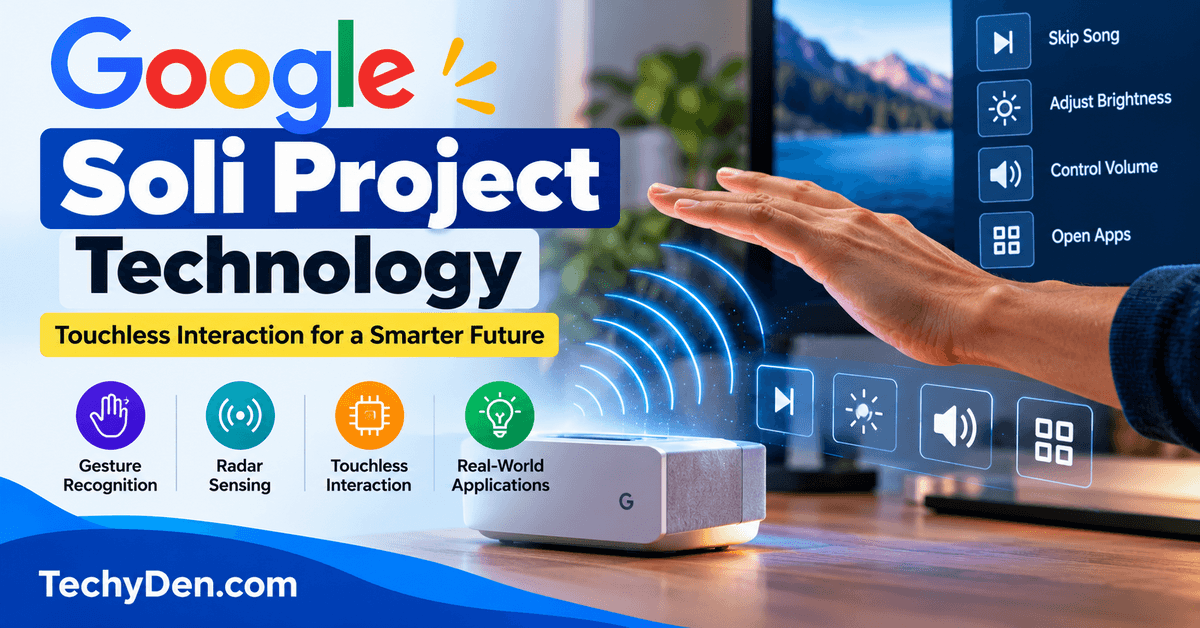
Imagine controlling a device without touching a screen, pressing a button, or speaking a voice command. What once sounded like a concept from a science-fiction movie is becoming possible through advanced sensing technologies such as Google Soli Project Technology.
As technology becomes more intelligent, AI productivity tools are increasingly useful for automating routine tasks and improving workflows.
What is Google Soli Project Technology?
Google Soli is a miniature radar-based sensing technology developed by Google’s Advanced Technology and Projects (ATAP) team. Instead of relying on cameras to visually track hand movements, Soli uses radio waves to detect motion, gestures, and proximity around a device. Machine-learning algorithms can then interpret the radar data to recognize specific movements and translate them into interactions.

Google introduced Project Soli in 2015 as an experimental approach to creating a new form of human-computer interaction. The technology later moved beyond prototypes and was integrated into consumer products. The Google Pixel 4, for example, used Soli-powered Motion Sense to recognize gestures such as waving a hand to skip songs, snooze alarms, and silence calls. Soli has also been used in Google Nest devices for features such as Quick Gestures and Sleep Sensing.
The technology is interesting because it does not require a camera to understand many types of motion. Soli sensors transmit radio signals and analyze the signals that bounce back from objects and movements. This allows the system to detect changes in position and motion, while machine-learning models help distinguish intentional human gestures from other movements.
Google’s research around Soli has also expanded beyond simple hand gestures. The ATAP team has explored how radar can help computers understand presence, proximity, body language, orientation, and other nonverbal cues. This research is connected to Google’s broader vision of ambient computing, where devices can respond more naturally to what people are doing instead of requiring explicit commands for every interaction.
How Google Soli Technology Works
At the heart of Soli is a small radar sensor containing antennas that transmit and receive radio signals. When those signals interact with a person’s hand or body, the reflected signals contain information about movement. Software and machine-learning models analyze this information to determine what type of motion has occurred.
This approach enables touchless interaction with compatible devices. Instead of physically touching a screen, a user can perform a predefined gesture to trigger an action. This can be particularly useful when touching a device is inconvenient, such as while cooking, exercising, driving, or interacting with a smart display from a short distance.
Soli has already demonstrated practical applications in smartphones and smart-home devices. On the second-generation Google Nest Hub, for example, Soli’s low-energy radar supports Sleep Sensing by detecting movement and breathing without using a camera or requiring a wearable device.
Why Google Soli Is Important
The significance of Soli is not simply that it allows users to wave at a device. Its larger potential lies in creating more natural and context-aware human-computer interaction.
Traditional interfaces generally require users to touch a screen, move a mouse, press a button, or speak a command. Soli explores another possibility: devices can sense what is happening around them and respond to subtle physical interactions.
Google’s ATAP researchers have described this direction as a way for computers to develop a form of “social intelligence” by understanding nonverbal cues such as proximity, orientation, and movement. This could eventually contribute to more intuitive ambient-computing experiences across smart-home devices, wearables, automotive systems, accessibility technologies, and other connected products.
The concept also connects with the broader evolution of virtual reality and touchless interfaces. Similar technologies can potentially make digital systems easier to operate when conventional touch-based controls are impractical.
From Project Soli to Real-World Applications
Project Soli is no longer simply an experimental concept. Google has demonstrated its technology in several consumer products and research projects. Pixel 4 used Soli for Motion Sense and proximity detection, while the second-generation Nest Hub used Soli radar for Quick Gestures and Sleep Sensing.
Google has also explored Soli in creative and experimental projects, including installations where miniature radar was used to capture human movement and translate interactions into digital experiences.
For users interested in related technologies, Google’s work on Soli can also be viewed alongside developments in virtual reality, smart devices, AI, machine learning, and touchless computing. These technologies are gradually changing how people interact with computers and connected devices.
The original vision of Google Soli was ambitious: make technology respond to subtle human movements instead of requiring physical contact. Although not every experimental Soli concept has become a mainstream product, the technology has demonstrated that miniature radar and machine learning can provide a powerful alternative to traditional touch and camera-based interaction.
Google Soli Project Technology therefore represents an important step toward more natural human-computer interaction, where devices can sense movement, understand context, and respond with less physical effort from the user.
Creating a Wireless Bond Between Man and Machine
The concept of Soli Technology emerged from a long-running research project into gesture identification. Gestures play a significant part in human interaction, and if human gestures can control the devices, it will be a revolutionary change in human life.
The human being will become a miraculous magician using his magic hand, which knows Soli Technology. Soli Technology uses a tiny radar device for detecting touchless and virtual gesture identification.
We can use this technology in mobile phones, automobiles, devices for the Internet of Things, and wearable devices. After having complete nourishment and nurture, Soli technology will have the capacity to identify about 3000 movements per second. This project is being undertaken jointly by Google and Infineon. The chip used for Soli technology devices will have an amalgamation of software and hardware that enables a perceptive user interface.
How Does Project Soli Technology Work?
In this Soli Technology, the chip monitors the movement of the hand as a kind of kinetic energy transducer in the electrical signals. Then the electrical signal responds in time and amplitude as per the movements of the hands.
The primary objective of Google’s ATAP’s Soli Project is to utilize radar technology to analyze the gestures of the human hand to issue commands and control electronic devices using Soli Technology.
Sensor equipment works by discharging electromagnetic impressions in a broad beam. The substances inside the shaft diffuse a level of energy, such as redirecting a small part in the direction of the radar aerial.
- Best Virtual reality headsets in India 2025 (VR Headsets)
- 7 Best Wi-fi range extenders in India below 2500 Rupees
The properties of the reflected signal, such as energy and delay time, provide statistics on the dynamism of the actions, including shape, orientation, size, shape, etc. Soli recognizes the dynamic gestures expressed by the fingers and hand movements and can distinguish them within his field of action.
Google’s Soli Project
Google’s ATAP’s Soli Project is working to control the devices using an imaginary or visualized switch between the thumb and the index finger or by grabbing a virtual slider in thin air. Even though these controls are not physical, Soli technology can percept the human movement, decode the information, and act as per the pre-programmed perceptive user interface.
Soli tracks and makes out dynamic movements expressed by minor indications of the fingers and hand. To achieve this facility, Google and Infineon developed an innovative radar sensing prototype with custom-made hardware, software, and a set of rules.
Soli does not need broad bandwidth and high spatial resolution like old-fashioned radar sensors. The devices using Soli have no moving parts. Soli fits onto a chip and uses little energy, and light conditions do not influence it, and it works through most materials.
Frequently Answered Questions (FAQs)
What is the Google Project Soli?
The Google Project Soli is a miniature radar chip, which is used in the new generation of smartwatches. It can measure movements and gestures of the hand with an accuracy of 1/100th of a millimeter.
Google has been working on this project for many years now, and it has finally come to fruition in 2016 with the release of this technology. The company claims that it will be able to detect a gesture as small as lifting your finger off the surface or rotating your wrist.
What does Google Project Soli do?
Google Project Soli is a hardware platform that uses radar to detect gestures and movement, without the need for touch or any other external sensors. It can be used in wearable devices, smart home appliances, and more. This technology is being developed by Google’s Advanced Technology and Projects group (ATAP).
How does Google Project Soli work?
Google Project Soli is a new technology from Google that will be able to detect gestures and other movements in midair. This is accomplished through the use of radar that can detect the motion of a finger. With this technology, you can use your hands to control your phone, or even interact with virtual objects.
Is Google Project Soli a wearable device?
Google’s Project Soli is a new type of wearable device that uses radar to detect movements. It’s a small chip that is embedded in the device and it can detect hand gestures and motions. The Project Soli chip is about the size of a penny, which means that it can be embedded in any wearable device. This includes watches, rings, or even clothing. In order for this technology to work, there needs to be a sensor-equipped surface nearby – like a table or desk. This surface will make up what Google calls the “sensing area” and will allow the radar to pick up on your hand movements.
What are the benefits of using Google Project Soli?
Google Project Soli is a type of radar technology that has been developed by Google. It can detect the smallest of movements, which in turn makes it possible for users to interact with devices without touching them. This technology is not meant to replace touch screens and keyboards but instead, it will help improve the way we interact with these devices.
The benefits of using Google Project Soli are:
1. It will make our interactions with devices more natural and intuitive.
2. It can be used in various fields such as gaming, healthcare, robotics and many more.
3. It has a variety of functionalities such as gesture control and object recognition.
What is the significance of Google Soli Project?
The Google Soli Project is a gesture-sensing device that can help people with limited mobility to control everyday tasks like opening a jar or turning on the lights.
What are the limitations of Google project soli?
Project Soli, developed by Google, is a cutting-edge technology that allows users to interact with items in the real world without having to touch them. Initiative Soli is a Google project that attempts to use radar to create new methods of engagement. It tracks hand movements and gestures using a radar sensor and machine learning algorithms, allowing users to interact with gadgets like as smartphones and watches without having to touch them. The technology’s disadvantages are that it requires extensive training before it can be used successfully, as well as a pricey gadget that only works on specified materials such as plastic or glass.
Final Words on Google Soli Project
The Google Soli Project Technology represents an important step toward more natural and intelligent human-computer interaction. By using miniature radar sensing and machine learning to understand movement, proximity, and gestures, Soli demonstrates how devices can respond to users without always requiring physical touch.
Although the original vision of Soli was highly experimental, the technology has already been applied to products such as Pixel smartphones and Google Nest devices. These applications demonstrate the practical potential of radar-based sensing for touchless controls, smart-home interactions, presence detection, and health-related sensing.
At the same time, Soli also highlights an important reality of technological innovation. New interaction methods can create opportunities while introducing questions about privacy, accuracy, reliability, accessibility, energy consumption, and how much information devices should be allowed to sense about their surroundings.
The future of Soli and similar sensing technologies will depend on how effectively they balance convenience with privacy, usability, security, and responsible technology design. As artificial intelligence and sensing technologies continue to develop, touchless and context-aware interfaces could become a more important part of the way we interact with computers and smart devices.
Google Soli may not have transformed every aspect of computing as originally imagined, but its research and real-world applications have demonstrated the potential of miniature radar to give machines a better understanding of human movement and context. That makes Google Soli Project Technology an important development in the continuing evolution of human-computer interaction.