Gemini 3.1 Pro Review 2026: The Smartest AI Model Ever Built?
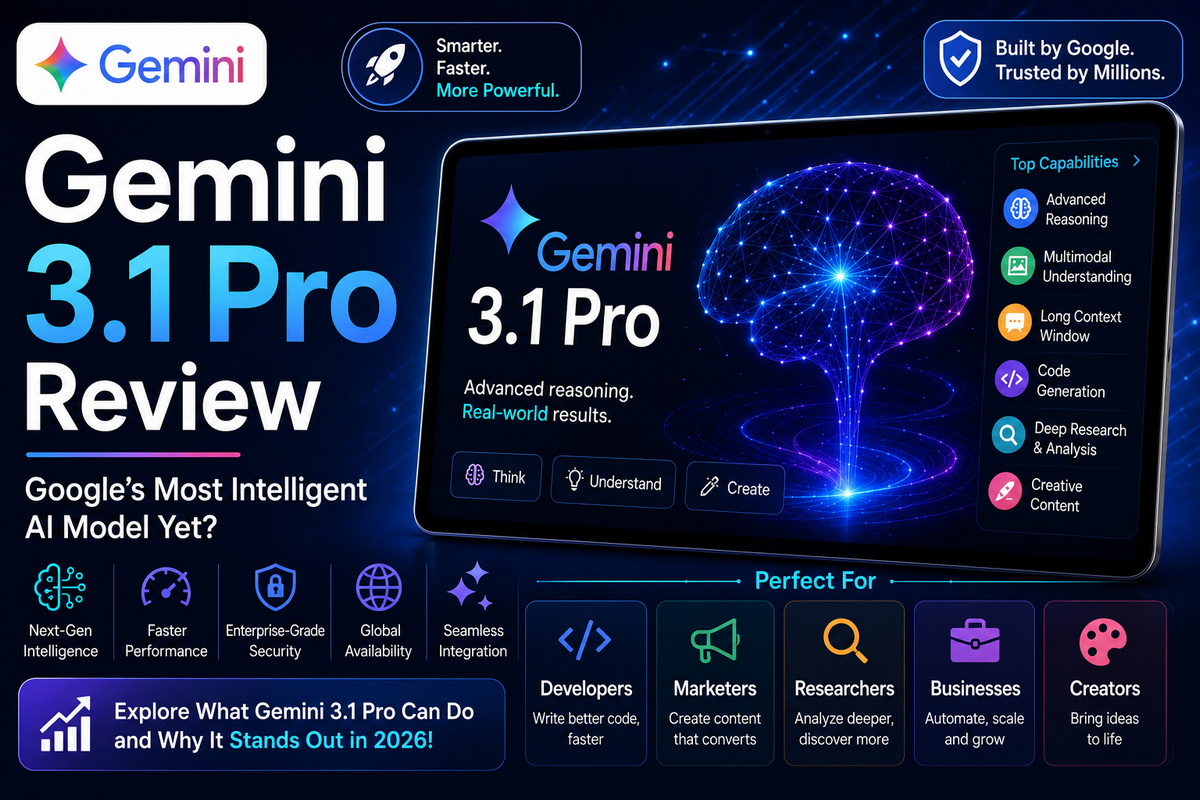
Google made a bold move on February 19, 2026, releasing Gemini 3.1 Pro—a model that doesn’t just push the envelope; it rewrites it.
With a jaw-dropping +148% improvement in abstract reasoning, a 2-million-token context window, and the highest GPQA Diamond score ever recorded, Gemini 3.1 Pro has genuinely shaken up the AI leaderboard.
But benchmark glory doesn’t always translate to real-world dominance. In this detailed review, we break down everything—features, benchmarks, real-world performance, pricing, and an honest head-to-head against GPT-5.6 and Claude Opus 4.6.
What Is Gemini 3.1 Pro?
Gemini 3.1 Pro is Google’s current flagship reasoning model for 2026, designed for complex analysis, long-context work, coding, and multi-step agentic tasks.
Google positions it as a major upgrade in reasoning quality and tool-use reliability, with wider access across consumer and developer products.
According to Google’s official model card, Gemini 3.1 Pro is built to “comprehend vast datasets and challenging problems from massively multimodal information sources, including text, audio, images, and video.”
Gemini 3.1 Pro is available through the Gemini app, Google AI Studio, Gemini CLI, Android Studio, Vertex AI, Gemini Enterprise, and NotebookLM, depending on your plan or developer access.
Google AI Pro and Ultra users get expanded access and higher limits, and Google continues to roll the model out across its ecosystem.
At a glance:
- Gemini 3.1 Pro is best for deep reasoning, coding, research, long-document analysis, and agentic workflows.
- It is especially useful when you need a model that can hold a lot of context and work through multi-step tasks with fewer handoffs
- Available across the Gemini app, Google AI Studio, Gemini CLI, Android Studio, Vertex AI, Gemini Enterprise, and NotebookLM.
- Commonly reported with a 1M-token context window, with some 2026 guides describing extended 2M-context configurations on certain platforms.
- Google reports a verified 77.1% ARC-AGI-2 score.
- Pricing is generally reported in the $2 to $3.50 input and $10 to $12 output range per 1M tokens
Gemini 3.1 Pro: Core Features Explained
1. Biggest Context Window in the Industry
Gemini 3.1 Pro is widely reported with a 1M-token context window, which makes it well suited for long documents, codebases, and multi-step workflows.
Some 2026 guides also describe extended 2M-context configurations or previews on certain platforms, so the exact limit can vary by product surface and access tier.
GPT-5.6 offers a 1-million-token window, and Claude Opus 4.6 supports just 200,000 tokens, making Gemini 3.1 Pro the undisputed leader for long-context research and analysis workloads.
2. Native Four-Modality Support
Gemini 3.1 Pro is the only frontier AI model with true native multimodal support—handling text, images, audio, and video simultaneously within a single unified model.
GPT-5.6 handles text and images natively but does not support audio or video at the API level. For use cases like video analysis, audio transcription alongside text reasoning, or podcast-to-content workflows, Gemini 3.1 Pro is in a class of its own.
3. Expanded Thinking Modes
The model now supports three configurable thinking levels—Low, Medium, and High—allowing users and developers to precisely control the trade-off between reasoning depth, response speed, and API cost.
This is a major improvement over Gemini 3 Pro’s single-mode thinking and is directly comparable to OpenAI’s reasoning effort levels in GPT-5.6.
4. Output Truncation — Finally Fixed
One of the most criticized flaws in Gemini 3 Pro is that it tends to cut off long responses mid-generation. Gemini 3.1 Pro fixes that completely. In real-world developer testing, users reported generating responses that exceed 55,000 output tokens and 48,307 input tokens in a single run with zero truncation.
Output efficiency simultaneously improved by 15%, meaning more accurate results with fewer tokens used.
5. Agentic Performance Doubled
Gemini 3.1 Pro approximately doubles the agentic capabilities, i.e., the ability to plan independently, execute multi-step tasks, use tools, and self-correct, of Gemini 3 Pro.
It now beats GPT-5.2 and Claude on most agentic benchmarks. This makes it the model of choice for developers building autonomous AI workflows, coding agents, and production pipelines.
On Terminal-Bench 2.0, it increased from 68.5% to 80.1%, a phenomenal +11.6% improvement in real time command line agent performance.
6. Grounding with Google Search
Gemini 3.1 Pro is powered by real time Google Search, not static AI models that are grounded on static data; Gemini 3.1 Pro can ground answers in verified live data from the web. This is a huge reduction in AI hallucinations and makes it a lot more reliable for factual content creation, research and journalistic applications.
Benchmark Results: Numbers That Matter
The benchmark performance of the Gemini 3.1 Pro is impressive and record-breaking in several categories .
Gemini 3.1 Pro scored 77.1% on ARC-AGI-2, a verified result that more than doubles the earlier Gemini 3 Pro score on that benchmark, according to Google.
| Benchmark | Gemini 3 Pro | Gemini 3.1 Pro | Change |
|---|---|---|---|
| ARC-AGI-2 (Abstract Reasoning) | ~31% | 77.1% | +148% 🔥 |
| GPQA Diamond (Grad-Level Science) | ~87% | 94.3% | Highest Ever Recorded |
| SWE-Bench Verified (Software Engineering) | ~68.5% | 80.6% | +18% |
| Terminal-Bench 2.0 (CLI Agent) | 68.5% | 80.1% | +11.6% |
| MRCR v2 @ 128k (Long Context) | 77.0% | 84.9% | +7.9% |
| Context Window | 1M tokens | 2M tokens | 2x larger |
| Output Token Limit | ~32K | 65K | 2x larger |
| Processing Speed | ~110 tok/sec | 133 tok/sec | +21% faster |
Independent 2026 summaries also place it around 80.6% on SWE-bench Verified and about 94.1% to 94.3% on GPQA Diamond, making it one of the strongest reasoning and coding models of 2026.
GPQA Diamond scores 94.3% on this graduate-level science benchmark, the highest score ever reported on this dataset, beating GPT-5.6 (92.8%) and every version of Claude.
Gemini 3.1 Pro vs. GPT-5.6 vs. Claude Opus 4.6
| Feature | Gemini 3.1 Pro | GPT‑5.6 (Sol/Terra)* | Claude Opus 4.8 |
|---|---|---|---|
| ARC‑AGI‑2 | 77.1% | High 70s–low 80s on internal/third‑party reports (varies by variant) | Around the mid‑70s in public 2026 summaries (varies by test) |
| GPQA Diamond | ~94.1–94.3% | Low‑to‑mid 90s (close but slightly behind on some reports) | Low‑90s range in many 2026 comparisons |
| SWE‑Bench Verified | ~80.6% (reported) | High 70s–low 80s depending on variant and config | High‑70s on recent SWE‑bench Pro/coding tests |
| Terminal‑Bench 2.0 | High 60s–low 70s (developer reports) | Around 90%+ on some GPT‑5.6 Sol/Terra tests | Strong, but fewer public Terminal‑Bench 2.0 numbers |
| Context Window | Commonly 1M tokens, with some 2M‑context configs reported locally | Typically 128K–272K, with some long‑context tiers approaching 1M | 1M‑token context window on the recent Opus releases platform. |
| Output Speed | Competitive; optimized for long, structured outputs | Very fast in medium and high reasoning modes | Strong but slightly behind GPT‑5.6 on some speed‑focused tests |
| Output Token Limit | Up to ~65K per response (reported) | 32K–64K typical, depending on model and plan | Up to ~128K in some Opus 4.8 configs |
| Native Video Input | ✅ (multimodal: text, images, audio, video) | ✅ (Video handling varies by product surface.) | ✅ (image/video understanding via the Claude Vision) platform. |
| Native Audio Input | ✅ | ✅ | ✅ platform. |
| Computer Use / Desktop Agent | Emerging via Google’s agent tools (e.g., Antigravity) | ✅ Mature “computer use” and agent workflows in ChatGPT and tools | ✅ Strong agentic workflows via Claude Code and Cowork |
| Native Image Generation | Gemini image models, integrated via Gemini APIs | DALL‑E / GPT Image integrated in ChatGPT | No built‑in image generation (can call external tools) |
| API Price (Input / Output per 1M) | Roughly $2–$3.5 input / $10–$12 output (varies by tier/platform) | Often around $5 input / $20+ output for higher‑tier 5.x models | About $5 input / $25 output for Opus 4.8; higher for fast mode |
The Takeaway:
- Choose Gemini 3.1 Pro if you prioritize deep reasoning, long‑context research, scientific and technical analysis, and multimodal (text + images + audio + video) understanding, especially when you want tight integration with Google tools and a large context window.
- Choose GPT‑5.6 if you need fast, versatile agents, strong coding pipelines, and rich computer‑use / plugin workflows inside ChatGPT and its ecosystem, plus native image and video generation for creative work.
- Choose Claude Opus 4.8 if you want careful, structured planning, long‑form enterprise writing, and strong coding with 1M‑token context at a predictable price, especially alongside Claude Code and Cowork
Real-World Performance: Honest Developer Feedback
Beyond benchmarks, community feedback from the developer ecosystem paints a clear and nuanced picture. In a widely cited Day 1 Reddit review comparing Gemini 3.1 Pro against Claude Opus 4.6 and OpenAI Codex 5.3, developers noted that Gemini 3.1 Pro represents a “massive, massive improvement” over Gemini 3 Pro, which was widely criticized as a poorly performing model outside of benchmark conditions.
The new model now listens to system prompts reliably, avoids unnecessary verbosity in simple tasks, and handles complex code refactoring significantly more cleanly.
However, real-world testers also flagged one key weakness: when asked to produce detailed, comprehensive planning documents, Gemini 3.1 Pro still generates shorter plans (~2.5k tokens) compared to Claude Opus 4.6 (~25k tokens) for the same complex task.
For planning-heavy enterprise workflows, Claude still holds an edge.
DataCamp’s hands-on testing summarizes it best: “Gemini 3.1 Pro is the best model right now for abstract reasoning, scientific knowledge, and multimodal breadth.”
Pricing & Access: How to Get Gemini 3.1 Pro
Gemini 3.1 Pro pricing is commonly reported at around $2 to $3.50 per 1M input tokens and $10 to $12 per 1M output tokens, depending on the platform and access tier. That places it in the mid-to-premium API range, but it remains competitive for high-context reasoning workloads.
| Plan | Gemini 3.1 Pro Access | Monthly Price |
|---|---|---|
| Free (Gemini App) | Limited access | $0 |
| Google AI Pro | Full access + Deep Research, NotebookLM | $19.99/month |
| Google AI Ultra | Full access + Deep Think 3.1, Veo 3.1, Project Mariner | $249.99/month |
| Gemini API (Developers) | Pay-per-use via AI Studio | $1.25 input / $5 output per 1M tokens |
| Vertex AI (Enterprise) | Full enterprise access | Custom pricing |
For developers and startups building AI-powered products, this pricing advantage alone is a compelling reason to switch.
Who Should Use Gemini 3.1 Pro?
Gemini 3.1 Pro is purpose-built for the following:
- Researchers & academics who need graduate-level scientific reasoning and massive multi-document analysis
- Software developers & AI engineers building agentic pipelines, multi-step coding agents, or production APIs
- SEO professionals & content bloggers leveraging deep research and AI-assisted long-form content creation
- Data scientists & analysts processing massive financial datasets, spreadsheets, or multi-source reports in one prompt
- Video & media content creators who need the only frontier AI with native video comprehension built in
- Startups & enterprises seeking the most capable frontier AI at the lowest per-token cost
Pros & Cons: The Honest Verdict
Pros
- Strong reasoning and long-context performance.
- Broad availability across Google products and developer tools.
- Competitive pricing for a flagship model.
- Excellent for coding, research, and agentic workflows.
Cons
- Pricing and exact context limits can vary by platform.
- Access may be limited depending on the plan or rollout stage.
- Like most frontier models, benchmark results do not guarantee performance on every real-world task
Frequently Asked Questions on Gemini 3.1 Pro Review
Is Gemini 3.1 Pro better than Gemini 3 Pro?
Yes. Google reports a major reasoning jump, including a verified 77.1% ARC-AGI-2 score, and multiple 2026 benchmark summaries show stronger performance than Gemini 3 Pro.
Where can I use Gemini 3.1 Pro?
You can use it in the Gemini app, Google AI Studio, Gemini CLI, Android Studio, Vertex AI, Gemini Enterprise, and NotebookLM, depending on your access tier.
Is Gemini 3.1 Pro good for coding?
You can use it in the Gemini app, Google AI Studio, Gemini CLI, Android Studio, Vertex AI, Gemini Enterprise, and NotebookLM, depending on your access tier.
Is Gemini 3.1 Pro good for coding?
Yes, the 2026 benchmark summaries place it around 80.6% on SWE-bench Verified, which makes it a strong choice for coding, debugging, and agentic development tasks.
What’s the context window?
Gemini 3.1 Pro is commonly reported at 1M tokens, with some 2026 guides describing extended 2M-context configurations on certain platforms.
Conclusion
Gemini 3.1 Pro stands out as Google’s strongest reasoning-focused model in 2026, especially for users who need long context windows, dependable multi-step thinking, and tight integration with Google’s broader AI ecosystem.
Its combination of high reasoning performance, strong coding ability, and broad product availability makes it one of the most capable options for serious professional use.
For researchers, coders, analysts, and teams working with large documents, technical workflows, or agent-style tasks, Gemini 3.1 Pro is a strong fit.
If your work depends on handling complex inputs at scale while staying inside Google’s tools, this is one of the best models to choose in 2026.
Source: Gemini 3.1 Pro: A smarter model for your most complex tasks