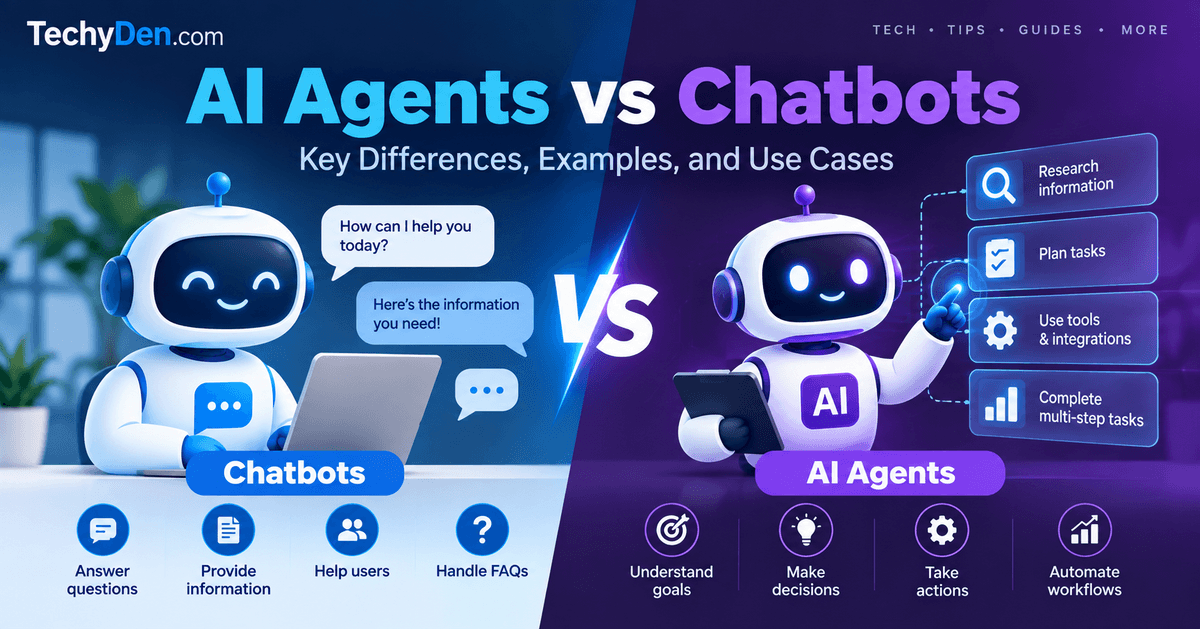
10 Best AI Agents for Bloggers and Content Creators in 2026

Creating high-quality content consistently is one of the biggest challenges for bloggers and content creators.
Finding profitable topics, researching keywords, writing articles, optimizing SEO, creating images, and promoting content can take several hours every day.
This is where AI agents can help.
The best AI agents for bloggers and content creators do more than generate text.
They can help plan content, perform research, create drafts, improve articles, manage repetitive tasks, and support publishing workflows.
Whether you run a WordPress blog, affiliate website, YouTube channel, newsletter, or social media brand, the right AI agent can save time and help you focus on creating valuable content.
In this guide, we will explore the best AI agents for bloggers and content creators in 2026, their features, advantages, limitations, and how to use them in a practical content creation workflow.
What Are AI Agents for Bloggers and Content Creators?
AI agents for bloggers and content creators are AI-powered tools that can perform one or more tasks in a content workflow with limited manual instructions.
Unlike traditional AI writing assistants that mainly respond to prompts, an AI agent can work through a sequence of tasks to achieve a goal.
For example, instead of asking an AI tool to write an article manually, you could give it a broader instruction:
Research the keyword “best free SEO tools,” create an SEO-friendly outline, draft a helpful article, suggest internal links, and prepare a WordPress publishing checklist.
Depending on the tool and its integrations, the agent may research information, organize the content, generate a draft, and prepare the next steps.
AI Writing Assistant vs AI Agent
| Feature | AI Writing Assistant | AI Agent |
|---|---|---|
| Main purpose | Generate or improve text. | Complete a multi-step task |
| User input | Usually individual prompts | A goal, instructions, or workflow |
| Research | May require manual prompting | Can perform research when tools are available |
| SEO optimization | Suggests improvements | Can combine research, optimization, and workflow tasks |
| Automation | Usually limited | Can automate connected tasks |
| Publishing | Often manual | May support connected CMS workflows |
| Human review | Recommended | Essential before important content is published |
Important: Not every AI writing tool is a fully autonomous agent. Some are AI assistants with agent-like features, while others can execute multi-step workflows. The tools below are selected for their usefulness in real blogging and content creation tasks.
Why Should Bloggers Use AI Agents?
Blogging involves much more than writing articles. A successful content workflow includes research, planning, writing, editing, SEO, visual creation, and promotion.
AI agents can help with these repetitive activities.
1. Save Time on Content Research
AI agents can help you discover content ideas, analyze search intent, organize keywords, and create research briefs.
Instead of starting every article from scratch, you can use an AI-powered workflow to prepare a structured plan.
2. Create Content More Consistently
Publishing regularly is easier when you have a repeatable process.
AI agents can help prepare:
- Blog post outlines.
- First drafts.
- FAQ sections.
- Social media captions.
- Email newsletter drafts.
- Video scripts.
- Content calendars.
You still need to review the content, but the initial workload can be reduced.
3. Improve SEO Workflows
SEO-focused AI tools can assist with keyword clustering, content structure, title suggestions, meta descriptions, internal linking, and content optimization.
They do not guarantee rankings. Search performance still depends on relevance, quality, competition, technical SEO, and other factors.
4. Repurpose Existing Content
One blog post can become several pieces of content.
For example:
One blog article →
- LinkedIn post.
- X post.
- Instagram caption.
- YouTube video outline.
- Newsletter summary.
- Short-form video script.
AI agents can help transform the same source material into different formats.
5. Automate Repetitive Workflows
With suitable integrations, AI agents can help connect tasks across writing tools, spreadsheets, WordPress, email platforms, and automation services.
For example, a content workflow could collect article ideas in a spreadsheet, create a draft, and notify you when the draft is ready for review.
Best AI Agents for Bloggers and Content Creators in 2026
Here are some of the best AI tools to consider for different content creation needs.
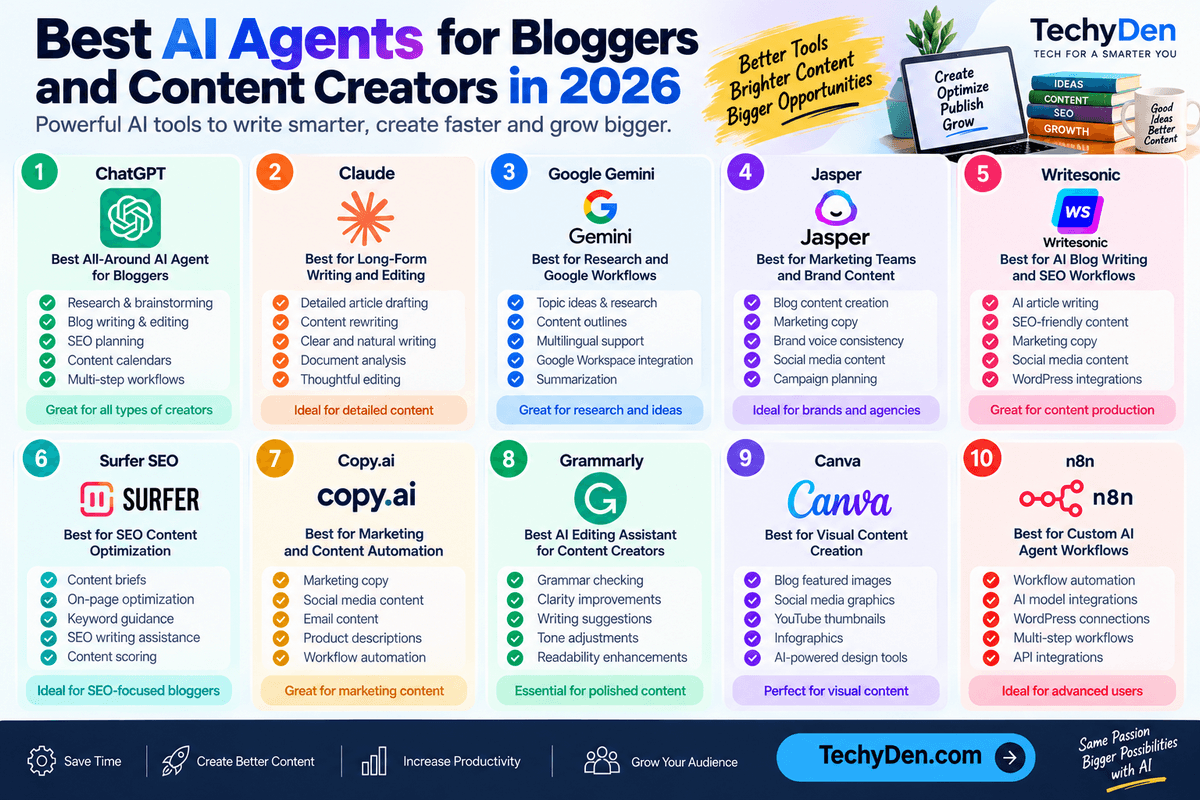
Quick Comparison
| AI Tool | Best For | Main Use |
|---|---|---|
| ChatGPT | All-around content workflows | Research, writing, planning, agentic tasks |
| Claude | Long-form writing and editing | Drafting, rewriting, analysis |
| Google Gemini | Research and Google ecosystem workflows | Brainstorming, research, content assistance |
| Jasper | Marketing teams and brand content | Brand voice, campaigns, marketing copy |
| Writesonic | AI content and SEO workflows | Blog writing, SEO content, marketing |
| Surfer | SEO-focused content optimization | Content briefs, optimization, SEO writing |
| Copy.ai | Marketing and business workflows | Copywriting, campaign content, automation |
| Grammarly | Editing and content polishing | Grammar, clarity, rewriting |
| Canva | Visual content creation | Thumbnails, graphics, social media designs |
| n8n | Custom AI automation | Multi-step workflows and integrations |
Note: These tools serve different purposes. Some are AI assistants, some are specialized content platforms, and others support agentic automation. Always check the current feature set and pricing on the official website.
1. ChatGPT
Best All-Around AI Agent for Bloggers

ChatGPT is one of the most versatile AI tools for bloggers and content creators. It can assist with nearly every stage of content production, from generating ideas to preparing an article for publication.
With suitable features and access to tools, ChatGPT can support agentic workflows that involve research, file analysis, planning, and other connected tasks.
Best for: Content research, article writing, SEO planning, content calendars, and multi-step workflows.
Key Features for Bloggers
- Blog topic brainstorming.
- Keyword clustering and search intent analysis.
- SEO-friendly article outlines.
- Long-form article drafting.
- FAQ and People Also Ask content.
- Meta title and meta description suggestions.
- Content rewriting and editing.
- Social media content creation.
- Content calendar planning.
- Data and spreadsheet analysis.
- Research and multi-step task assistance, where available.
How Bloggers Can Use ChatGPT
Suppose you run a technology blog and want to publish an article about AI writing tools.
You can give ChatGPT an instruction such as:
Create a content brief for "best AI writing tools for bloggers." Identify the target audience, search intent, article structure, important subtopics, FAQs, and internal linking opportunities. Separate facts that require verification from general recommendations.
ChatGPT can help prepare a useful starting point for your article.
You can then ask it to draft individual sections, review the content, and create promotional copy.
Pros
- Versatile for many blogging tasks.
- Useful for both beginners and experienced creators.
- Can help with research, writing, and planning.
- Supports a wide range of content formats.
Cons
- Output still needs fact-checking.
- SEO recommendations depend on the quality of your instructions and data.
- Advanced features and usage limits vary by plan.
Verdict: ChatGPT is an excellent starting point for bloggers who want one flexible AI tool to support their entire content workflow.
- ChatGPT Images 2.5: Features, Improvements
- ChatGPT Atlas Shutdown
- 1980s AI Photo Prompts
- ChatGPT Trending Prompts
- Best ChatGPT Prompts for SEO
2. Claude
Best AI Agent for Long-Form Writing and Editing
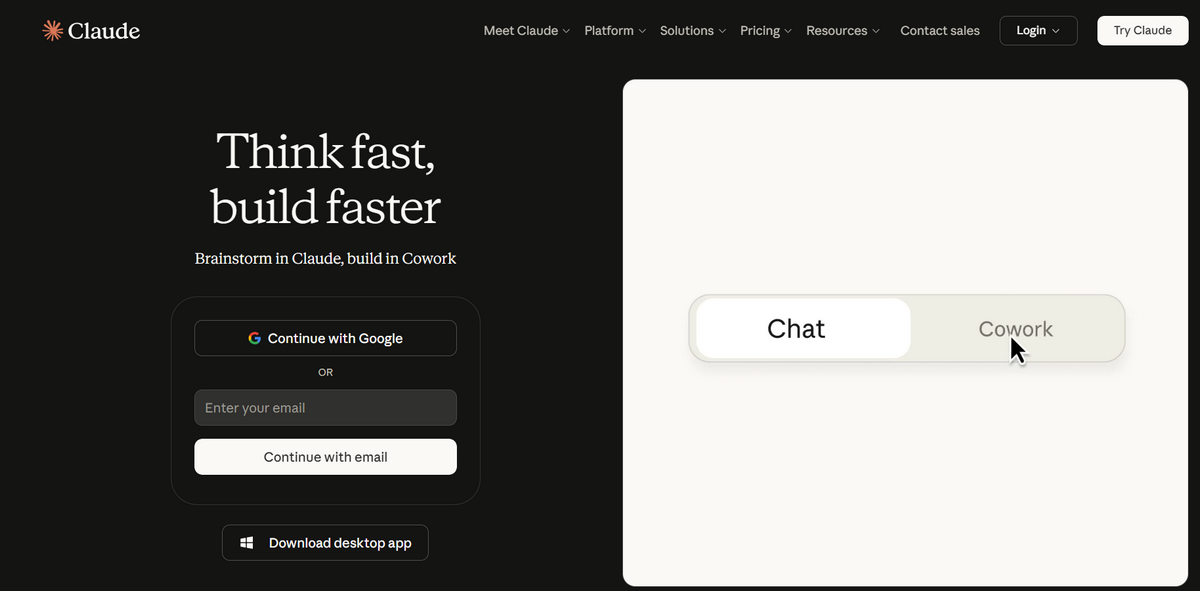
Claude by Anthropic is a strong option for bloggers who prioritize writing quality, clear explanations, and thoughtful editing.
It can help transform rough notes into polished articles, improve readability, and review lengthy content.
Best for: Detailed articles, editing, content structure, and natural-sounding writing.
Key Features of Claude
- Long-form article drafting.
- Content rewriting.
- Grammar and style improvements.
- Article structure suggestions.
- Summarization of documents.
- Content brief development.
- Brand voice guidance.
- Research assistance when supported by available tools.
Example Use Case
You have written a 2,000-word article about WordPress plugins, but the content feels repetitive.
You can ask Claude:
Review this article for clarity, repetition, weak explanations, and unnecessary sections. Suggest improvements while preserving the original meaning and adding practical examples where appropriate.
Claude can help improve the draft without requiring you to rewrite everything manually.
Pros of Claude
- Useful for detailed writing and editing.
- Good for organizing complex information.
- Helpful for rewriting and improving article flow.
- Suitable for long-form content workflows.
Cons of Claude
- It does not replace SEO research tools.
- Factual claims still require verification.
- Availability of agentic features depends on the plan and environment.
Verdict: Claude is a strong choice for bloggers who want polished long-form content and a reliable editing assistant.
- Claude AI and Models: The Complete Guide
- Claude AI vs ChatGPT: Which AI Chatbot is Best for Your Workflow?
- How to Use Claude Cowork
- Claude AI Pricing for Indian Users
3. Google Gemini
Best for Research and Google Workspace Workflows
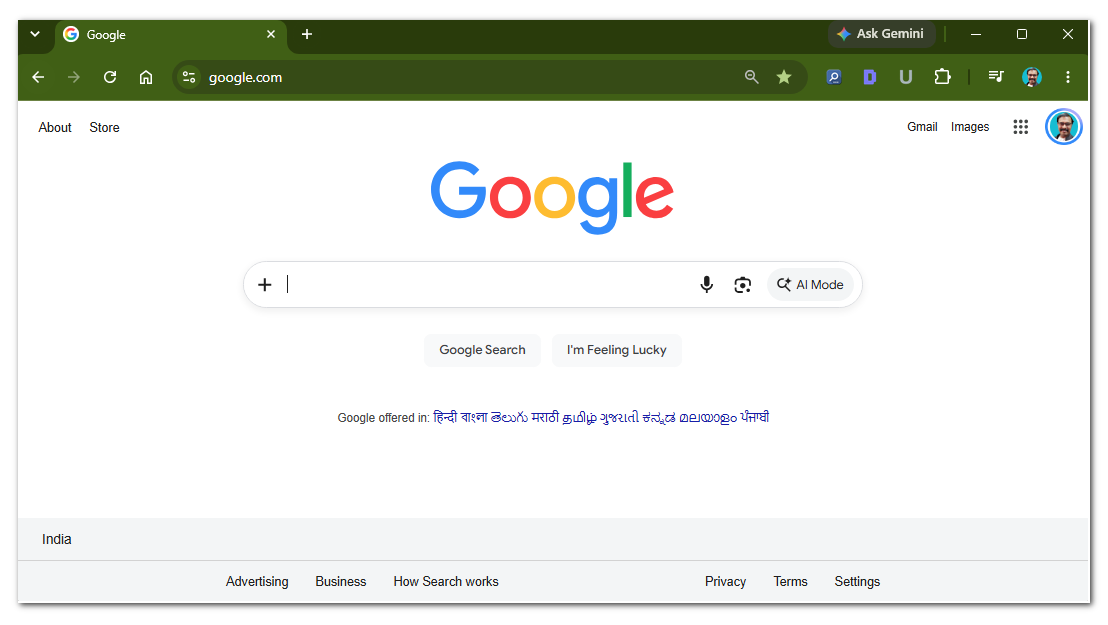
Google Gemini is another useful AI assistant for bloggers and content creators.
It can help with content ideas, outlines, summaries, writing, and research tasks. Its usefulness is especially relevant for creators who already work with Google Docs, Gmail, Drive, and other Google services, where supported.
Best for: Research assistance, brainstorming, multilingual content, and workflows involving Google services.
Key Features of Google Gemini
- Blog topic ideas.
- Content outlines.
- Article drafting.
- Research assistance.
- Content summarization.
- Multilingual writing.
- Google Workspace-related workflows, depending on access and plan.
- Brainstorming for videos and social media.
How Bloggers Can Use Gemini
A blogger creating content for an Indian audience could ask Gemini to:
Suggest 20 blog topics about smartphone tips for beginners. Organize the ideas by search intent and explain which topics are suitable for tutorials, comparisons, or troubleshooting guides.
Gemini can help generate a structured content plan.
For important factual claims, product specifications, and current information, verify details using reliable sources before publishing.
Pros of Google Gemini
- Useful for research and content planning.
- Supports a variety of content formats.
- Helpful for multilingual content workflows.
- Can fit naturally into Google-based work environments.
Cons of Google Gemini
- Feature availability varies by region and plan.
- Research output must be verified.
- It is not a dedicated SEO publishing platform.
Verdict: Google Gemini is a practical option for bloggers who need research assistance and content creation support within a Google-centered workflow.
4. Jasper
Best AI Agent for Marketing Teams and Brand Content
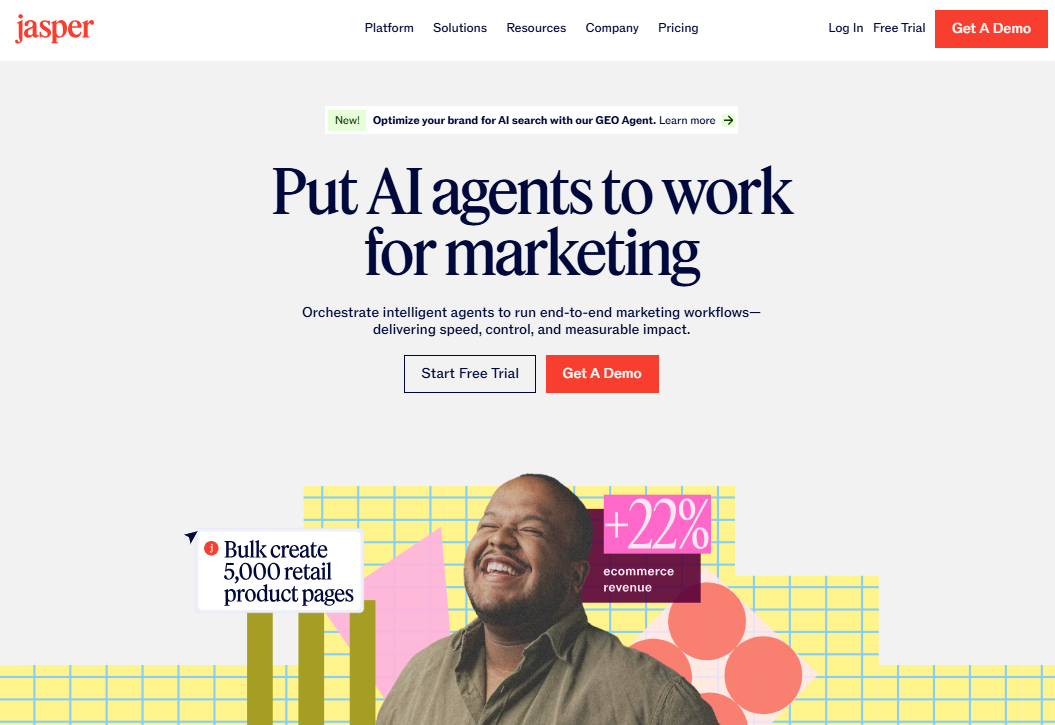
Jasper is designed around marketing and content creation. It is particularly useful for businesses, agencies, and creators who need consistent messaging across multiple channels.
Unlike a general-purpose chatbot, Jasper focuses on marketing workflows and brand-oriented content production.
Best for: Marketing campaigns, brand voice, social media, and business content.
Key Features of Jasper
- Blog content creation.
- Marketing copywriting.
- Brand voice guidance.
- Social media content.
- Email marketing copy.
- Campaign content planning.
- Content rewriting.
- Marketing workflow assistance.
Example Use Case
If you run a SaaS blog, you can use Jasper to create a campaign around a new product feature.
The workflow could include:
- Create a blog post explaining the feature.
- Generate a newsletter announcement.
- Write LinkedIn promotional content.
- Prepare short social media posts.
- Create alternative headlines and calls to action.
Pros of Jasper
- Designed for marketing content.
- Useful for brand consistency.
- Suitable for teams and agencies.
- Supports multiple marketing content types.
Cons of Jasper
- May be more than a solo blogger needs.
- Pricing and features should be checked before subscribing.
- It is not a replacement for independent SEO research.
Verdict: Jasper is best suited to professional content teams, agencies, and brands that produce marketing content at scale.
5. Writesonic
Best for AI Blog Writing and SEO Workflows
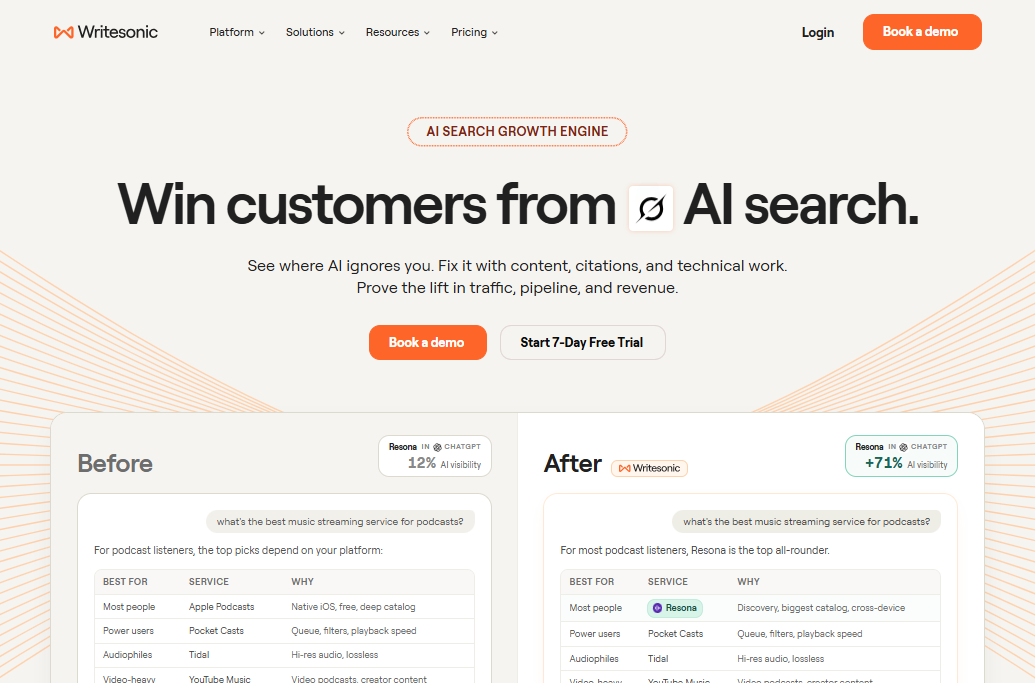
Writesonic is a dedicated AI content platform that can help bloggers generate articles and other marketing content.
It is worth considering if you want a tool focused on content production rather than a general-purpose AI assistant.
Best for: Blog content, SEO-focused writing, and marketing content creation.
Key Features of Writesonic
- AI article writing.
- Blog outlines.
- SEO content assistance.
- Content rewriting.
- Marketing copy.
- Social media content.
- Content optimization workflows.
- WordPress-related publishing capabilities, depending on the current plan and integration.
How to Use Writesonic
A blogger targeting the keyword “best free video editing software” could use Writesonic to:
- Generate an article outline.
- Create an initial draft.
- Develop comparison sections.
- Add FAQs.
- Prepare a meta description.
- Review the article before publishing.
The article should still include original testing, screenshots, accurate specifications, and useful recommendations.
Pros of Writesonic
- Focused on content creation.
- Useful for blog and marketing workflows.
- Can support SEO-related content tasks.
- Suitable for creators producing content regularly.
Cons of Writesonic
- Quality depends on the selected workflow and instructions.
- Plans and usage limits can change.
- AI-generated content still needs human review.
Verdict: Writesonic is a useful option for bloggers who want a dedicated AI content platform with writing and SEO-related features.
6. Surfer SEO
Best AI Agent for SEO Content Optimization
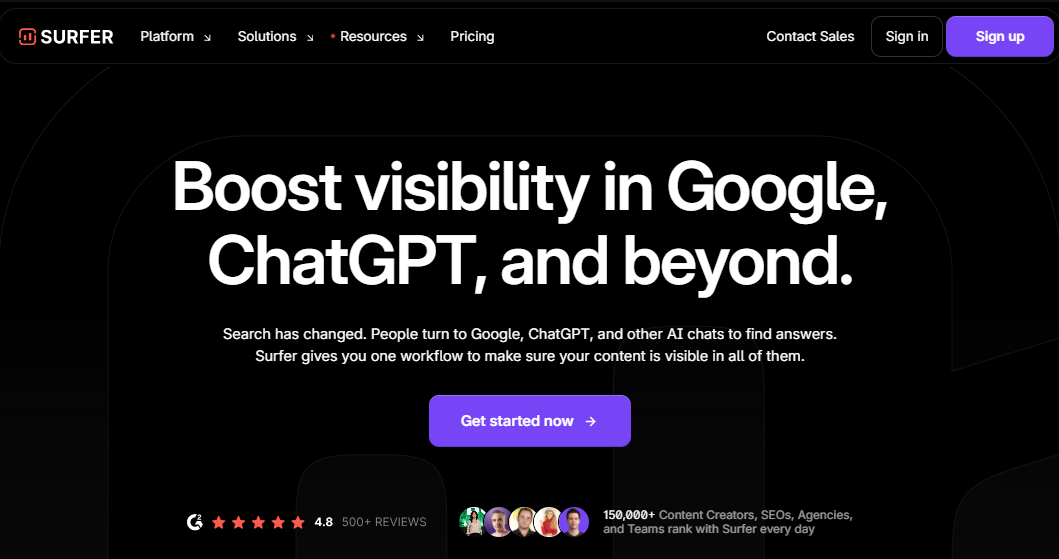
Surfer is an SEO-focused platform that helps content creators improve the structure and relevance of their articles.
It is different from a general AI writing assistant because its main value is connected to search-focused content optimization.
Best for: On-page SEO, content briefs, keyword coverage, and optimizing blog articles.
Key Features of Surfer
- Content briefs.
- Keyword and topic guidance.
- On-page content optimization.
- Content scoring.
- SEO writing assistance.
- Content structure suggestions.
- WordPress-related workflows, where supported.
- AI-assisted content creation features, depending on the plan.
Example Use Case
You have an article targeting “how to speed up WordPress.”
Surfer can help you identify content optimization opportunities such as:
- Important subtopics to cover.
- Relevant terms and concepts.
- Article structure improvements.
- Content gaps.
- On-page optimization suggestions.
You should not blindly add keywords just to increase a score. The article should remain useful and natural.
Pros of Surfer
- Strong focus on SEO workflows.
- Useful for content briefs and optimization.
- Helps create a more systematic content process.
- Suitable for SEO-focused bloggers and agencies.
Cons of Surfer
- SEO tools can be expensive for beginners.
- Optimization scores do not guarantee rankings.
- It does not replace real expertise or original content.
Verdict: Surfer is a good choice for bloggers who already understand basic SEO and want a structured content optimization workflow.
7. Copy.ai
Best for Marketing and Content Automation
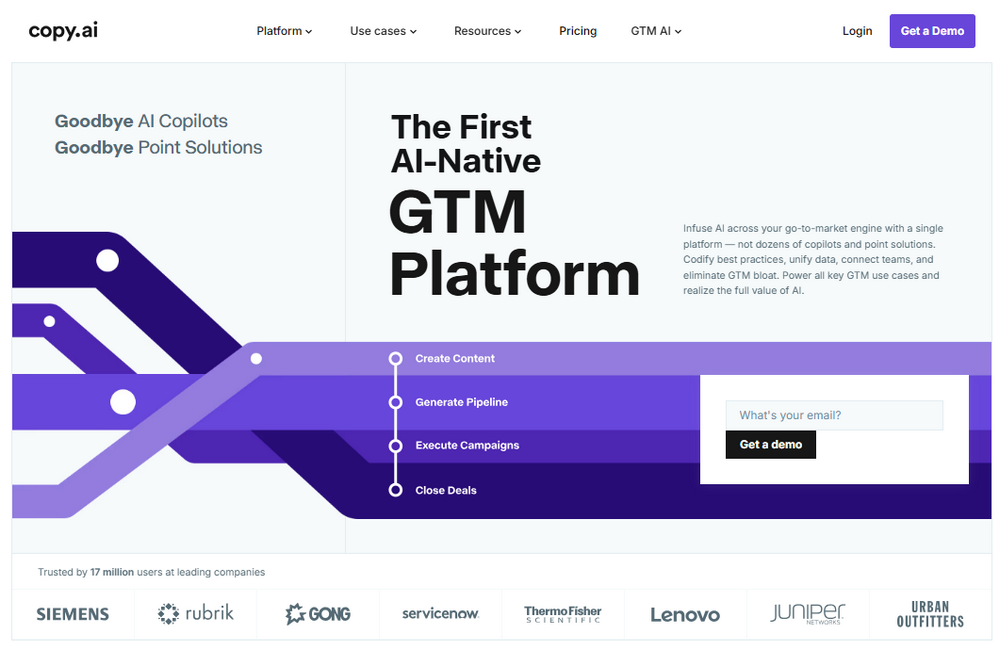
Copy.ai is an AI-powered platform focused on content creation and marketing workflows.
It can help businesses and creators produce marketing content and organize repetitive content-related tasks.
Best for: Marketing copy, social media, email content, and business workflows.
Key Features of Copy.ai
- Blog introductions and outlines.
- Social media copy.
- Email marketing content.
- Product descriptions.
- Marketing campaign ideas.
- Content rewriting.
- Workflow automation features, depending on the current product offering.
How Bloggers Can Use Copy.ai
For an affiliate marketing blog, you can use Copy.ai to create:
- Product comparison introductions.
- Calls to action.
- Email newsletter drafts.
- Social media captions.
- Short product descriptions.
Always verify product claims and disclose affiliate relationships where required.
Pros of Copy.ai
- Useful for marketing content.
- Helpful for short-form copy.
- Suitable for business and creator workflows.
- Can reduce repetitive writing work.
Cons of Copy.ai
- Less specialized for detailed SEO analysis.
- Output needs editing for originality and accuracy.
- Pricing and automation capabilities vary.
Verdict: Copy.ai is a useful addition to a content marketing workflow, especially for promotional content.
8. Grammarly
Best AI Editing Assistant for Content Creators
Grammarly is not a traditional autonomous AI agent, but it is a valuable AI-powered assistant for bloggers.
Writing a helpful article is only part of the job. You also need to make sure the content is easy to read and free from unnecessary errors.
Best for: Grammar, readability, clarity, and polishing articles.
Key Features of 8. Grammarly
- Grammar checking.
- Spelling corrections.
- Sentence rewriting.
- Clarity improvements.
- Tone suggestions.
- Writing assistance.
- Editing support for emails and articles.
Example Use Case of Grammarly
After writing a blog post, use Grammarly to check:
- Long and confusing sentences.
- Repeated words.
- Grammar mistakes.
- Unclear explanations.
- Unnecessary passive voice.
- Inconsistent tone.
Pros of Grammarly
- Easy to use.
- Useful for polishing articles.
- Helpful for non-native English writers.
- Works well as a final editing step.
Cons of Grammarly
- Does not perform comprehensive keyword research.
- Does not replace an SEO platform.
- AI suggestions still need editorial judgment.
Verdict: Grammarly is an excellent companion tool for bloggers who want cleaner and more readable content.
9. Canva
Best AI Tool for Visual Content Creation

Bloggers and content creators need more than written content. Visuals play an important role in making articles and social media posts attractive.
Canva is a popular design platform with AI-powered features that can help create visual content.
Best for: Blog featured images, thumbnails, infographics, and social media graphics.
Key Features of Canva
- Blog featured image designs.
- YouTube thumbnails.
- Social media graphics.
- Presentation designs.
- Infographics.
- AI-assisted design features.
- Templates and brand assets.
How Bloggers Can Use Canva
Suppose you publish an article titled “Best AI Agents for Bloggers.”
You can use Canva to create:
- A featured image for the article.
- A Pinterest graphic.
- An Instagram carousel.
- A LinkedIn image.
- A YouTube thumbnail.
Pros of Canva
- Beginner-friendly design workflow.
- Useful templates.
- Supports multiple content formats.
- Helpful for branding and visual consistency.
Cons of Canva
- It is primarily a design platform, not a blogging agent.
- AI-generated visuals may need editing.
- Some features require a paid plan.
Verdict: Canva is one of the best companion tools for bloggers who want professional-looking visual content without advanced design skills.
10. n8n
Best for Custom AI Agent Workflows
n8n is a workflow automation platform that can connect different services and automate multi-step processes.
It is especially useful when you want to build a custom content workflow instead of relying on a single AI application.
Best for: Advanced bloggers, automation enthusiasts, agencies, and developers.
Example Blogging Workflow of n8n
A custom workflow could look like this:
Content idea → Research → AI outline → Draft → Human review → WordPress draft → Social media promotion
Depending on your setup, n8n can connect AI models, spreadsheets, databases, WordPress, email platforms, and other services.
Key Features of n8n
- Workflow automation.
- AI model integrations.
- API connections.
- WordPress-related automation.
- Spreadsheet and database workflows.
- Custom triggers and actions.
- Multi-step content pipelines.
Pros of n8n
- Highly flexible.
- Useful for advanced automation.
- Can connect multiple tools.
- Suitable for custom blogging workflows.
Cons of n8n
- Requires more technical knowledge.
- Setup can take time.
- Incorrect automation can create publishing errors.
- API and hosting costs may apply.
Verdict: n8n is a powerful option for bloggers and agencies that want to build custom AI-powered content systems.
How to Choose the Best AI Agent for Your Blog
The best AI agent depends on your goals, budget, content type, and technical knowledge.
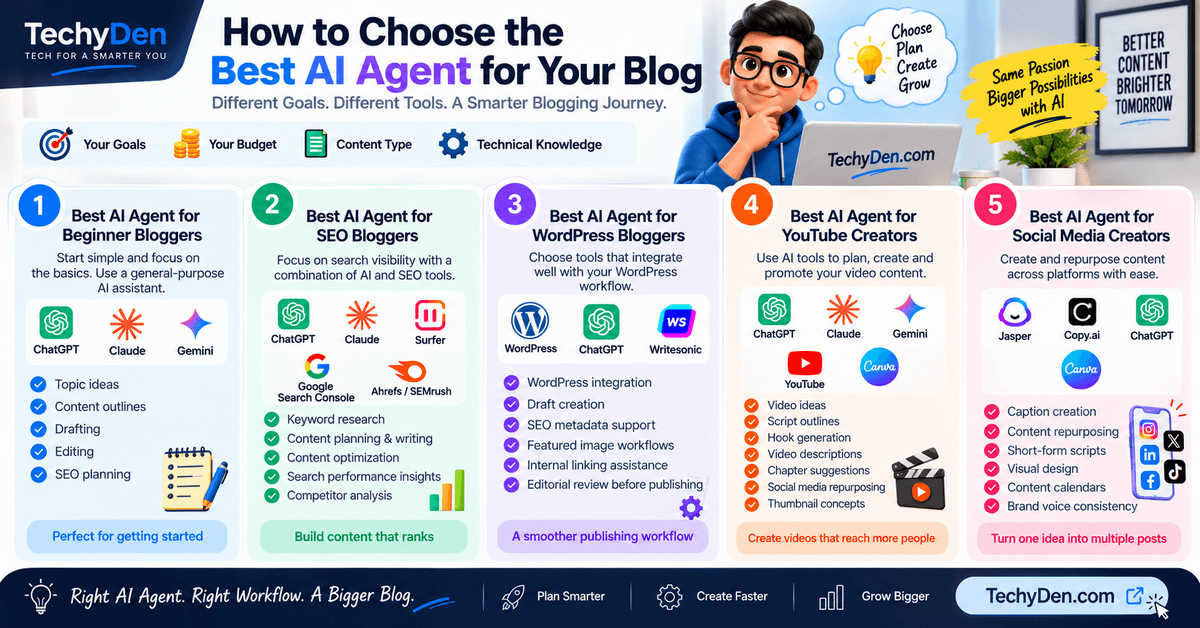
1. Best AI Agent for Beginner Bloggers
If you are new to blogging, start with a general-purpose AI assistant such as ChatGPT, Claude, or Gemini.
Use it for:
- Topic ideas.
- Content outlines.
- Drafting.
- Editing.
- SEO planning.
You do not need an expensive automation system when you are publishing only a few articles per month.
2. Best AI Agent for SEO Bloggers
If SEO is your main priority, consider a combination of:
- ChatGPT or Claude for planning and writing.
- Surfer for content optimization.
- Google Search Console for performance data.
- A keyword research platform for search demand and competition.
This gives you a more complete SEO workflow than relying on a single AI writing tool.
3. Best AI Agent for WordPress Bloggers
WordPress bloggers should look for tools that support their publishing workflow.
Useful features include:
- WordPress integration.
- Draft creation.
- SEO metadata support.
- Featured image workflows.
- Internal linking assistance.
- Editorial review before publishing.
Some dedicated AI content platforms offer WordPress integrations, but capabilities vary by product and plan.
Tip: Always test whether a tool creates a WordPress draft or publishes content automatically. These are very different levels of automation.
4. Best AI Agent for YouTube Creators
YouTube creators can use AI tools to help with:
- Video ideas.
- Script outlines.
- Hook generation.
- Video descriptions.
- Chapter suggestions.
- Social media repurposing.
- Thumbnail concepts.
ChatGPT, Claude, Gemini, and Canva can work together for these tasks.
5. Best AI Agent for Social Media Creators
For social media content, look for tools that support:
- Caption creation.
- Content repurposing.
- Short-form scripts.
- Visual design.
- Content calendars.
- Brand voice consistency.
Jasper, Copy.ai, ChatGPT, and Canva are useful tools to explore.
Recommended AI Agent Workflow for Bloggers
You do not need to automate everything from day one.
A practical workflow is to use AI for repetitive tasks while keeping human control over research, accuracy, and publishing.
Step 1: Find a Content Topic
Use ChatGPT, Claude, or Gemini to brainstorm article ideas.
Example prompt:
Suggest 20 SEO-friendly blog topics for a technology blog targeting beginners. Prioritize useful tutorials, software guides, and emerging AI topics.
Step 2: Research Keywords
Use a keyword research tool and Google Search Console to identify relevant search queries.
Look for:
- Search intent.
- Keyword relevance.
- Competition.
- Existing content gaps.
- Questions readers ask.
AI can help organize the keywords, but search volume and competition data should come from reliable sources.
Step 3: Create an Article Brief
Ask your AI assistant to prepare:
- Target keyword.
- Search intent.
- Suggested title.
- Article outline.
- H2 and H3 headings.
- Questions to answer.
- Examples to include.
- Internal linking opportunities.
Step 4: Write the First Draft
Use ChatGPT, Claude, or another suitable AI writing tool to create a draft. Provide clear instructions about:
- Target audience.
- Writing style.
- Article length.
- Examples.
- Formatting.
- Information that must be verified.
Step 5: Add Original Experience
This is one of the most important steps.
Add your own:
- Screenshots.
- Testing results.
- Personal observations.
- Product comparisons.
- Real examples.
- Expert explanations.
- Case studies.
Generic AI content is easier to replace than useful content based on real experience.
Step 6: Optimize the Article for SEO
Use your SEO plugin and optimization tools to review:
- SEO title.
- Meta description.
- URL slug.
- Heading structure.
- Internal links.
- Image alt text.
- Schema markup where appropriate.
- Search intent alignment.
Do not overuse keywords.
Step 7: Edit and Fact-Check
Before publishing, check:
- Product names.
- Pricing.
- Feature availability.
- Dates.
- Technical instructions.
- Statistics.
- External links.
- Grammar and readability.
AI-generated information can be incorrect or outdated. It has useful content based on real experience.
Step 8: Create Visual Content
Use Canva or an image generation tool to create:
- Video thumbnails.
- Featured images.
- Infographics.
- Screenshots with annotations.
- Social media graphics.
Step 9: Publish as a WordPress Draft
If your tool supports WordPress integration, create a draft rather than publishing immediately.
Review the complete article in WordPress before making it live.
Step 10: Repurpose and Promote
Turn your article into:
- LinkedIn posts.
- X posts.
- Instagram carousels.
- Email newsletters.
- YouTube scripts.
- Pinterest graphics.
This helps you get more value from every article.
Example: AI Agent Workflow for TechyDen
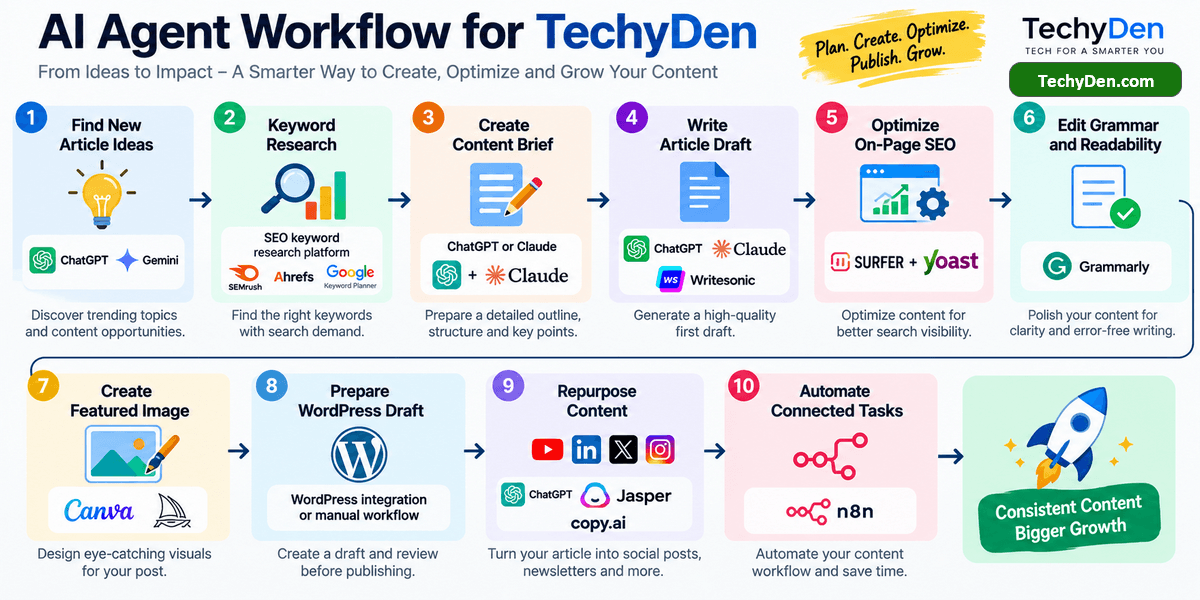
For a technology blog such as TechyDen, you can use the following workflow.
| Task | Recommended Tool |
|---|---|
| Find new article ideas. | ChatGPT, Gemini |
| Keyword research | SEO keyword research platform |
| Create a content brief. | ChatGPT or Claude |
| Write an article draft. | ChatGPT, Claude, Writesonic |
| Optimize on-page SEO. | Surfer + SEO plugin |
| Edit grammar and readability | Grammarly |
| Create a featured image. | Canva or an image generation tool |
| Prepare a WordPress draft. | WordPress integration or manual workflow |
| Repurpose content | ChatGPT, Jasper, Copy.ai |
| Automate connected tasks. | n8n |
This workflow can help reduce repetitive work while keeping the blogger in control.
How Much Do AI Agents for Bloggers Cost?
The cost depends on the tool and the features you need.
Some AI assistants have free plans. Others use monthly subscriptions, usage-based credits, or separate charges for advanced automation and integrations.
General Cost Categories
| Budget | Suitable For |
|---|---|
| Free tools | Beginners and occasional bloggers |
| Low-cost subscriptions | Solo bloggers and small websites |
| Mid-range tools | Active bloggers and content marketers |
| Premium platforms | Agencies, businesses, and large content teams |
| Custom automation | Advanced users with technical requirements |
Important: AI tool pricing changes frequently. Check the official pricing page before purchasing. The cost of AI models, SEO platforms, image generation, hosting, and automation may be separate.
Are AI Agents Good for SEO?
Yes, AI agents can help with SEO, but they do not guarantee search rankings.
They are useful for supporting SEO tasks such as
- Keyword organization.
- Search intent analysis.
- Article outlines.
- Content optimization.
- Internal linking suggestions.
- Meta title generation.
- FAQ creation.
- Content refresh planning.
However, ranking well requires more than AI-generated text.
What Makes AI Content More Useful for SEO?
Focus on:
- Search intent: Answer what the reader actually wants to know.
- Accuracy: Verify important facts and current information.
- Originality: Add unique experience, examples, and insights.
- Readability: Make the article easy to understand.
- Helpful structure: Use clear headings, lists, tables, and examples.
- Internal linking: Connect relevant articles naturally.
- Technical SEO: Maintain good site performance, crawlability, and indexing.
- Content updates: Refresh outdated information when necessary.
AI should support your SEO strategy, not replace it.
Are AI Agents Safe for WordPress Blogs?
AI agents can be useful for WordPress, but you should be careful when giving them access to your website.
Follow These Safety Practices
- Use trusted tools and integrations.
- Keep WordPress and plugins updated.
- Use the minimum permissions required.
- Prefer draft creation over automatic publishing.
- Review generated content before publication.
- Avoid sharing passwords or private credentials.
- Keep backups of important content.
- Monitor any automated changes.
- Test workflows on a staging site when possible.
An AI agent that can edit or publish content should be treated like a tool with real website access.
Common Mistakes to Avoid When Using AI Agents
- Publishing AI Content Without Editing: AI-generated content may contain errors, repetitive writing, or generic explanations. Always review and improve the draft.
- Relying on AI for All SEO Decisions: AI can suggest keywords and topics, but real SEO decisions should use search data, competitor analysis, and your website performance.
- Automating Publishing Too Early: Automatic publishing can create problems if the content contains incorrect facts, broken links, or poor formatting. Start with a human approval step.
- Ignoring Original Experience: Readers want useful information they cannot get from every other website. Add your own testing, screenshots, examples, and opinions where appropriate.
- Using Too Many AI Tools: You do not need ten different subscriptions to run a successful blog. Start with one general AI assistant and add specialized tools only when they solve a clear problem.
Frequently Asked Questions (FAQs) on Best AI Agents for Bloggers and Content Creators
What is the best AI agent for bloggers in 2026?
ChatGPT is a strong all-around option for bloggers because it can help with topic ideas, content planning, research, writing, editing, and other workflows. Claude is useful for long-form writing, while Surfer is better suited to SEO-focused optimization. The best choice depends on your specific content needs and budget.
Can AI agents write complete blog posts?
Yes, many AI tools can generate complete blog post drafts from a topic or detailed brief. However, a complete draft is not automatically a high-quality publishable article. Bloggers should verify facts, improve the writing, add original insights, check SEO, and review the final formatting before publishing.
Can AI agents publish articles directly to WordPress?
Some AI content platforms support WordPress integrations that can create drafts or publish content, depending on their current features and plan. Other AI assistants require manual copying or a separate automation workflow. Always verify the integration and use a human review step before publishing.
Are AI agents useful for SEO blogging?
AI agents are useful for SEO blogging because they can assist with keyword organization, article outlines, content optimization, internal linking ideas, and content refreshes. However, AI cannot guarantee Google rankings. Search intent, content quality, accuracy, technical SEO, and original value remain important.
What is the best free AI agent for content creators?
ChatGPT, Claude, and Google Gemini are useful starting points because they offer free access options, although limits and features vary. Canva also provides a useful free design workflow for visual content. Start with the tool that best fits your needs before paying for advanced features.
Can AI agents create social media content from blog posts?
Yes, AI tools can turn a blog article into social media captions, LinkedIn posts, X posts, newsletter summaries, and short video scripts. Tools such as ChatGPT, Jasper, Copy.ai, and Canva can support these tasks. Review each platform’s content length, tone, and formatting requirements before publishing.
Do bloggers need multiple AI agents?
Not necessarily. Beginners can start with one general-purpose AI assistant and a keyword research tool. As your content volume grows, you may add a dedicated SEO platform, editing assistant, image design tool, or automation platform. Choose tools based on actual workflow problems rather than collecting many subscriptions.
Will using AI agents hurt my blog’s Google rankings?
Using AI assistance does not automatically determine whether a blog will rank well. The important factors include content quality, usefulness, accuracy, and compliance with search engine guidelines. Low-quality, repetitive, or misleading content can perform poorly regardless of whether it was written by AI or a human.
Final Verdict: Which AI Agent Should You Choose?
The best AI agents for bloggers and content creators depend on what you want to accomplish.
- Best all-around AI agent: ChatGPT.
- Best for long-form writing: Claude.
- Best for research and Google workflows: Google Gemini.
- Best for marketing teams: Jasper.
- Best for AI blog writing: Writesonic.
- Best for SEO optimization: Surfer.
- Best for marketing automation: Copy.ai.
- Best for editing: Grammarly.
- Best for visual content: Canva.
- Best for custom workflows: n8n.
For most solo bloggers, a simple combination of ChatGPT or Claude, an SEO tool, WordPress, and Canva is enough to build an efficient content creation workflow.
- 25+ Best AI Tools for Small Business
- 12 Best AI Humanizer Tools
- 6 Free AI Content Detectors to Check Your Digital Content
The key is not to let AI replace your expertise. Use AI agents to save time on repetitive tasks, while you focus on creating accurate, useful, and original content that readers want to consume.
Start small, test your workflow, and expand your AI toolkit as your blog grows.