
How to Make Money With Google AdSense From Your Blog in 2026

Google AdSense is one of the most popular ways to make money blogging. It allows website owners to display advertisements on their blogs and earn revenue when visitors view or interact with eligible ads.
You do not need to sell products, manage inventory, or handle customer orders to get started.
Whether you run a technology blog, a personal finance website, an educational blog, or a website about blogging and SEO, Google AdSense can become part of your monetization strategy.
However, earning money from AdSense requires more than placing advertisements on your website.
You need useful content, a steady flow of relevant visitors, a good user experience, and an understanding of how advertising revenue works.
Before monetizing a website, establish consistent blog branding so visitors can easily recognize your site.
In this guide, you will learn how to make money with Google AdSense from your blog, how to get approved, how to increase your earnings, and which mistakes you should avoid.
What Is Google AdSense?
Google AdSense is an advertising program that enables website publishers to earn money by displaying ads on their content.
Google uses advertising demand and its ad-serving systems to match ads with available advertising space on participating websites.
For example, imagine that you run a technology blog that publishes articles about Windows, AI tools, WordPress, and software tutorials.
After your website is approved for AdSense, eligible pages can display advertisements to visitors.
When visitors view or interact with eligible ads, you may earn revenue according to the advertising model and auction results.
Your earnings depend on several factors, including visitor location, content topic, advertiser demand, ad placement, and traffic quality.
AdSense is attractive to bloggers because it can monetize existing content while allowing them to focus on publishing useful articles.
However, approval and income are not guaranteed. Your website must comply with Google’s policies, and your earnings will depend on the performance of your advertising inventory.
How Does Google AdSense Work for Bloggers?
Google AdSense connects website publishers with advertising demand. Once your website is approved and your ads are configured, Google can display eligible advertisements on your pages.
Here is how the process generally works:
- Create a blog: Build a website with original, useful content for a clearly defined audience.
- Apply for AdSense: Create an account and submit your website for review.
- Complete site verification: Follow the instructions in your AdSense account to verify your site and install the required code.
- Get approval: Google reviews your website for eligibility and policy compliance.
- Display advertisements: Configure Auto ads or suitable ad placements on your website.
- Attract visitors: Publish helpful articles and promote them through appropriate channels.
- Earn advertising revenue: Eligible ad impressions and interactions can generate revenue.
- Receive payment: Complete the required account, identity, address, tax, and payment steps applicable to your account.
Google provides reporting tools that help you monitor impressions, clicks, estimated earnings, and other performance metrics.
Remember that an AdSense account and an approved website are not the same thing. Your site must be reviewed and marked as ready before it can serve ads through the relevant AdSense product.
How to Make Money With Google AdSense From Your Blog
If you want to earn money blogging with AdSense, follow these strategies to build a website that attracts readers and creates sustainable advertising opportunities.
1. Choose a Profitable Blogging Niche
Your blogging niche influences the topics you cover, the audience you attract, the advertisers interested in that audience, and your potential advertising revenue.
Some niches have strong commercial intent because readers are researching products, services, or solutions. However, no niche guarantees high earnings, and competition can vary significantly.
Here are several blogging niches you can consider.
| Blogging niche | Example article topics |
|---|---|
| Technology | Software reviews, computer troubleshooting, AI tools |
| Personal finance | Budgeting, saving money, financial education |
| Digital marketing | SEO, blogging, email marketing |
| Education | Study guides, exam preparation, learning resources |
| Health and fitness | General wellness, exercise, healthy habits |
| Travel | Destination guides, itineraries, travel tips |
| Food | Recipes, cooking guides, meal planning |
| Home improvement | DIY projects, maintenance, buying guides |
Choose a niche that matches your knowledge and the needs of your target audience.
For example, if you understand WordPress, SEO, and technology, you can create tutorials that solve specific problems. These articles can attract readers searching for solutions and may continue to receive traffic after publication.
Before choosing a niche, research keyword demand, competition, content opportunities, and your ability to produce accurate, helpful articles consistently.
2. Create High-Quality Content That Attracts Visitors
Content is one of the most important foundations of a successful AdSense blog.
You can place advertisements on your website, but you cannot earn meaningful revenue without attracting visitors who find your content useful.
Focus on publishing original articles that answer real questions, solve problems, or help readers make decisions.
Examples include
- How-to guides
- Troubleshooting tutorials
- Product comparisons
- Educational resources
- Software reviews
- Beginner-friendly explanations
- Industry updates and analysis
- Frequently asked questions
Before writing an article, understand what readers want to accomplish. Then provide clear instructions, relevant examples, accurate information, and practical advice.
If you need help with research, brainstorming, and content planning, explore the best AI tools for bloggers to support your content workflow.
Avoid publishing large numbers of thin articles simply to increase your page count. Google recommends unique, useful content and a good user experience when preparing a website for AdSense.
You can review Google’s official guidance on making your site ready for AdSense.
3. Conduct Keyword Research Before Writing Articles
Keyword research helps you understand what people search for and how you can create content that meets their needs.
For example, a technology blogger might research these keywords:
- How to enable Hibernate in Windows 11
- Best AI tools for bloggers
- How to speed up a WordPress website
- Best free blogging platforms
- How to fix common computer problems
These queries reveal specific information needs. By publishing useful answers, you can improve your chances of attracting relevant search traffic.
Useful keyword research tools include Google Keyword Planner, Google Trends, Google Search Console, Semrush, and Ahrefs.
When researching keywords, consider the following factors:
- Search intent: Understand whether readers want instructions, comparisons, product recommendations, or general information.
- Competition: Assess whether your website can realistically compete with existing search results.
- Relevance: Choose keywords that match your niche and expertise.
- Content depth: Determine whether you can provide a more useful answer than the existing results.
- Long-term value: Look for topics that may continue attracting visitors after publication.
Do not target a keyword only because it has a high search volume. A smaller, more specific topic can be valuable when it attracts the right readers and fits your website.
4. Publish Content Consistently
Consistency helps you build a useful content library and gives readers more reasons to return to your website.
You do not need to publish several articles every day. Instead, create a realistic schedule that allows you to research, write, edit, and maintain your content properly.
For example, you could publish two or three comprehensive articles each week, depending on your available time and the complexity of your topics.
Develop a content calendar that includes:
- Primary keyword
- Article title
- Search intent
- Publication date
- Supporting keywords
- Internal linking opportunities
- Update date
Organize related articles into topic clusters. For example, a WordPress category could include hosting guides, theme comparisons, plugin tutorials, website security, and speed optimization.
You can streamline your writing workflow with the best AI writing tools for bloggers, while ensuring that every published article is accurate, original, and useful to readers.
This structure helps readers discover related resources and gives search engines clearer signals about your website’s subject matter.
5. Optimize Your Blog for Search Engines
Search engine optimization can help your articles reach people who are actively searching for information.
Although SEO does not guarantee traffic, it can support long-term growth when combined with useful content and a good website experience.
Focus on these essential SEO practices:
- Use descriptive, readable URLs.
- Write clear page titles and meta descriptions.
- Include your primary keyword naturally.
- Use headings to organize content.
- Add relevant internal links.
- Link to trustworthy external sources when useful.
- Optimize images and add descriptive alternative text.
- Improve page loading speed.
- Ensure your website works well on mobile devices.
- Keep important content accessible to search engines.
Use Google Search Console to monitor impressions, clicks, search queries, indexing, and page performance. Review the data regularly to identify articles that need better titles, more useful information, or improved internal links.
Avoid keyword stuffing or creating multiple pages that target nearly identical search intent without a clear reason.
6. Get Your Blog Approved for Google AdSense
Before you can earn advertising revenue, your website must meet the applicable AdSense requirements and pass Google’s site review.
There is no universal minimum traffic threshold that guarantees approval. Google focuses on eligibility, policy compliance, content quality, site ownership, and user experience.
Use this checklist to prepare your blog.
- Publish original content: Your articles should provide useful information and demonstrate your own contribution. Avoid copying other websites or publishing pages with little original value.
- Create clear navigation: Organize your categories, menus, and important pages so visitors can find what they need.
- Make your website complete: Ensure that the site is live, functional, and not filled with unfinished pages or placeholder content.
- Use a secure website: Configure HTTPS correctly and make sure your website loads reliably.
- Provide essential information: Consider publishing clear About, Contact, Privacy Policy, and other appropriate legal or disclosure pages. Their exact requirements depend on your website and applicable policies.
- Check your content: Ensure that your pages and advertising placements comply with Google’s publisher policies.
- Verify website ownership: Follow the verification instructions provided in your AdSense account.
- Submit your website for review: Add your site through AdSense and complete the required setup steps.
You can read Google’s official AdSense eligibility requirements before applying.
Approval is not guaranteed, even if you complete every item on this checklist. If your website is rejected, review the reason provided in your account, fix the identified issues, and request another review when appropriate.
7. Set Up Google AdSense on Your Blog
After your account and website are approved, configure your ads carefully.
The exact steps depend on your website platform and the setup instructions in your AdSense account.
A typical process looks like this:
- Sign in to your Google AdSense account.
- Open the Sites section and select your approved website.
- Complete any remaining verification or setup requirements.
- Follow Google’s instructions for installing the AdSense code.
- Choose Auto ads or configure eligible manual ad placements.
- Test your website on desktop and mobile devices.
- Monitor the AdSense dashboard to confirm that ads are serving correctly.
If you use WordPress, you can add the required code through an appropriate theme or plugin method. Make sure the code is installed correctly and does not conflict with your site’s existing scripts.
Do not install multiple competing implementations of the same ad code or use plugins that create prohibited placements.
If you are unsure about the installation, consult the official AdSense setup documentation or your theme’s instructions.
8. Choose Between Auto Ads and Manual Ad Placements
AdSense offers different ways to manage advertisements on your website.
Auto ads
Auto ads use Google’s systems to determine where eligible advertisements may appear on your pages. Depending on the available formats and settings, this can reduce the amount of manual placement work required.
Auto ads may be convenient for beginners who want to test ad delivery without managing every placement individually.
However, you should review the results and user experience rather than assuming that every automatic placement is ideal.
Manual ad placements
Manual placements allow you to choose specific locations for ad units, subject to Google’s policies and the available ad formats.
For example, you may test placements within suitable article content, in a sidebar, or in other appropriate areas of your layout.
Manual placement gives you more control, but it also requires careful implementation and ongoing review.
Which option should you choose?
Beginners can start by testing Auto ads and reviewing how advertisements affect their pages. More experienced publishers may prefer a combination of automated and carefully managed placements.
If you prefer automated ad placement, learn how Google AdSense Auto ads can analyze your page layout and place eligible ads in suitable locations across your website.
The right setup depends on your content, audience, layout, device mix, and revenue data.
9. Place Ads Where They Can Perform Well
Ad placement can influence the visibility of advertisements and the overall user experience.
However, placing more ads on a page does not automatically increase your income. Excessive or disruptive advertisements can frustrate readers, reduce engagement, and violate applicable policies.
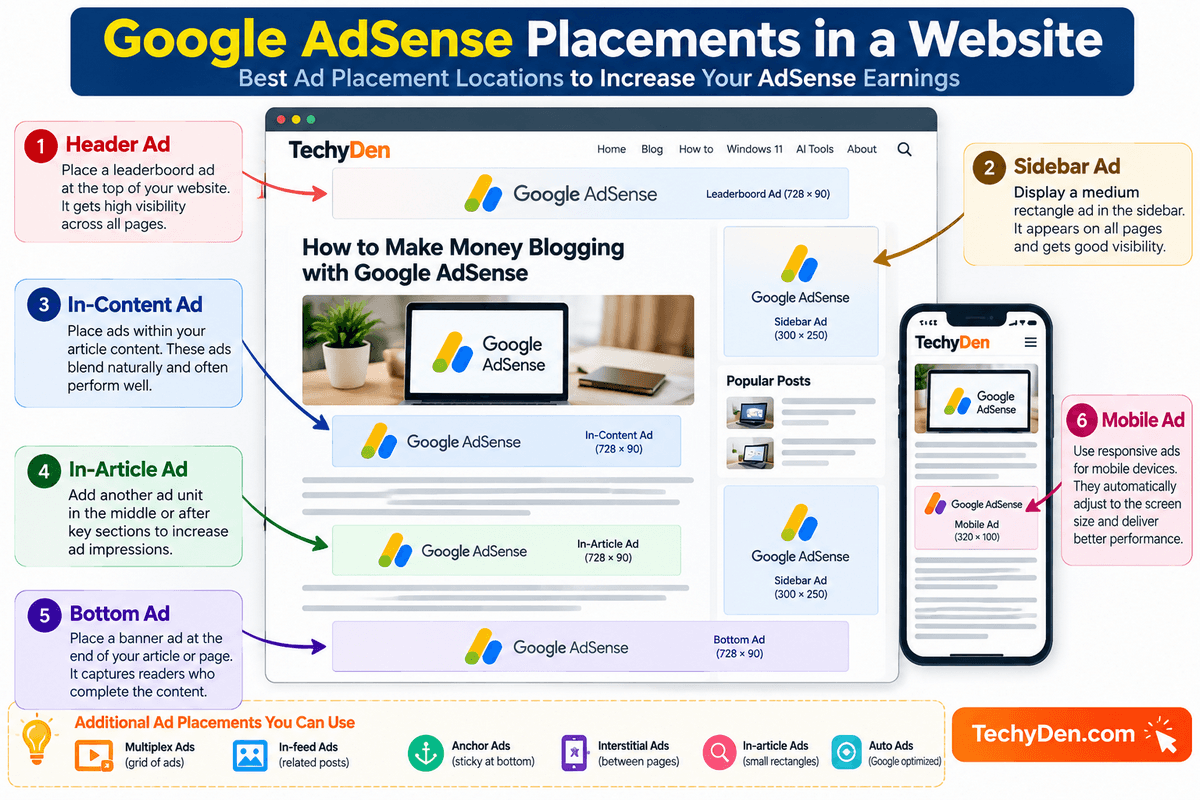
Consider these general placement principles:
- Keep advertisements visually distinct from your article content.
- Avoid placing ads where visitors may accidentally click them.
- Do not make advertisements resemble navigation menus or download buttons.
- Ensure ads do not obstruct important content.
- Check the layout on mobile devices.
- Leave enough space for readers to navigate comfortably.
- Follow Google’s current ad placement and content policies.
For example, an article may include a suitable ad placement between major sections, provided it does not disrupt the reading experience or create accidental-click risks.
Always follow Google’s ad placement policies to prevent accidental clicks, keep advertisements distinct from website content, and maintain a positive user experience.
Review your website regularly after changing themes, fonts, spacing, or ad settings. A placement that looks acceptable on a desktop screen may become disruptive on a mobile device.
10. Increase Your Blog Traffic With Multiple Channels
Traffic is an important factor in AdSense revenue, but the quality and relevance of that traffic also matter.
You should build a sustainable audience instead of relying on a single source.
- Organic search traffic: Publish useful articles and improve their search visibility through SEO.
- Social media: Share relevant content on platforms where your target audience spends time.
- Email newsletters: Encourage interested readers to subscribe and send useful updates about new articles.
- Community participation: Answer relevant questions in legitimate communities without spamming links.
- Internal linking: Help readers discover related articles on your website.
- Content updates: Refresh outdated articles with accurate information, new examples, and useful improvements.
Do not purchase traffic from unreliable sources or use traffic-exchange services that artificially generate impressions or clicks. These methods can lead to invalid traffic and account enforcement.
Google’s official guidance explains common invalid traffic and policy violations.
The goal is to attract genuine readers who are interested in your content.
11. Improve Your Website’s User Experience
A positive user experience helps visitors find information, read your articles, and navigate to related pages.
It is also an important part of preparing a website for AdSense.
Focus on the following improvements:
- Mobile responsiveness: Your pages should work correctly on smartphones, tablets, and desktop computers.
- Page speed: Optimize images, scripts, caching, and other performance factors that affect loading times.
- Readable typography: Use appropriate font sizes, line spacing, and paragraph lengths.
- Simple navigation: Make categories and important pages easy to find.
- Clear article structure: Break long articles into meaningful sections with descriptive headings.
- Limited distractions: Avoid excessive pop-ups, intrusive overlays, and other elements that interfere with reading.
- Reliable hosting: Choose hosting that can support your website’s expected traffic and technical requirements.
If you use WordPress, a lightweight theme and carefully selected plugins can help you maintain performance. Test the results after making changes rather than installing more plugins without a clear need.
12. Understand AdSense Revenue Metrics
To improve your earnings, you need to understand how AdSense measures advertising performance.
Here are the main metrics to monitor.
- Page views: The number of times visitors view pages on your website.
- Ad impressions: The number of times advertisements are displayed, according to the relevant reporting definitions.
- Clicks: The number of valid clicks recorded on advertisements.
- CPC (cost per click): The amount advertisers pay for a click, subject to the applicable advertising model and reporting definitions.
- Page RPM: Estimated earnings per 1,000 page views.
- Impression RPM: Estimated earnings per 1,000 ad impressions.
Page RPM is especially useful for estimating website revenue because it relates earnings to page views.
The formula is:
Page RPM = (Estimated earnings ÷ Page views) × 1,000
For example, suppose your blog receives 50,000 page views in a month and generates $150 in estimated AdSense revenue.
Page RPM = ($150 ÷ 50,000) × 1,000 = $3
Your estimated Page RPM would be $3.
This is an illustrative calculation, not a prediction of what your blog will earn. Actual RPM can vary substantially by niche, audience location, season, advertiser demand, and other factors.
13. Estimate How Much Your Blog Can Earn From AdSense
Your potential income depends on your traffic and the revenue generated per 1,000 page views.
The following table shows hypothetical earnings at different monthly traffic levels.
| Monthly page views | At $2 Page RPM | At $5 Page RPM | At $10 Page RPM |
|---|---|---|---|
| 10,000 | $20 | $50 | $100 |
| 25,000 | $50 | $125 | $250 |
| 50,000 | $100 | $250 | $500 |
| 100,000 | $200 | $500 | $1,000 |
| 250,000 | $500 | $1,250 | $2,500 |
| 500,000 | $1,000 | $2,500 | $5,000 |
These figures are examples based on assumed Page RPM values. They are not guaranteed earnings or typical results for every blog.
A website with a higher Page RPM can earn more from the same number of page views.
However, you should not choose a niche based only on estimated RPM. Your expertise, competition, audience needs, and ability to attract traffic also matter.
Use your own AdSense reports to calculate realistic estimates once your website starts generating revenue.
14. Optimize Content for Higher AdSense Earnings
Once your website receives traffic, analyze which pages and topics contribute to your results.
You do not need to rewrite every article or add more ads to every page. Focus on improvements supported by your data.
- Identify high-traffic pages: Find articles that attract consistent visitors and make sure they provide a useful experience.
- Improve underperforming articles: Review pages with impressions but low click-through rates in search results. Consider improving their titles, search intent alignment, or content usefulness.
- Expand successful topics: Publish related articles that address additional questions from the same audience.
- Review device performance: Compare desktop and mobile traffic and earnings to identify technical or layout problems.
- Test ad settings carefully: Compare appropriate ad configurations while monitoring user experience and policy compliance.
- Update outdated information: Keep tutorials, product information, and other time-sensitive articles accurate.
- Improve internal linking: Guide readers toward useful related content rather than leaving them at the end of an article.
Do not encourage visitors to click ads, ask friends to click them, or use artificial traffic. Only legitimate advertising activity should contribute to your revenue.
15. Combine AdSense With Other Blogging Income Sources
AdSense does not need to be your only source of revenue.
Depending on your audience and niche, you may be able to diversify your income with other monetization methods.
- Affiliate marketing: Earn commissions when readers purchase products through qualifying affiliate links.
- Sponsored content: Work with relevant companies to publish clearly disclosed sponsored articles, subject to applicable rules.
- Digital products: Sell eBooks, templates, guides, courses, or other resources.
- Online services: Offer consulting, writing, SEO, website setup, or other professional services.
- Memberships: Provide premium resources or community access through an appropriate membership model.
For example, a technology blog could earn AdSense revenue from tutorials while also promoting relevant software through affiliate programs and selling downloadable guides.
Bloggers can diversify their income beyond advertising by selling digital products such as eBooks, templates, downloadable guides, and online resources.
Keep advertising and commercial disclosures clear. Your content should serve readers first, and your use of other monetization methods must remain consistent with AdSense policies.
16. Track Your Performance With Google Analytics and Search Console
Analytics tools can help you understand how people discover and use your website.
- Google Analytics can help you analyze visitor behavior, engagement, traffic sources, and conversions.
- Google Search Console provides information about search impressions, clicks, queries, indexing, and technical issues affecting your pages.
- Google AdSense reports help you monitor advertising impressions, estimated earnings, RPM, and other available metrics.
Use these tools together to answer practical questions:
- Which articles attract the most visitors?
- Which search queries generate impressions?
- Which pages have declining traffic?
- Which traffic sources bring engaged readers?
- How does revenue change when traffic changes?
- Are technical problems affecting important pages?
Avoid focusing on a single metric. A high number of page views is useful, but you should also consider content quality, visitor satisfaction, revenue per page view, and long-term growth.
17. Follow Google AdSense Policies to Protect Your Account
Policy compliance is essential for anyone earning money through AdSense.
Violations can result in restricted ad serving, suspended accounts, or account closure. Some violations may also lead to adjustments or withholding of earnings associated with invalid activity.
Avoid these common mistakes:
- Never click your own ads: Do not click advertisements to test them or increase your revenue.
- Do not encourage ad clicks: Never ask visitors to click advertisements or offer rewards for clicking or viewing ads.
- Avoid artificial traffic: Do not use bots, click exchanges, paid-to-click services, or other methods designed to generate invalid impressions or clicks.
- Do not copy content: Scraped or copyrighted material without the required rights or meaningful original contribution can create serious policy problems.
- Avoid deceptive placements: Ads should not be designed or positioned to trick users into clicking.
- Monitor suspicious traffic: Review your analytics and AdSense reports if you notice unusual traffic patterns or unexplained changes.
- Keep content compliant: Review Google’s publisher policies for prohibited content and restricted advertising categories.
Google uses automated systems and other methods to detect invalid traffic. Do not assume that artificial activity will go unnoticed.
For more information, review the official Google AdSense invalid traffic guidance.
18. Understand AdSense Payments
Your earnings are not necessarily paid immediately after an advertisement appears.
Google finalizes eligible earnings, applies any necessary adjustments, and pays publishers according to the applicable payment schedule and account requirements.
Before receiving payments, you may need to complete the following steps:
- Verify your identity when requested.
- Confirm your address or complete address verification.
- Submit applicable tax information.
- Add a supported payment method.
- Resolve any account holds or policy issues.
- Reach the payment threshold applicable to your account and currency.
Payment thresholds, available payment methods, and verification requirements can vary by country and account circumstances.
Check the Payments section of your AdSense account for your current balance, required actions, payment information, and any holds.
Do not plan your finances around estimated earnings alone. Finalized revenue may differ from earlier estimates because of adjustments, invalid traffic deductions, and other factors.
Common Reasons Bloggers Fail to Make Money With AdSense
Not every blog earns significant revenue from AdSense. Several common mistakes can limit growth.
Publishing Low-Quality Content
Articles that provide little original information may struggle to attract readers and may create approval or monetization problems.
Focus on answering questions thoroughly and providing useful information that readers cannot easily get from a superficial summary.
Expecting Instant Traffic
New websites often need time to build visibility, authority, and an audience. Publishing an article does not guarantee that it will rank or attract visitors.
Research your topics, improve your content, and monitor performance over time.
Choosing Topics Without Research
Writing about subjects solely because they appear profitable can lead to weak content and intense competition.
Choose topics that fit your expertise and audience, and validate them with keyword research.
Overloading Pages With Ads
Excessive advertisements can interfere with reading and may lead to a poor user experience.
Use suitable placements and review how the page looks on different devices.
Ignoring Website Performance
Slow loading times, broken navigation, intrusive pop-ups, and difficult layouts can frustrate readers.
Test your website regularly and prioritize improvements that help visitors access content quickly.
Relying on AdSense Alone
Advertising revenue can fluctuate with traffic, seasonality, and advertiser demand.
Where appropriate, diversify your income with affiliate marketing, digital products, and services while maintaining compliance with all applicable policies.
Frequently Asked Questions About Making Money With Google AdSense
How do I make money with Google AdSense from my blog?
Create a blog with original, useful content, apply for AdSense, and complete the required site review and setup steps. Once your website is approved, configure advertisements and attract genuine visitors. Your earnings depend on eligible ad activity, traffic quality, advertiser demand, audience location, and the performance of your pages.
How much can I earn from Google AdSense with 1,000 visitors?
There is no fixed amount you can earn from 1,000 visitors. Revenue depends on page views, Page RPM, audience location, niche, advertiser demand, and ad performance. Use your AdSense reports to calculate your actual Page RPM and estimate earnings instead of relying on generic income claims.
How much traffic do I need to get AdSense approval?
Google does not publish a universal minimum traffic requirement that guarantees approval for a website. Your blog needs original, useful content, clear navigation, policy compliance, and a good user experience. Focus on building a complete website that serves readers rather than trying to reach an arbitrary visitor count.
Can I make money with AdSense without a blog?
AdSense supports eligible websites and certain other content properties, depending on the product and program. You do not necessarily need a traditional blog, but you must use a supported property that meets the applicable requirements. YouTube monetization uses the YouTube Partner Program and AdSense for YouTube rather than ordinary website AdSense setup.
How long does it take to earn money from AdSense?
The time required varies by website. You must first get approved, configure your ads, and attract visitors. Some blogs take months or longer to build meaningful traffic, while others grow differently depending on their niche and promotion. There is no guaranteed timeline for approval or earning your first payment.
Which blog niche is best for Google AdSense?
There is no single best niche for every blogger. Technology, education, finance, travel, food, and digital marketing can all support advertising, but earnings vary by audience and advertiser demand. Choose a niche that matches your expertise, has meaningful audience demand, and allows you to create accurate, useful content consistently.
Does Google AdSense pay for page views or clicks?
AdSense can generate revenue through different advertising models, including eligible impressions and clicks. Not every ad uses the same payment model, and not every impression or click produces the same earnings. Review your AdSense reports to understand how your site’s advertising performance contributes to estimated and finalized revenue.
Can I use AdSense with WordPress?
Yes, eligible WordPress websites can use Google AdSense. You need to apply, complete the relevant site review, and install the required code using an appropriate method. You can use a theme or a suitable plugin to manage implementation, but make sure the setup is correct and does not create prohibited placements or duplicate code.
Can I use affiliate marketing and AdSense on the same blog?
Yes, you can generally use affiliate marketing alongside AdSense when your website and commercial practices comply with applicable policies. Publish useful content, make relevant disclosures, and ensure that ads and affiliate links do not mislead visitors. Your website should provide genuine value rather than existing primarily to display ads or affiliate links without useful content.
Why is my AdSense revenue low even when my blog gets traffic?
Low revenue can result from a low Page RPM, visitor location, niche, advertiser demand, ad visibility, device mix, or the types of pages attracting visitors. Check your reports to identify patterns, and improve content quality, traffic relevance, page performance, and suitable ad settings. Avoid artificial traffic or encouraging clicks to increase earnings.
Final Thoughts
Learning how to make money with Google AdSense from your blog requires patience, useful content, and a consistent strategy. AdSense can help you monetize your website, but your long-term results depend on attracting the right audience and providing a positive user experience.
Start by choosing a niche you understand, researching relevant keywords, and publishing original articles that answer readers’ questions. Make sure your website is easy to navigate, performs well on mobile devices, and follows Google’s policies before applying for AdSense.
After approval, monitor your traffic, Page RPM, ad performance, and content results. Use that information to improve your website instead of adding more advertisements without a clear reason.
Most importantly, treat blogging as a long-term business. Focus on helping readers, building search visibility, and diversifying your income where appropriate. With consistent effort and realistic expectations, Google AdSense can become one part of a sustainable blog monetization strategy.