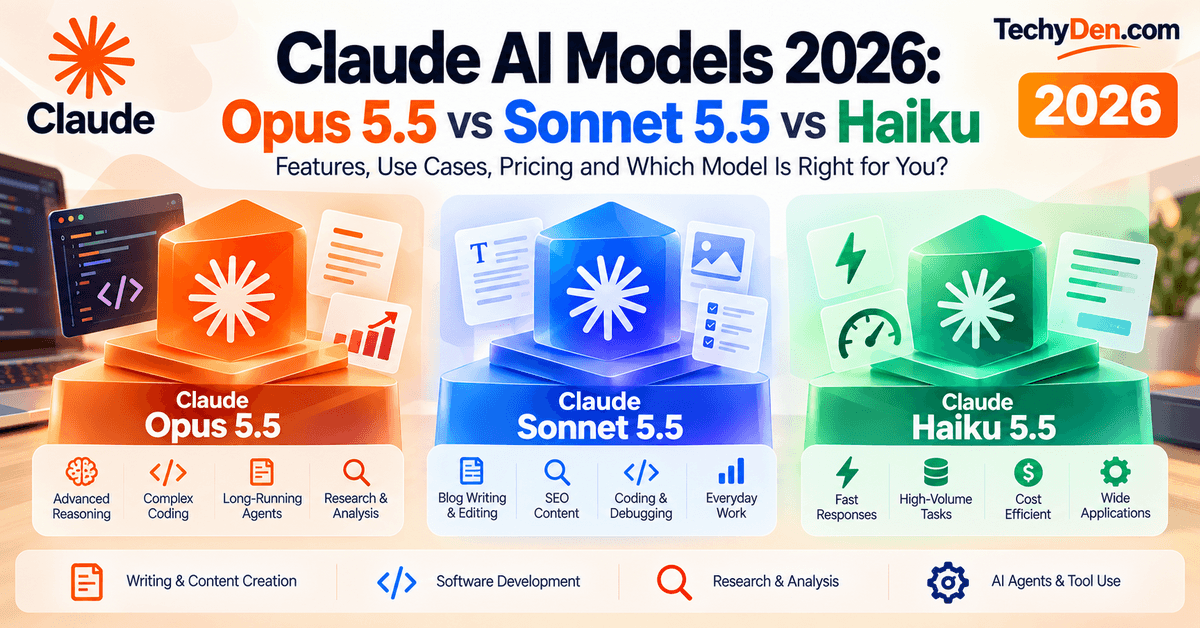
Claude AI Models 2026: Opus 5.5 vs Sonnet 5.5 vs Haiku
If you’re exploring AI tools in 2026, you’ve probably come across Claude, Anthropic’s AI assistant and family of large language models. Claude is used for writing, coding, research, analysis, document work, and increasingly complex agentic workflows.
But Claude isn’t a single AI model. Anthropic offers different Claude models designed to balance capability, reasoning, speed, and cost for different types of tasks.
The Claude model lineup has also changed significantly in 2026. Anthropic’s latest generation includes Claude Opus 5.5 and Claude Sonnet 5.5, while Claude Haiku 5.5 is the next model in the 5.5 family.
In this guide, we’ll explain the latest Claude AI models, compare Opus, Sonnet, and Haiku, look at their pricing and capabilities, and show which Claude model makes the most sense for blogging, SEO, coding, research, and everyday AI tasks.
What Is Claude AI?
Claude is an AI assistant and family of large language models developed by Anthropic, an AI research and safety company founded in 2021 by former OpenAI employees including Dario Amodei and Daniela Amodei.
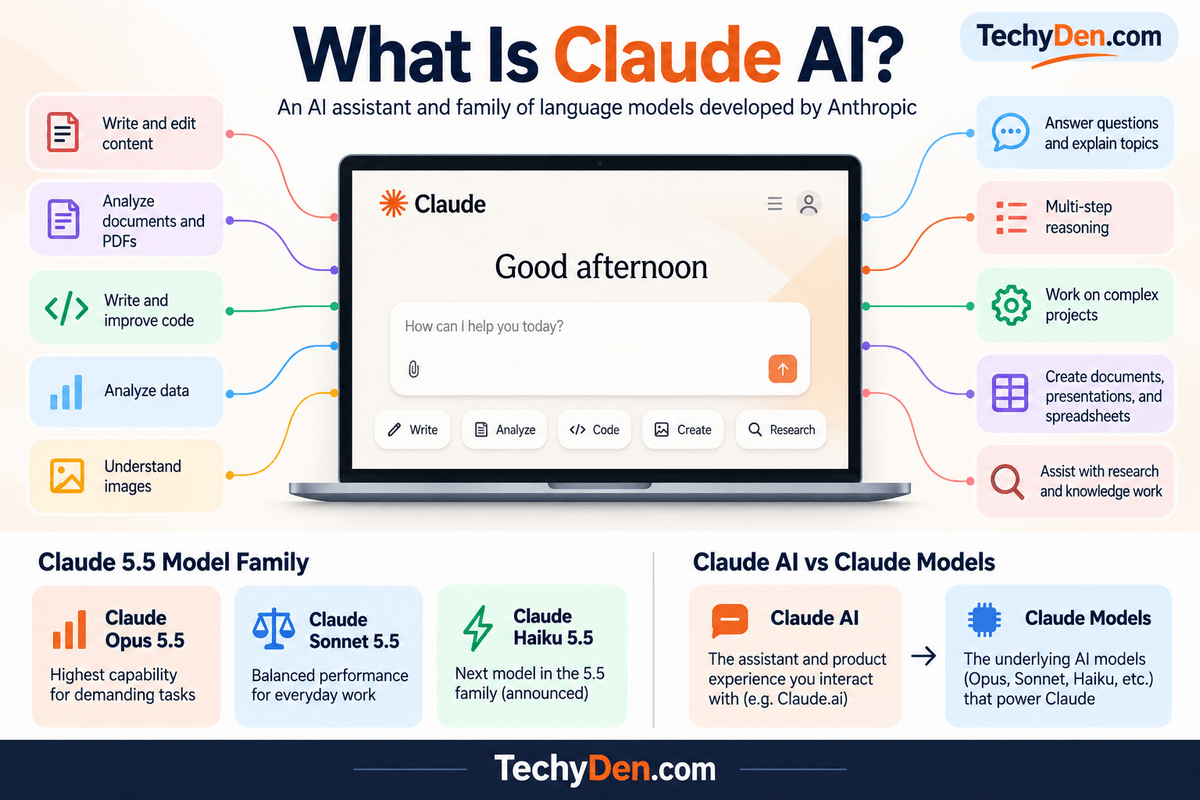
The name Claude can refer to both the AI assistant available through Claude.ai and the underlying Claude models that power Anthropic’s products and developer services. Different Claude models are designed to balance intelligence, reasoning ability, speed, and cost for different workloads.
Anthropic has developed Claude with a strong emphasis on AI safety and responsible development. One of the approaches associated with Claude’s development is constitutional AI, a method in which models are trained using a set of principles intended to guide their behavior and improve helpfulness, safety, and reliability.
What Can Claude AI Do?
Depending on the Claude model and product you use, Claude can help with tasks such as:
- Writing, rewriting, editing, and summarizing content
- Analyzing documents, PDFs, research papers, and other files
- Answering questions and explaining complex topics
- Writing, debugging, reviewing, and improving code
- Analyzing data and structured information
- Understanding images and other visual information
- Performing multi-step reasoning and agentic tasks
- Working with long and complex projects
- Creating and working with documents, presentations, and spreadsheets
- Assisting with research and professional knowledge work
Claude’s capabilities vary by model, platform, plan, and available features. Anthropic’s current Claude lineup includes the Opus 5.5 and Sonnet 5.5 models, with Haiku 5.5 announced as the next addition to the 5.5 family.
For a detailed comparison, see our Claude AI models comparison below, where we examine the differences between Opus, Sonnet, and Haiku and explain which model is better suited to different types of work.
Claude AI vs Claude Models
It’s useful to distinguish between the Claude product and Claude models.
Claude AI is the assistant and product experience that users interact with, while Claude models are the underlying AI models that perform the actual language, reasoning, coding, vision, and other tasks.
Anthropic also provides Claude through developer platforms and APIs, allowing developers and businesses to integrate Claude models into their own applications and workflows.
Claude has evolved through several generations since its initial release. Rather than listing every historical model in this section, we’ve covered the major releases separately in our Claude model release timeline.
Anthropic and the Philosophy Behind Claude
To understand Claude, it helps to understand the company behind it. Anthropic is an AI research and safety company founded in 2021 by former OpenAI employees, including Dario and Daniela Amodei. The company develops AI systems with a strong focus on safety, reliability, and responsible deployment.
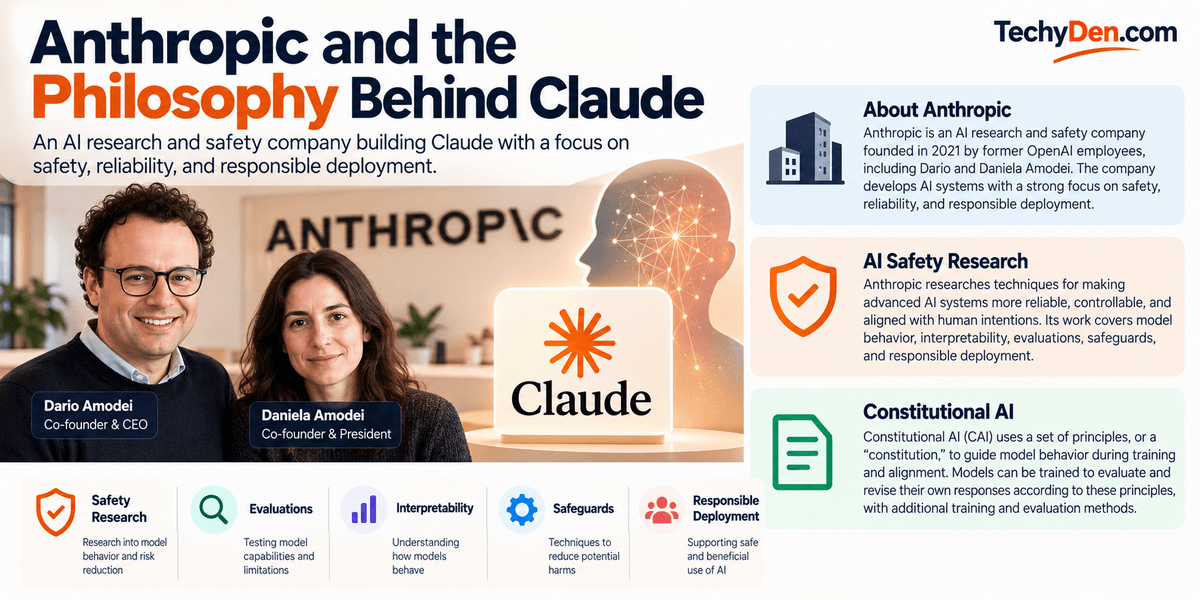
Anthropic’s approach is relevant to Claude because safety research is incorporated into the development and evaluation of its models rather than treated solely as a separate product feature.
Anthropic’s Approach to AI Safety
Anthropic researches techniques for making advanced AI systems more reliable, controllable, and aligned with human intentions. Its work covers areas including model behavior, interpretability, evaluations, safeguards, and responsible deployment.
For Claude users, this means that model capabilities are developed alongside research into how the models behave, where they can fail, and how their risks can be evaluated and reduced.
However, Claude is still an AI system and can produce incorrect or misleading information. Important facts, citations, technical instructions, and other consequential information should be independently verified.
What Is Constitutional AI?
Constitutional AI (CAI) is one of Anthropic’s approaches to training AI assistants. It uses a set of principles, or a “constitution,” to guide model behavior during parts of the training and alignment process.
The approach was developed to reduce the need for human feedback on every individual harmful or undesirable response. Instead, models can be trained to evaluate and revise their own responses according to specified principles, with additional training and evaluation used to improve the resulting behavior.
Constitutional AI is an important part of Anthropic’s research history, but it should not be interpreted as a guarantee that Claude will always produce safe, accurate, or unbiased answers.
For everyday users, the practical takeaway is simple: Claude’s behavior is shaped by both its underlying model capabilities and Anthropic’s training, safety, and evaluation methods. The specific capabilities and limitations still vary between Claude models and products.
Key Features and Capabilities of Claude AI
Claude has evolved from a conversational AI assistant into a platform capable of handling writing, coding, research, document analysis, reasoning, and complex multi-step workflows. The exact capabilities available to you depend on the Claude model, product, plan, and platform.
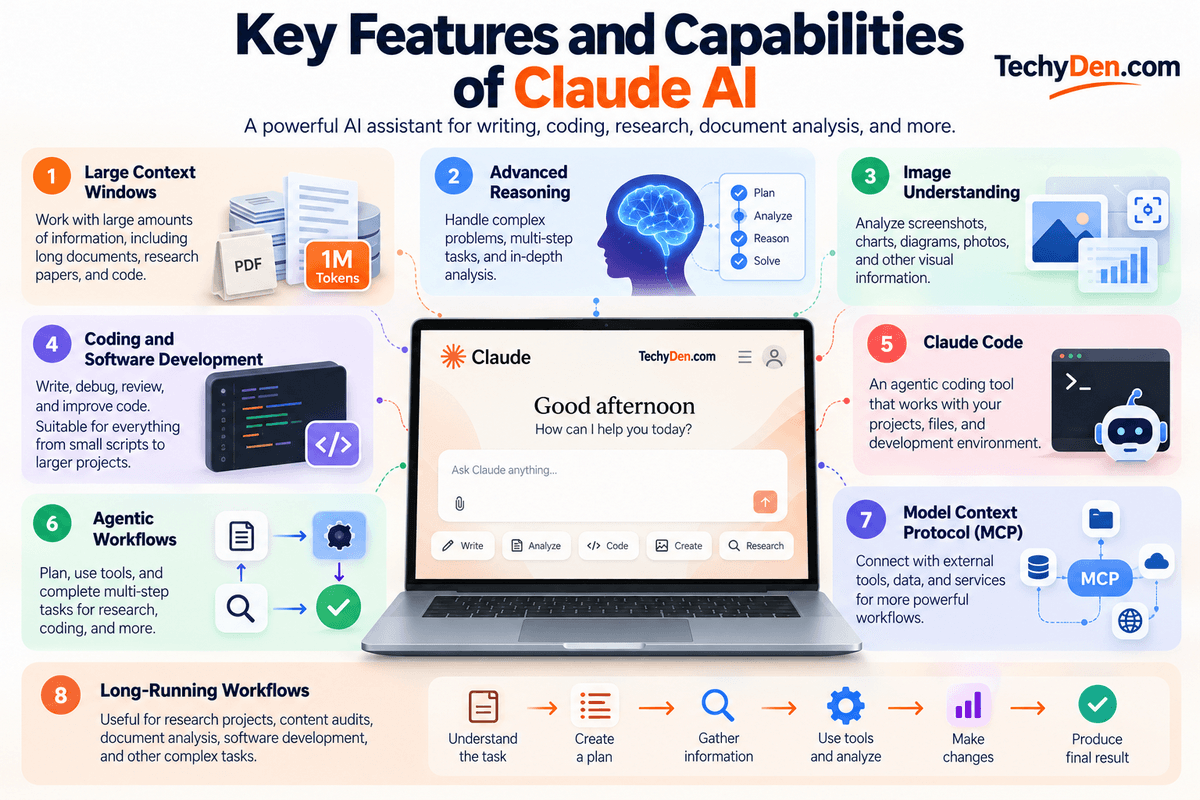
Here are some of the most important capabilities of modern Claude models.
1. Large Context Windows
Claude can work with large amounts of information within a single conversation or task. This is particularly useful when analyzing lengthy documents, research papers, technical documentation, or large amounts of code.
A large context window allows Claude to consider more information at the same time instead of requiring you to divide a large project into many smaller prompts.
However, context-window limits vary between Claude models and platforms. Therefore, you should check Anthropic’s current documentation for the specific model and product you are using.
2. Advanced Reasoning
Claude’s newer models are designed to handle complex reasoning and multi-step problems rather than simply generating an immediate response.
Reasoning capabilities can be useful for:
- Complex research questions
- Technical analysis
- Mathematics and logic
- Programming and debugging
- Planning multi-step projects
- Analyzing large amounts of information
- Comparing different solutions
Depending on the model and configuration, Claude can adjust the amount of reasoning used for a task. More complex problems may require additional computation, while simple requests can be handled more quickly.
3. Image Understanding
Claude supports image understanding, allowing you to provide images alongside text and ask questions about their contents.
For example, you can use Claude to:
- Analyze screenshots
- Explain charts and diagrams
- Read information from supported visual documents
- Review website or application screenshots
- Describe photographs
- Analyze visual layouts
- Help interpret technical diagrams
Claude’s image capabilities are primarily focused on understanding and analyzing visual information, rather than generating images.
4. Coding and Software Development
Coding is one of Claude’s major use cases. Claude can help developers write, explain, debug, review, refactor, and improve code.
Depending on the model and product, Claude can also work through more complex development tasks involving multiple files and steps.
Common coding tasks include:
- Writing new code
- Debugging errors
- Explaining existing code
- Code reviews
- Refactoring
- Writing tests
- Finding potential bugs
- Working with large codebases
- Planning software projects
Claude Opus 5.5 is designed for demanding coding and agentic workloads, while Sonnet 5.5 provides a faster and lower-cost option for many everyday coding tasks. Anthropic specifically positions both models for modern software-development workflows.
5. Claude Code
Claude Code is Anthropic’s coding-focused agent for working with software projects and development environments.
Instead of simply generating code in a chat window, Claude Code can work through development tasks using tools and project files. Depending on the setup, it can inspect code, modify files, run commands, investigate problems, and help complete multi-step development tasks.
This makes Claude Code particularly useful for developers working on real-world projects rather than isolated code snippets.
6. Agentic Workflows
Modern Claude models can be used for tasks that involve multiple steps, planning, tool use, and iterative work.
For example, an agentic workflow might involve Claude:
- Understanding a task
- Creating a plan
- Gathering information
- Using available tools
- Analyzing the results
- Making changes
- Checking the work
- Producing a final result
These capabilities are especially useful for coding, research, data analysis, content workflows, and other complex projects.
The exact agentic capabilities available depend on the Claude model and the product or platform you are using.
7. Model Context Protocol (MCP)
Claude can also work with external tools and data through Model Context Protocol (MCP).
MCP is an open protocol designed to provide a standardized way for AI applications to connect with external tools, services, files, databases, and other data sources.
For developers, this can make it possible to build Claude-powered workflows that interact with information and tools outside the AI model itself.
For example, an MCP-based workflow could allow an AI assistant to access information from a connected application, retrieve data, or perform an action through an approved external tool.
8. Long-Running Workflows
Claude can be useful for projects that require multiple interactions or extended work rather than a single question and answer.
Examples include:
- Research projects
- Large content audits
- Software development
- Document analysis
- Business analysis
- Data-related tasks
- Multi-step planning
Features such as context management and compaction can help manage information during longer workflows, although the exact behavior depends on the model and platform.
Important: Claude Capabilities Vary by Model
Not every Claude model has exactly the same capabilities, performance, speed, context limits, or pricing.
For example, Claude Opus 5.5 is positioned for demanding tasks that require greater reasoning and sustained work, while Claude Sonnet 5.5 is designed to provide a balance of capability, speed, and cost for a broad range of everyday professional tasks.
Therefore, the best Claude model depends on what you are trying to accomplish.
In the next sections, we’ll look at the current Claude models individually and compare Opus 5.5, Sonnet 5.5, and the upcoming Haiku 5.5 so you can choose the model that fits your workflow.
All Claude Models Explained in 2026
Anthropic’s Claude model lineup has changed significantly during 2026. The current generation includes Claude Opus 5.5 and Claude Sonnet 5.5, while Anthropic has announced Claude Haiku 5.5 as the next addition to the Claude 5.5 family.
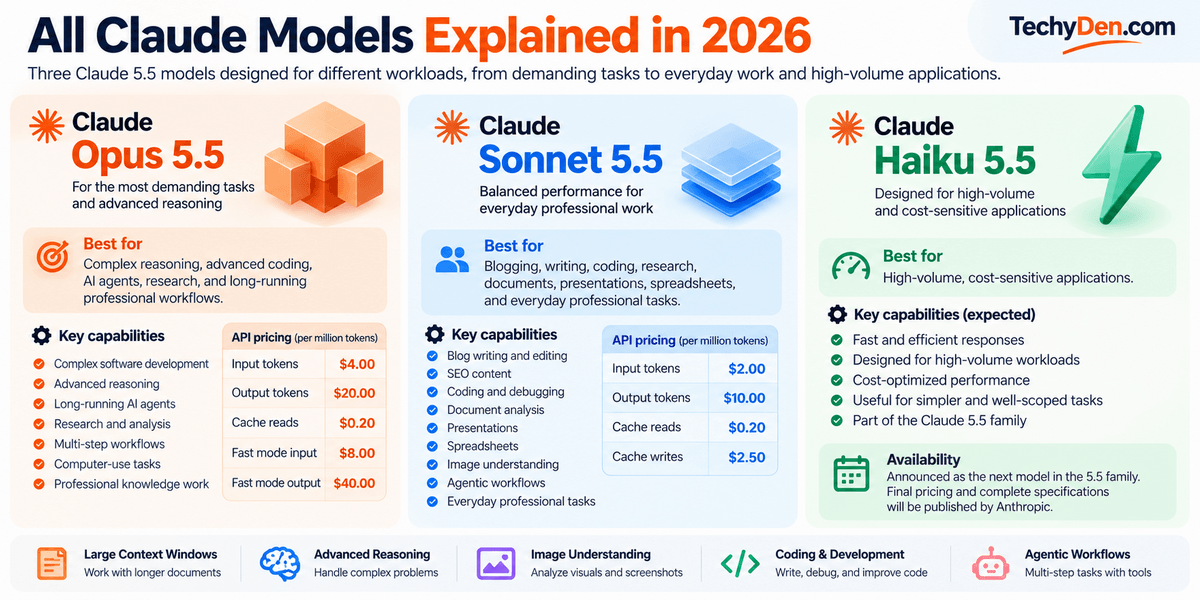
Different Claude models are designed for different workloads. Opus is positioned for the most demanding tasks requiring sustained judgment, while Sonnet provides a faster and lower-cost option for many everyday professional, coding, and knowledge-work tasks. Haiku 5.5 is intended for high-volume and cost-sensitive applications when it becomes available.
1. Claude Opus 5.5
Best for: Complex reasoning, advanced coding, AI agents, research, and long-running professional workflows.
Claude Opus 5.5 is Anthropic’s flagship Claude model and the first model in the Claude 5.5 family. Anthropic introduced it on September 22, 2026, describing it as a major improvement over Opus 5 for complex work. Anthropic also says Opus 5.5 costs about 40% less to run than Opus 5 for typical workloads.
Key capabilities
Opus 5.5 is designed for demanding tasks such as:
- Complex software development
- Large codebase work
- Advanced reasoning
- Long-running AI agents
- Research and analysis
- Professional knowledge work
- Multi-step workflows
- Computer-use tasks
- Tasks requiring sustained judgment
Anthropic describes Opus 5.5 as its strongest Opus model and makes it available through Claude for Pro, Max, Team, and Enterprise users, as well as through the Claude Platform and major cloud platforms.
Claude Opus 5.5 API pricing
| Pricing | Cost |
|---|---|
| Input tokens | $4 per million |
| Output tokens | $20 per million |
| Cache reads | $0.20 per million |
| Fast mode input | $8 per million |
| Fast mode output | $40 per million |
Anthropic also offers US-only inference at 1.1× pricing for workloads that require US-only processing.
When should you use Opus 5.5?
Consider Opus 5.5 when the task requires substantial reasoning, complex coding, long-running agentic work, or a high degree of judgment.
For routine writing, simple questions, and less demanding tasks, Sonnet 5.5 may provide a better balance of capability, speed, and cost.
2. Claude Sonnet 5.5
Best for: Blogging, writing, coding, research, documents, presentations, spreadsheets, and everyday professional work.
Claude Sonnet 5.5 is the second model in Anthropic’s Claude 5.5 family. Anthropic introduced it on September 28, 2026, positioning it as a faster and lower-cost complement to Opus 5.5.
Anthropic reports that Sonnet 5.5 generates output more than 30% faster than Sonnet 5 and can cost up to 30% less per task because it typically requires fewer tokens to complete the same work.
Key capabilities
Sonnet 5.5 is designed for:
- Blog writing and editing
- SEO content
- Coding and debugging
- Software development
- Research
- Document analysis
- Presentations
- Spreadsheets
- Image understanding
- Agentic workflows
- Everyday professional tasks
Anthropic describes Sonnet 5.5 as particularly strong for well-scoped everyday tasks, fixing bugs, and creating polished documents, presentations, and spreadsheets.
Claude Sonnet 5.5 API pricing
| Pricing | Cost |
|---|---|
| Input tokens | $2 per million |
| Output tokens | $10 per million |
| Cache reads | $0.20 per million |
| Cache writes | $2.50 per million |
These are the current prices published by Anthropic for Sonnet 5.5.
When should you use Sonnet 5.5?
Sonnet 5.5 is a practical choice when you need strong AI capabilities without using the more expensive Opus tier for every task.
For bloggers and content creators, it can be useful for creating outlines, drafting and editing articles, analyzing content, researching topics, generating SEO briefs, and working with existing documents.
For developers, it can handle many coding, debugging, code-review, and software-development tasks while providing faster responses than the previous Sonnet generation.
3. Claude Haiku 5.5
Best for: High-volume, cost-sensitive applications.
Anthropic has announced Claude Haiku 5.5 as the next member of the Claude 5.5 family. Anthropic says it is being designed for high-volume and cost-sensitive applications and will join the Claude 5.5 family in the coming weeks.
At the time of this article’s October 2026 update, Anthropic has not published the final Haiku 5.5 pricing and complete specifications in the sources used for this guide.
Therefore, we are not listing estimated pricing or unverified specifications here.
When officially available, Haiku 5.5 is expected to be particularly relevant to applications where response speed, throughput, and cost efficiency are important.
Claude Opus 5.5 vs Sonnet 5.5 vs Haiku 5.5
The three models are designed around different workload requirements rather than being interchangeable versions of the same product.
| Feature | Claude Opus 5.5 | Claude Sonnet 5.5 | Claude Haiku 5.5 |
|---|---|---|---|
| Model position | Flagship | Mainstream | Lightweight |
| Best for | Complex work and agents | Everyday professional work | High-volume workloads |
| Complex reasoning | Excellent | Very strong | To be confirmed |
| Coding | Excellent | Excellent | To be confirmed |
| Agentic workflows | Excellent | Strong | To be confirmed |
| Writing | Excellent | Excellent | To be confirmed |
| Research | Excellent | Strong | To be confirmed |
| Speed | Fast | 30%+ faster than Sonnet 5 | To be confirmed |
| Input price | $4/M | $2/M | Not announced |
| Output price | $20/M | $10/M | Not announced |
| Availability | Available | Available | Coming |
Anthropic’s own guidance emphasizes that Opus 5.5 remains stronger for complex, open-ended work requiring sustained judgment, while Sonnet 5.5 is designed as the faster, lower-cost option for many well-scoped tasks.
Which Claude model should you choose?
- Choose Opus 5.5 when maximum capability and sustained reasoning are more important than cost.
- Choose Sonnet 5.5 when you want a strong balance of capability, speed, and cost for writing, coding, research, documents, and everyday professional work.
- Consider Haiku 5.5 for high-volume and cost-sensitive applications once it becomes available and its final specifications are published.
The right choice ultimately depends on the workload rather than simply choosing the model with the highest specifications.
Claude Model Generation History: From Claude 1 to Claude 5.5
Claude has gone through several major generations since Anthropic introduced its first models in 2023. Each generation has expanded Claude’s capabilities in areas such as reasoning, coding, context handling, multimodal understanding, tool use, and agentic workflows.
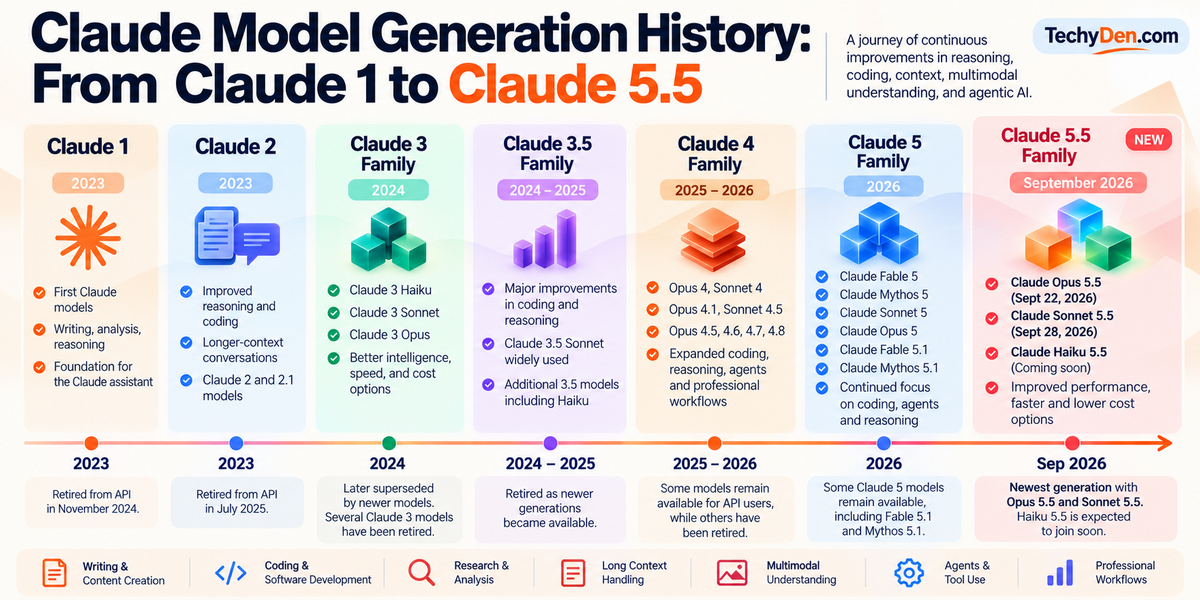
Here’s a simplified timeline of the major Claude generations.
1. Claude 1 — 2023
Claude 1 was among Anthropic’s first publicly available Claude models. It established the foundation for the Claude assistant and demonstrated capabilities in areas such as writing, analysis, reasoning, and conversation.
Claude 1 is now a historical model rather than a current option. Anthropic retired the Claude 1 API models in November 2024.
2. Claude 2 — 2023
Claude 2 followed in July 2023 and brought improvements in reasoning, coding, analysis, and longer-context conversations.
Claude 2 and Claude 2.1 were subsequently retired from the Claude API in July 2025.
3. Claude 3 Family — 2024
The Claude 3 generation introduced the Haiku, Sonnet, and Opus model tiers that became an important part of Anthropic’s model strategy.
The family included:
- Claude 3 Haiku
- Claude 3 Sonnet
- Claude 3 Opus
The three models were designed to provide different balances of intelligence, speed, and cost. Anthropic introduced the Claude 3 family in March 2024.
The Claude 3 generation was later superseded by newer models, and several of the original Claude 3 models have since been retired from the API.
4. Claude 3.5 Family — 2024–2025
Claude 3.5 introduced major improvements over the original Claude 3 generation, particularly in coding, reasoning, and practical knowledge work.
Claude 3.5 Sonnet became widely used for software development and other demanding tasks, followed by additional 3.5-generation models including Haiku.
Anthropic later retired the Claude 3.5 models as newer generations became available.
5. Claude 4 Family — 2025–2026
The Claude 4 generation significantly expanded Claude’s capabilities for coding, reasoning, agents, and professional workflows.
Important releases included:
- Claude Opus 4
- Claude Sonnet 4
- Claude Opus 4.1
- Claude Sonnet 4.5
- Claude Opus 4.5
- Claude Opus 4.6
- Claude Sonnet 4.6
- Claude Opus 4.7
- Claude Opus 4.8
Anthropic introduced Opus 4.7 in April 2026 with improvements in advanced software engineering, vision, and complex multi-step tasks.
Opus 4.8 followed in May 2026 with additional improvements in coding, agentic tasks, and professional work. Anthropic also introduced user-controlled effort settings, dynamic workflows in Claude Code, and a faster mode for Opus 4.8.
Some Claude 4 models remain available for API users, while others have been retired. Therefore, historical model names should not be confused with Anthropic’s newest models.
6. Claude 5 Family — 2026
The Claude 5 generation introduced new model families and continued Anthropic’s focus on coding, agents, reasoning, and professional knowledge work.
Important releases during 2026 included:
- Claude Fable 5
- Claude Mythos 5
- Claude Sonnet 5
- Claude Opus 5
- Claude Fable 5.1
- Claude Mythos 5.1
Anthropic’s September 2026 system-card archive lists Fable 5.1 and Mythos 5.1 alongside the newer Opus 5.5 release.
7. Claude 5.5 Family — September 2026
The newest major generation is the Claude 5.5 family.
a. Claude Opus 5.5 — September 22, 2026
Anthropic introduced Claude Opus 5.5 on September 22, 2026, describing it as the first model in the Claude 5.5 family. Anthropic says Opus 5.5 performs at the level of Fable 5.1 on most work while costing 40% less to run than Opus 5.
Opus 5.5 is positioned for demanding work involving complex reasoning, coding, agents, and professional knowledge work.
b. Claude Sonnet 5.5 — September 28, 2026
Anthropic introduced Claude Sonnet 5.5 six days later on September 28, 2026.
Sonnet 5.5 is positioned as a faster and lower-cost complement to Opus 5.5. Anthropic says it is particularly suited to well-scoped everyday tasks, coding, bug fixing, documents, presentations, and spreadsheets.
c. Claude Haiku 5.5 — Coming Soon
Anthropic has also announced Claude Haiku 5.5 as the next member of the 5.5 family. The company says Haiku 5.5 is being developed for high-volume and cost-sensitive applications and will join the family in the coming weeks.
At the time of this October 2026 update, we are not listing unannounced Haiku 5.5 pricing or specifications.
Claude Model Evolution at a Glance
| Generation | Major period | Key development |
|---|---|---|
| Claude 1 | 2023 | Foundation of Claude |
| Claude 2 | 2023 | Improved reasoning and coding |
| Claude 3 | 2024 | Haiku, Sonnet and Opus tiers |
| Claude 3.5 | 2024–2025 | Major improvements in coding and practical work |
| Claude 4 | 2025–2026 | Stronger reasoning, coding and agentic capabilities |
| Claude 5 | 2026 | New model families and stronger agents |
| Claude 5.5 | September 2026 | Opus 5.5 and Sonnet 5.5 |
The model family continues to evolve quickly, so historical model names should be treated as part of Claude’s development timeline rather than as recommendations for new projects.
How to Access Claude AI
You can access Claude through Anthropic’s own applications, developer APIs, and several major cloud platforms. The best option depends on whether you want to use Claude for everyday tasks, professional workflows, software development, or building your own applications.
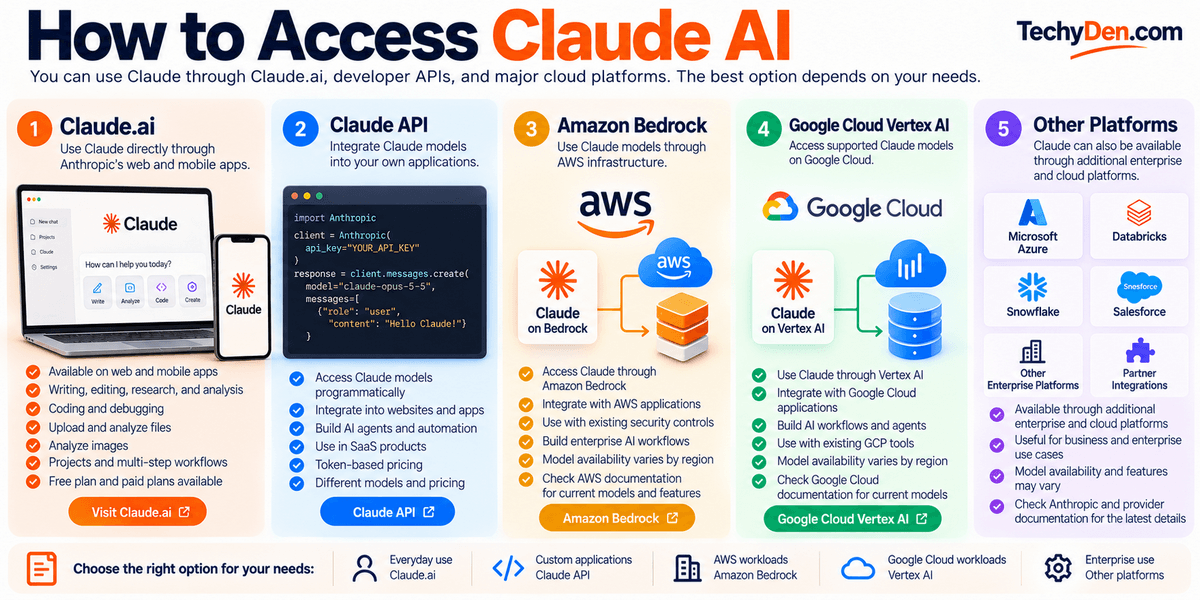
1. Claude.ai
Claude.ai is Anthropic’s primary interface for using Claude directly.
You can use Claude through the web and supported mobile applications for tasks such as:
- Writing and editing
- Research and analysis
- Coding
- Summarizing documents
- Working with uploaded files
- Analyzing images
- Creating and working with projects
- Multi-step AI workflows
Claude is available through different subscription tiers, including a free option and paid plans. The available models, usage limits, and features can vary by plan and can change as Anthropic releases new models.
For the latest subscription prices and included features, check Anthropic’s official Claude pricing page rather than relying on a fixed price in this article.
2. Claude API
Developers can access Claude models programmatically through the Claude API.
The API allows developers to integrate Claude into:
- Websites
- Mobile applications
- SaaS products
- AI agents
- Automation workflows
- Internal business applications
- Customer-support systems
- Content and research tools
API usage is generally billed based on the number of input and output tokens used. Pricing varies by Claude model, so developers should check the current pricing for the specific model they plan to use.
For example, as of this October 2026 update, Anthropic lists Opus 5.5 at $4 per million input tokens and $20 per million output tokens, while Sonnet 5.5 is priced at $2 per million input tokens and $10 per million output tokens.
3. Amazon Bedrock
Claude models are also available through Amazon Bedrock, allowing organizations to use Anthropic models through AWS infrastructure.
This can be useful for businesses that already use AWS and want to incorporate Claude into existing cloud applications, security controls, data workflows, and enterprise infrastructure.
Availability of specific Claude models and features can vary by AWS region and over time, so organizations should check the current Amazon Bedrock documentation before deploying a particular model.
4. Google Cloud Vertex AI
Organizations can also access supported Claude models through Google Cloud’s Vertex AI platform.
This option can be useful for teams that already use Google Cloud and want to integrate Claude into existing cloud-based applications and AI workflows.
As with AWS Bedrock, model availability can vary by region and platform configuration.
5. Other Enterprise and Cloud Platforms
Anthropic’s models can also be made available through additional enterprise and cloud platforms. The exact models, regions, pricing, features, and availability can change as new Claude generations are released.
For this reason, it is better to check Anthropic and the relevant cloud provider’s current documentation before choosing a deployment platform.
Which Way Should You Use Claude?
Your choice depends mainly on what you want to accomplish:
| What you want to do | Recommended access method |
|---|---|
| Chat with Claude | Claude.ai |
| Write blog posts | Claude.ai |
| Analyze documents | Claude.ai |
| Use Claude for everyday work | Claude.ai |
| Build an AI application | Claude API |
| Build an AI agent | Claude API |
| Integrate Claude into your software | Claude API |
| Use Claude within AWS infrastructure | Amazon Bedrock |
| Use Claude within Google Cloud | Vertex AI |
| Deploy Claude in an enterprise environment | API or supported cloud platform |
For most individual users and content creators, Claude.ai is the simplest starting point. Developers building their own applications will generally want the API, while organizations can evaluate the cloud deployment options that fit their existing infrastructure and security requirements.
Claude AI Pricing Plans 2026
Claude offers several plans for individual users, power users, teams, and enterprises. The plans differ primarily in usage capacity, access to features, collaboration tools, and billing structure.
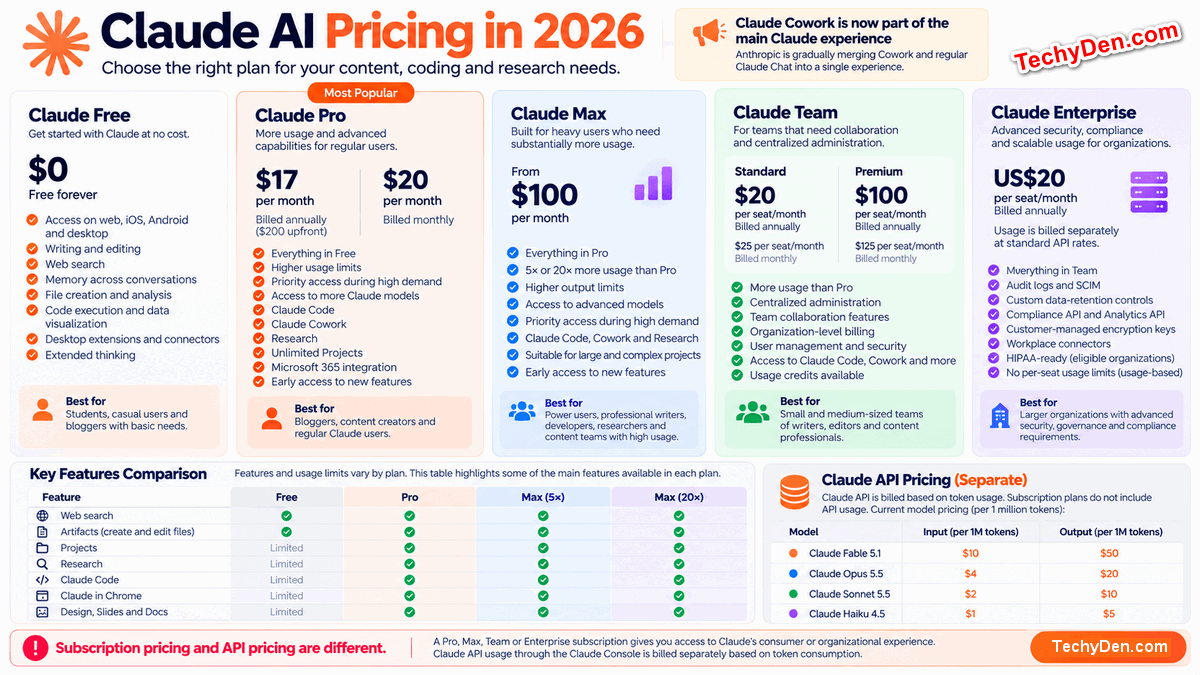
Anthropic’s individual plans currently include Free, Pro, Max 5x, and Max 20x. Team and Enterprise plans are designed for organizations.
Claude Pricing at a Glance
| Plan | Price | Best for | Key features |
|---|---|---|---|
| Free | $0 | Occasional users | Limited Claude usage |
| Pro | $20/month or $200/year | Regular individual users | Higher usage, Claude Code, priority access, longer tasks |
| Max 5x | $100/month | Frequent users | 5x Pro usage capacity per session |
| Max 20x | $200/month | Heavy users | 20x Pro usage capacity per session |
| Team Standard | $25/user/month or $20/user/month annually | Teams | Higher usage, admin controls, collaboration |
| Team Premium | $125/user/month or $100/user/month annually | Heavy team users | Significantly higher usage capacity |
| Enterprise | Usage-based | Large organizations | Enterprise security, administration, compliance, and usage-based billing |
Prices shown above are based on Anthropic’s published U.S. pricing and can vary by country, currency, taxes, billing interval, and plan availability. Check Anthropic’s current pricing page before purchasing.
1. Claude Free Plan
The Free plan costs $0 and is designed for occasional Claude use.
It provides access to Claude with limited usage. The amount you can use Claude depends on current usage limits and other factors, which Anthropic can change as capacity and product features evolve.
The Free plan is suitable for users who want to try Claude before paying for a subscription.
2. Claude Pro
Claude Pro costs $20 per month in the United States or $200 per year when billed annually.
Pro provides more usage than the Free plan and includes features such as:
- Higher usage capacity
- Priority access during high-traffic periods
- Claude Code
- Access to longer, multi-step tasks
- Early access to selected new features
Anthropic’s current documentation states that Claude Pro is a subscription for the Claude chat experience and does not include Claude API usage. Developers using the API need separate Console/API billing.
3. Claude Max 5x
Claude Max 5x costs $100 per month.
It provides approximately 5 times the Pro usage capacity per session and is designed for users who work with Claude frequently and need more capacity than Pro provides.
Max subscribers also receive priority access to newer models and features.
4. Claude Max 20x
Claude Max 20x costs $200 per month.
It provides approximately 20 times the Pro usage capacity per session and is aimed at users who rely heavily on Claude throughout the day.
Both Max tiers include Claude Code access and higher usage capacity than Pro.
5. Claude Team
Claude Team is designed for organizations rather than individual users and requires a minimum of two members.
Anthropic currently offers two Team seat types:
| Team seat | Monthly price | Annual price |
|---|---|---|
| Standard | $25/user/month | $20/user/month |
| Premium | $125/user/month | $100/user/month |
Team plans provide organization-level administration and billing, identity and access controls such as SSO and Domain Capture, increased usage, and collaboration features.
Premium seats provide substantially more usage than Standard seats and are intended for team members who need greater capacity.
6. Claude Enterprise
Claude Enterprise is designed for organizations that require additional security, compliance, administration, and scalable usage.
The current Enterprise model uses a seat fee plus usage-based billing. The seat provides access to Claude on web, desktop, and mobile, as well as Claude Code, while usage is billed separately according to actual consumption at standard API rates.
Enterprise features include options such as:
- Advanced identity and access management
- Audit logs
- SCIM
- Custom data-retention controls
- Compliance API
- Analytics API
- Customer-managed encryption keys
- US-only inference
- Workplace connectors
- Usage and spending controls
Enterprise is therefore intended for organizations with more demanding security, compliance, and governance requirements.
Claude Subscription vs Claude API
One of the most important things to understand about Claude pricing is that a Claude subscription and Claude API access are separate products.
Paying for Claude Pro, Max, Team, or Enterprise does not automatically give an individual user unlimited API access.
The Claude API is billed separately according to model usage, generally based on input and output tokens.
For example, Anthropic currently lists:
| Model | Input | Output |
|---|---|---|
| Claude Opus 5.5 | $4 / million tokens | $20 / million tokens |
| Claude Sonnet 5.5 | $2 / million tokens | $10 / million tokens |
These API prices are separate from the monthly Claude subscription plans.
Which Claude Plan Should You Choose?
Your choice depends on how frequently you use Claude and what you want to do with it.
- Choose Free if you only need occasional AI assistance.
- Choose Pro if you regularly use Claude for writing, research, coding, content creation, and other professional tasks.
- Choose Max 5x if Pro’s usage limits are frequently restrictive.
- Choose Max 20x if Claude is a major part of your daily workflow and you need substantially more capacity.
- Choose Team if multiple people need Claude with centralized administration and collaboration.
- Choose Enterprise if your organization requires advanced security, compliance, governance, and usage-based deployment.
Because Anthropic can change pricing, usage limits, and included features, verify the current plan details before subscribing.
Which Claude Model Should You Use?
The best Claude model depends on the type of work you want to perform. You don’t necessarily need the most expensive or most capable model for every task.
Anthropic’s current Claude 5.5 generation includes Opus 5.5 and Sonnet 5.5, while Haiku 5.5 is the next model in the family. Opus 5.5 is designed for demanding work requiring sustained reasoning and judgment, while Sonnet 5.5 is designed to provide a balance of capability, speed, and cost for a broad range of professional tasks. (anthropic.com)
Claude Model Recommendations by Use Case
| Use case | Model to consider | Why |
|---|---|---|
| Blog writing | Sonnet 5.5 | Strong writing, editing, research, and instruction following |
| SEO content | Sonnet 5.5 | Useful for content briefs, analysis, optimization, and research |
| Complex content audits | Opus 5.5 | Better suited to complex, multi-step analysis |
| Software development | Opus 5.5 or Sonnet 5.5 | Both are designed for coding; choose based on complexity and cost |
| Large coding projects | Opus 5.5 | Designed for demanding and long-running engineering work |
| Everyday coding | Sonnet 5.5 | Strong capability with lower API cost than Opus |
| Research | Sonnet 5.5 or Opus 5.5 | Choose based on complexity and depth required |
| Complex research | Opus 5.5 | Designed for sustained reasoning and difficult tasks |
| Document analysis | Sonnet 5.5 | Strong fit for everyday professional knowledge work |
| AI agents | Opus 5.5 or Sonnet 5.5 | Both support agentic workflows |
| High-volume applications | Haiku 5.5 when available | Designed for high-volume, cost-sensitive workloads |
| Maximum capability | Opus 5.5 | Anthropic’s current flagship Opus model |
Best Claude Model for Bloggers and Content Creators
For most blogging and content-creation workflows, Sonnet 5.5 is the model to consider first.
You can use it for:
- Blog outlines
- Article drafting
- Content editing
- Content updates
- SEO content briefs
- Search-intent analysis
- FAQ generation
- Content summarization
- Research assistance
- Content repurposing
- Analyzing existing articles
For a large content audit or a complex multi-step research project, Opus 5.5 may be more appropriate when the task requires deeper reasoning and sustained work.
For TechyDen-style workflows, a practical approach is to use Sonnet 5.5 for routine content work and reserve Opus 5.5 for more complex projects.
Best Claude Model for SEO
Sonnet 5.5 can handle many everyday SEO workflows, including:
- Search-intent analysis
- Content briefs
- Topic research
- Competitor-content analysis
- FAQ research
- Content optimization
- Internal-link suggestions
- Existing-content updates
For large-scale content audits, complex research, or workflows involving many interconnected steps, Opus 5.5 may be worth considering.
However, no Claude model can guarantee Google rankings. AI-generated SEO recommendations should be combined with search data, first-hand expertise, accurate sources, and human editorial review.
Best Claude Model for Coding
Both Opus 5.5 and Sonnet 5.5 are designed for software development.
Consider Sonnet 5.5 for:
- Everyday coding
- Debugging
- Code explanations
- Code reviews
- Writing tests
- Refactoring
- Smaller development tasks
Consider Opus 5.5 for:
- Large codebases
- Complex software architecture
- Difficult debugging
- Long-running coding tasks
- Complex agentic development workflows
- Tasks requiring more sustained reasoning
Anthropic specifically positions Opus 5.5 for advanced coding and long-running agentic work, while Sonnet 5.5 is positioned as a faster, lower-cost option for many coding and knowledge-work tasks.
Best Claude Model for Research
For everyday research and document analysis, Sonnet 5.5 can be a practical choice.
Use Opus 5.5 when the research task involves:
- Multiple interconnected questions
- Complex reasoning
- Large projects
- Detailed analysis
- Long-running workflows
- Difficult synthesis tasks
Regardless of the model, important research claims should be checked against primary sources and authoritative references.
Best Claude Model for AI Agents
Agentic workflows can involve planning, tool use, multiple steps, and iterative problem solving.
- Opus 5.5 is designed for complex agentic tasks that require sustained judgment.
- Sonnet 5.5 can be a more economical choice for well-defined agentic workflows where the task does not require the maximum level of reasoning.
For production applications, developers should evaluate both capability and total token cost rather than choosing solely based on the model name.
Best Claude Model for High-Volume Applications
Haiku 5.5 is intended for high-volume and cost-sensitive applications, according to Anthropic. However, at the time of this October 2026 update, Anthropic has announced the model but has not yet published all final specifications and pricing.
Once it becomes generally available, it may be relevant for applications where throughput, latency, and cost efficiency are more important than maximum model capability.
Quick Claude Model Selection Guide
If you’re still unsure which model to use, start with this simple rule:
- Choose Opus 5.5 for the most demanding reasoning, coding, research, and agentic tasks.
- Choose Sonnet 5.5 for everyday writing, blogging, SEO, coding, research, documents, and general professional work.
- Consider Haiku 5.5 for high-volume, cost-sensitive workloads once the model is available with published pricing and specifications.
The best model isn’t necessarily the most powerful one. The right choice depends on the complexity of the task, required speed, available budget, and how much reasoning the workflow actually needs.
Claude AI Safety: What Is Constitutional AI?
One of the defining aspects of Claude is Constitutional AI (CAI), an approach Anthropic developed to guide the behavior of its AI models using a set of written principles.
Unlike a system that relies only on human feedback to determine which responses are desirable, Constitutional AI gives the model explicit principles that describe the type of behavior Anthropic wants Claude to follow.
Anthropic has continued to evolve this approach, and its current Claude Constitution, published in January 2026, describes the values and behavioral principles intended to shape Claude.
What Is Constitutional AI?
Constitutional AI is a training and alignment approach in which AI models are guided by a written set of principles, known as a constitution.
These principles can be used during different stages of training to help models evaluate and improve their responses.
Anthropic has described Constitutional AI as a way to make the desired values and behavioral expectations of an AI system more explicit rather than relying entirely on implicit preferences learned from human feedback.
Anthropic’s current constitution describes several broad goals for Claude, including:
- Being broadly safe
- Acting ethically and avoiding harmful or deceptive behavior
- Following relevant Anthropic guidelines
- Being genuinely helpful to users
- Supporting appropriate human oversight
- Being honest and thoughtful when handling difficult situations
The constitution is not simply a list of rigid rules. Anthropic says it is intended to provide broader guidance that can help Claude navigate situations involving competing considerations, such as helpfulness, safety, honesty, and protection of sensitive information.
Constitutional AI vs. Human Feedback
Constitutional AI is sometimes described as an alternative to Reinforcement Learning from Human Feedback (RLHF), but the distinction is more nuanced.
Anthropic has used human feedback as well as Constitutional AI and other training and evaluation techniques in developing Claude models.
Constitutional AI adds another mechanism for shaping model behavior by using explicit principles and AI-assisted evaluation rather than depending entirely on human ratings for every training example.
This approach can make the intended behavioral principles more explicit and gives Anthropic a framework for evaluating and improving Claude’s responses.
Why Does Constitutional AI Matter?
Constitutional AI helps explain some of Claude’s behavior during conversations.
For example, Claude may:
- Acknowledge uncertainty instead of presenting an uncertain answer as a fact
- Refuse or redirect requests that could create significant harm
- Explain limitations when a request conflicts with safety requirements
- Consider privacy and other potential harms when responding
- Provide additional context when a question involves sensitive or high-risk information
However, Constitutional AI does not guarantee that Claude will always be accurate, unbiased, safe, or consistent. Anthropic explicitly notes that model behavior can differ from the ideals described in its constitution, which is why the company continues to use evaluations, safeguards, interpretability research, and other safety techniques.
Is Constitutional AI the Same as Claude’s Safety System?
No. Constitutional AI is one component of Anthropic’s broader approach to AI safety.
Anthropic also uses safety evaluations, safeguards, monitoring, interpretability research, model-specific testing, and other methods to assess how Claude behaves in real-world and adversarial situations.
In simple terms: Constitutional AI gives Anthropic a written framework for the behavior it wants Claude to develop, while additional training, testing, and safeguards help evaluate whether the resulting models actually behave according to those intentions.
For Claude users, the practical takeaway is that Claude’s responses are shaped not only by its language-model capabilities but also by Anthropic’s training, safety, and behavioral guidelines.
Claude AI Use Cases for Bloggers, Marketers, and Professionals
Claude can be useful for bloggers, affiliate marketers, SEO professionals, content writers, researchers, and other knowledge workers. The most suitable model depends on the complexity of the task, the amount of context involved, required speed, and cost.
For everyday content and professional work, Claude Sonnet 5.5 is positioned as a faster, lower-cost model for well-scoped tasks. Claude Opus 5.5 is designed for more demanding work that requires deeper reasoning, sustained effort, complex coding, or long-running agentic workflows.
1. Long-Form Content Creation
Claude can help create and revise long-form content when you provide relevant source material, outlines, drafts, style guidelines, research notes, and other reference information.
For example, a blogger can ask Claude to:
- Turn an outline into a complete article
- Rewrite an outdated article while preserving useful information
- Improve the structure of a long-form guide
- Combine information from multiple drafts
- Maintain a consistent tone across a large document
- Create introductions, conclusions, FAQs, and summaries
- Repurpose an article into social media posts or newsletters
Large-context capabilities can be particularly useful when an article depends on multiple reference documents. However, context limits and availability vary by model and product, so check Anthropic’s current documentation rather than assuming that every Claude model supports the same context size.
2. Research and Information Synthesis
Claude can analyze information that you provide and help organize it into a structured summary or research brief.
For bloggers and researchers, useful workflows include:
- Summarizing research papers and reports
- Comparing multiple documents
- Extracting key facts from supplied sources
- Identifying conflicting information
- Creating research notes
- Turning research into an article outline
- Finding unanswered questions that could become new content topics
Claude can still make mistakes or produce inaccurate information. Treat AI-generated research as a starting point rather than automatically verified evidence. For statistics, quotations, product specifications, scientific claims, and other important information, check the original source before publishing.
3. SEO Content Optimization
Claude can also assist with many parts of an SEO workflow. It can analyze content you provide and help you improve its organization, relevance, readability, and search intent.
For example, you can ask Claude to:
- Analyze the search intent behind a keyword
- Build a content outline
- Organize related keywords into topic clusters
- Suggest H2 and H3 headings
- Identify missing subtopics
- Improve title tags and meta descriptions
- Create FAQ sections
- Rewrite difficult passages for readability
- Compare your article structure with supplied competitor content
- Identify opportunities for stronger internal linking
- Improve topical coverage and content organization
Claude should not be treated as an automatic SEO ranking system. A strong SEO workflow still requires real search data, competitor research, first-hand experience, accurate information, useful content, and human editorial judgment.
4. Editing and Proofreading
Claude is particularly useful as an editorial assistant. Instead of asking only whether an article is “good,” you can give it specific criteria and ask for actionable recommendations.
For example, you can provide a complete article and ask Claude to check for:
- Repetitive sections
- Unclear sentences
- Inconsistent terminology
- Tonal changes
- Weak introductions
- Redundant headings
- Missing explanations
- Grammar and spelling issues
- Unsupported factual claims
- Poor transitions
- SEO structure
- Opportunities to improve reader experience
For a large article, it can be useful to divide the work into logical sections or use a workflow that preserves the necessary context.
5. Affiliate Content and Product Reviews
Claude can help affiliate publishers structure and improve product-focused content without simply producing generic promotional copy.
Useful tasks include:
- Creating product comparison tables
- Organizing specifications supplied by the publisher
- Writing product review outlines
- Identifying buyer questions
- Creating pros and cons sections
- Comparing products against specific criteria
- Updating outdated product information
- Creating FAQ sections
- Improving calls to action
Product specifications, pricing, availability, and performance claims should be verified against current manufacturer or retailer information before publication.
6. Content Updates and Content Audits
Claude can be especially useful for maintaining an existing content library.
For example, you can provide an older article and ask Claude to identify:
- Outdated information
- Broken or obsolete recommendations
- Missing sections
- Opportunities for internal links
- Duplicate or overlapping content
- Weak explanations
- New questions readers may have
- Sections that should be removed or consolidated
For a site such as TechyDen, this can turn Claude into a useful content-audit assistant rather than simply a blog-post generator.
7. Professional Knowledge Work
Claude is not limited to blogging. Anthropic positions Sonnet 5.5 for everyday professional work involving documents, presentations, spreadsheets, coding, analysis, and well-defined agentic tasks, while Opus 5.5 is intended for more complex and sustained work.
Common professional use cases include:
- Document analysis
- Business research
- Report drafting
- Data interpretation
- Presentation planning
- Spreadsheet-related tasks
- Coding and debugging
- Technical documentation
- Project planning
- Multi-step research
- AI-assisted workflows and agents
8. Claude for Bloggers: A Practical Workflow
A simple Claude-based blogging workflow could look like this:
- Step 1: Research: Collect reliable sources, search data, product information, and your own notes.
- Step 2: Content planning: Ask Claude to analyze the search intent and create a logical article structure.
- Step 3: Drafting: Use Claude Sonnet 5.5 for the initial article, explanations, FAQs, and supporting sections.
- Step 4: Editorial review: Ask Claude to identify repetition, unclear writing, missing information, and unsupported claims.
- Step 5: SEO optimization: Review headings, internal links, topical coverage, metadata, and search intent.
- Step 6: Human fact-checking: Verify important claims against primary sources and update information that may have changed.
- Step 7: Final editing: Add first-hand experience, original insights, examples, screenshots, and other information that makes the article genuinely useful.
For complex content audits or research projects involving many interdependent steps, Claude Opus 5.5 may be more appropriate than Sonnet 5.5 because Anthropic positions Opus for demanding reasoning, long-running work, coding, agents, and complex professional tasks.
The key is to use Claude as part of a content workflow rather than treating it as a replacement for research, fact-checking, or editorial judgment.
Frequently Asked Questions About Claude AI Models
What is Claude AI?
Claude is an AI assistant and family of large language models developed by Anthropic. You can use Claude through the Claude app and other Anthropic products, while developers can access Claude models through the API and supported cloud platforms. Different Claude models are designed to balance capability, reasoning, speed, and cost for different workloads.
What are the latest Claude models in 2026?
As of October 2026, Anthropic’s latest Claude generation is the Claude 5.5 family. Claude Opus 5.5 was introduced on September 22, 2026, followed by Claude Sonnet 5.5 on September 28, 2026. Anthropic has also announced Claude Haiku 5.5 for high-volume and cost-sensitive applications, with availability expected later. Anthropic’s model lineup also includes earlier generations such as Claude Opus 5, Sonnet 5, Fable 5.1, Mythos 5.1, and several Claude 4.x models. These historical models should not be confused with the current 5.5 generation.
Which Claude model is best for most everyday tasks?
Claude Sonnet 5.5 is designed for well-scoped everyday professional tasks, including writing, coding, document work, analysis, presentations, and spreadsheets. Anthropic describes it as a faster, lower-cost complement to Opus 5.5. For more demanding reasoning, complex coding, long-running projects, and advanced agentic workflows, Claude Opus 5.5 is the higher-capability option.
What is Claude’s context window?
Claude’s context window depends on the specific model, product, and environment. It should not be described as a single fixed number for all Claude models. For example, Anthropic currently lists a 1 million-token context window for Claude Opus 4.8 in supported environments. Other Claude models and products can have different limits. If you are working with a large book, research project, codebase, or collection of documents, check the current documentation for the particular Claude model and product you are using.
What is Claude’s Extended Thinking or reasoning capability?
Claude’s newer models can perform more extensive reasoning for difficult tasks. Depending on the model and product, users can configure reasoning or effort levels to allow Claude to spend more computation on complex problems. This can be useful for tasks such as:
– Complex coding and debugging
– Mathematical problems
– Research analysis
– Multi-step planning
– Technical problem-solving
– Difficult document analysis
The exact reasoning features and controls vary by Claude model and product, so they should not be treated as identical across the entire Claude lineup.
Is Claude AI free to use?
Yes. Claude offers a free plan with limited usage. Paid options provide higher usage limits and access to additional capabilities and products. Claude’s subscription plans and limits can change over time, so check Anthropic’s current pricing page before publishing specific plan limits or prices. The Claude subscription and Claude API are separate. API usage is generally billed according to the model’s token pricing rather than being included automatically with a Claude subscription.
What is Claude Code?
Claude Code is Anthropic’s agentic coding tool that works with a developer’s codebase and development environment. It can explore repositories, plan and implement changes, write and run tests, investigate bugs, and perform other multi-step coding tasks. Anthropic describes it as an agentic coding tool that lives in the terminal and repository. Claude Code can also work with tools and integrations such as MCP, and Anthropic supports workflows involving subagents and multiple coding agents.
Is Claude better than ChatGPT?
Claude and ChatGPT are different AI platforms with overlapping capabilities and different product features. There is no single model that is objectively better for every task. Claude may be particularly useful for workflows involving long-form writing, document analysis, coding, research, and agentic work, depending on the model and product. ChatGPT offers its own combination of models, tools, multimodal capabilities, and integrations. For a meaningful comparison, evaluate the specific tasks you perform, including writing quality, coding, research, context requirements, available tools, speed, usage limits, and price.
What is Constitutional AI?
Constitutional AI is an approach developed by Anthropic for guiding AI model behavior using explicit principles or a written “constitution.” The approach is designed to help models learn behavioral principles during training and evaluation. Anthropic also uses human feedback, safety evaluations, safeguards, and other techniques in developing Claude. Constitutional AI does not guarantee that Claude will always be accurate, unbiased, or safe. Claude can still make mistakes, so important information should be independently verified.
Where can I use Claude AI?
Claude is available through Anthropic’s own products and developer platform, as well as through supported cloud and enterprise platforms.
Depending on the model and service, Claude can be accessed through:
Claude’s web and supported mobile applications
– Claude Code
– Claude API
– Amazon Bedrock
– Google Cloud
– Microsoft Foundry
– Other supported enterprise integrations
Model availability can vary between platforms and regions. Developers should check Anthropic’s current documentation and the relevant cloud provider before choosing a deployment option.
What is the difference between Claude Opus 5.5 and Sonnet 5.5?
Claude Opus 5.5 is designed for more demanding work requiring complex reasoning, sustained judgment, advanced coding, and long-running agentic workflows. Sonnet 5.5 is designed as a faster and lower-cost option for well-scoped everyday tasks, including writing, coding, and professional document work. In simple terms, choose Opus 5.5 for demanding workloads and Sonnet 5.5 for everyday professional workloads where speed and cost are important.
Is Claude good for bloggers and SEO professionals?
Yes. Claude can assist with content research, outlines, long-form drafting, editing, content audits, SEO briefs, keyword organization, FAQs, internal-link planning, and content updates. However, AI-generated content should not be published without editorial review. Bloggers should verify factual claims, use reliable sources, add original insights and first-hand experience where appropriate, and make sure the final article genuinely satisfies the reader’s search intent.
Which Claude model should bloggers use?
For most blogging and content workflows, Claude Sonnet 5.5 is a practical starting point because Anthropic positions it for well-scoped everyday work. Claude Opus 5.5 can be useful for large content audits, complex research, difficult analysis, and multi-step projects requiring more sustained reasoning.
Is Claude 5.5 available through the API?
Yes. Claude Opus 5.5 and Claude Sonnet 5.5 are available through Anthropic’s developer platform, with model-specific API pricing. Anthropic lists Opus 5.5 at $4 per million input tokens and $20 per million output tokens, while Sonnet 5.5 is positioned as the lower-cost 5.5 option. API pricing and model availability can change, so verify current prices before publishing or budgeting for an application.
Final Thoughts: Is Claude AI Right for You?
Claude has evolved from a conversational AI assistant into a broader family of models and tools for writing, coding, research, document analysis, and agentic workflows.
The current Claude 5.5 generation includes Claude Opus 5.5 and Claude Sonnet 5.5, while Claude Haiku 5.5 is the next model planned for the 5.5 family. Each model is designed around a different balance of capability, speed, and cost.
For most bloggers, content creators, marketers, and professionals, Claude Sonnet 5.5 is a practical starting point for everyday writing, research, editing, coding, and document-related tasks. For complex research, demanding coding projects, advanced reasoning, and longer-running agentic workflows, Claude Opus 5.5 is designed for more intensive workloads.
What makes Claude particularly useful is the combination of its language-model capabilities, large-context workflows, coding tools, document analysis, and Anthropic’s approach to AI safety and model behavior. However, Claude can still make mistakes, so important facts, statistics, product information, and research claims should always be verified before publication or use in professional work.
If you’re new to Claude, start with the free Claude plan and test it with the tasks you actually perform. If you regularly need higher usage limits or additional features, compare the available paid plans and choose one based on your workload rather than simply selecting the most expensive option.
For TechyDen readers, Claude is particularly worth exploring if your workflow involves blog writing, SEO research, content updates, coding, document analysis, or multi-step AI-assisted tasks.
The most important takeaway is simple: don’t choose a Claude model based only on its name or benchmark scores. Choose the model that matches the complexity, volume, speed, and cost requirements of your actual work.