Google Gemini 4 Argon is a powerful AI reasoning model designed for complex research, document analysis, coding, financial calculations, and multi-step professional workflows.
Its million-token context window, adjustable reasoning levels, and competitive introductory API pricing make it an interesting option for developers, businesses, researchers, and content creators.
However, it is not automatically the best AI model for every task. Coding performance varies by benchmark, longer reasoning tasks can consume substantial output tokens, and generated information still requires verification.
TechyDen Review
Gemini 4 Argon
Advanced AI reasoning model
Editorial assessment: 4.3/5
Based on published specifications and external evaluations; not independently tested by TechyDen.
Quick verdict: A promising option for complex research, long-document analysis, and multi-step AI workflows. Compare task-specific results and total token costs before adopting it.
Pros: Large context window, adjustable reasoning, multimodal inputs, and tool integration.
Cons: Variable performance, potentially high output-token usage, and task-dependent response times.
Explore Google GeminiThis Google Gemini 4 Argon review evaluates its published specifications, Google’s benchmark claims, reported independent testing, pricing, and practical use cases. It is a research-based review rather than a hands-on test performed by TechyDen.
| Feature | Details |
|---|---|
| Developer | |
| Model | Gemini 4 Argon |
| Release | October 13, 2026, for broader availability |
| Context window | Up to 1,048,576 tokens |
| Reasoning levels | Low, Medium, and High |
| Input formats | Text, images, audio, video, and documents, depending on the interface or API |
| API pricing | $2 per million input tokens and $10 per million output tokens during the introductory period |
| Best for | Complex research, long-document analysis, coding, data analysis, and business automation |
| Main limitation | Performance, response time, and cost vary depending on the task and reasoning settings |
For the latest model details, see Google’s official Gemini 4 Argon announcement.
If you want to explore more AI solutions for your content workflow, check out our guide to the best AI tools for bloggers, which covers tools for research, writing, SEO, and productivity.
What Is Gemini 4 Argon?
Gemini 4 Argon is Google’s advanced reasoning model built to handle difficult tasks that require more than a quick question-and-answer response. It is designed to analyze large amounts of information, follow multi-step instructions, work with structured data, and support complex coding and professional workflows.
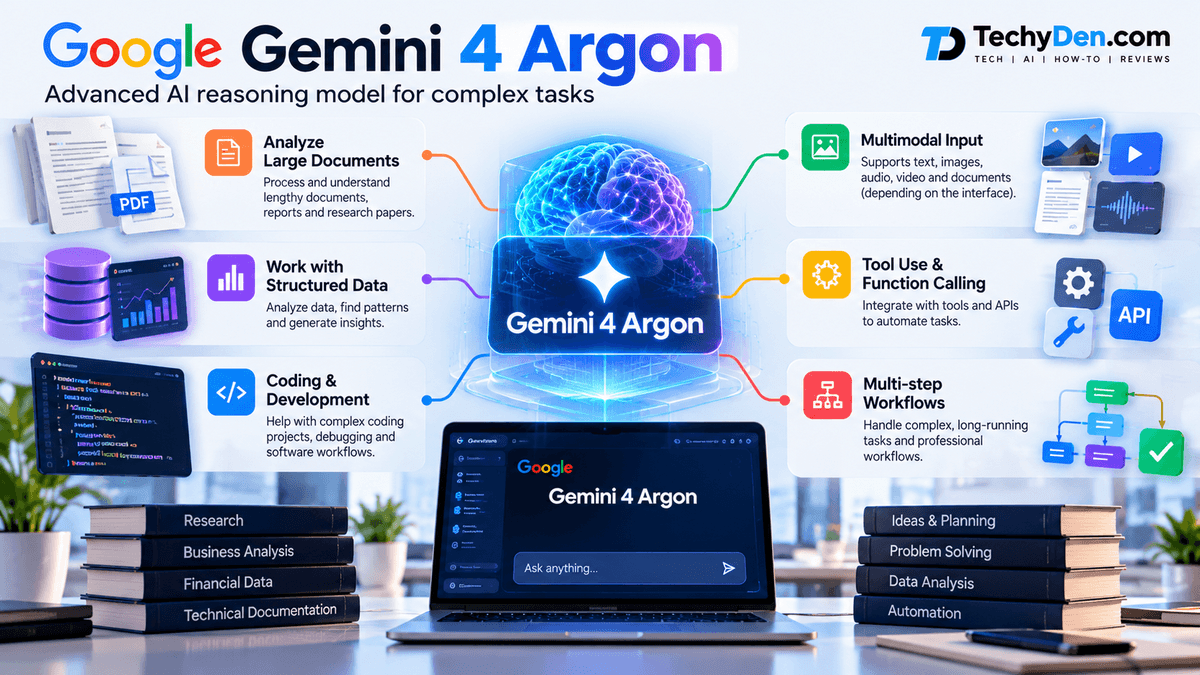
Unlike an AI assistant used primarily for everyday conversations, Argon is intended to help users complete more demanding tasks, such as reviewing lengthy documents, reconciling financial information, investigating software problems, and working through complex research questions.
Google announced the model in September 2026 and expanded access on October 13, 2026. It is available through supported Google AI products and developer platforms, with access and usage limits depending on the plan or service.
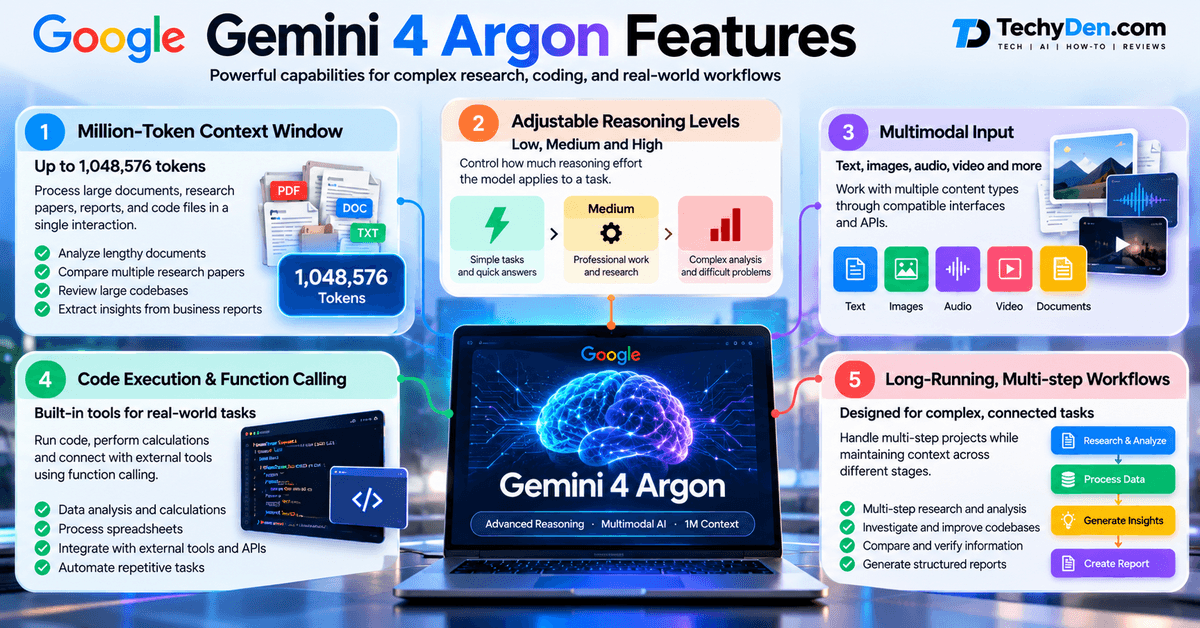
Its most notable capabilities include:
- A context window of approximately one million tokens.
- Adjustable reasoning depth.
- Multimodal input for supported content formats.
- Tool use and function calling through supported APIs.
- Code execution for analytical tasks.
- Support for long-running, multi-step workflows.
These capabilities make Gemini 4 Argon particularly relevant to developers, researchers, businesses, and professionals who regularly work with large datasets or complicated projects.
Gemini 4 Argon Features
1. Million-token context window
One of the most important features of Gemini 4 Argon is its context window of 1,048,576 tokens.
A large context window allows an AI model to process substantial amounts of information within a single interaction. For example, you could provide several lengthy reports, technical documents, research papers, or source-code files and ask the model to identify patterns, compare information, or summarize important findings.
This can be useful for:
- Analyzing lengthy PDF documents.
- Comparing multiple research papers.
- Reviewing large software projects.
- Extracting information from business reports.
- Summarizing extensive documentation.
- Identifying inconsistencies across several sources.
However, a one-million-token context window does not mean every answer will be perfectly accurate. Retrieval quality, the clarity of your instructions, and the complexity of the source material still affect the results.
2. Adjustable reasoning levels
Gemini 4 Argon supports three reasoning levels: Low, Medium, and High.
These settings let developers adjust how much reasoning effort the model applies to a task.
| Reasoning level | Best use case |
|---|---|
| Low | Straightforward questions, simple transformations, and routine tasks |
| Medium | Everyday professional work, research, and structured analysis |
| High | Complex coding, multi-step analysis, and difficult reasoning problems |
Higher reasoning settings can improve results on demanding tasks, but they may also increase latency and token consumption.
For bloggers and content creators, a lower setting may be sufficient for rewriting a paragraph or generating title ideas. Higher reasoning may be more appropriate when analyzing competing articles, organizing a large research dataset, or evaluating complex technical documentation.
You can also read our Gemini 3.1 Pro review for a comparison point when exploring Google’s earlier Gemini model lineup. Check the published specifications to understand the differences between the models.
3. Multimodal input
Gemini 4 Argon supports multiple input modalities through compatible interfaces and APIs, including text, images, audio, and video.
This makes it possible to use the model for more than conventional text-based conversations.
Potential applications include:
- Extracting information from screenshots.
- Analyzing charts and diagrams.
- Reviewing technical documentation containing images.
- Summarizing supported audio and video content.
- Understanding visual information alongside written instructions.
Actual capabilities depend on the product or API endpoint you use. For example, a video-generation feature in a Gemini application should not automatically be treated as a native video-output capability of the Argon model itself.
4. Code execution and function calling
Gemini 4 Argon supports code execution and function calling through supported developer tools.
Code execution can help with mathematical calculations, data analysis, and tasks that benefit from computational verification. Function calling allows an application to connect the model to approved tools or services.
Developers can use these capabilities to build workflows that:
- Process spreadsheet data.
- Perform calculations and comparisons.
- Retrieve information from connected systems.
- Automate repetitive tasks.
- Analyze structured datasets.
- Assist with software development.
Tool access does not mean the model can automatically control every application or perform every action without additional integration. Developers must configure the relevant tools, permissions, and execution environment.
5. Long-running, multi-step workflows
Google positions Argon for work that involves several connected steps rather than isolated prompts.
For example, a business could use an AI workflow to review documents, extract relevant figures, compare results, identify inconsistencies, and prepare a structured report.
Similarly, developers can use it to investigate a codebase, plan changes, edit files, and evaluate the results through an appropriately configured development environment.
The key advantage is its focus on completing complex tasks while maintaining context. Nevertheless, autonomous workflows still need testing, checkpoints, and human review, especially when they involve important business decisions or irreversible actions.
Businesses looking to automate repetitive tasks can also explore our guide to the best AI tools for small business for additional solutions beyond general-purpose AI assistants.
Gemini 4 Argon Benchmark Performance
Benchmarks help evaluate an AI model’s performance on defined tasks, but they do not establish that a model is the best choice for every user.
Google’s published comparison reports strong results for Argon in several areas, including knowledge work, long-context retrieval, and selected coding and automation tasks.
The following figures are from Google’s published benchmark comparison and should be interpreted within the context of the individual tests.
| Benchmark | Gemini 4 Argon | What it measures |
|---|---|---|
| Vals Index | 68.9% | Performance on professional knowledge-work tasks |
| AutomationBench | 51.3% | Multi-step automation tasks |
| Vals Finance Agent v2 | 65.4% | Financial analysis and agent performance |
| DeepSWE v1.1 | 77.9% | Software engineering tasks |
| FrontierSWE v2 | 55.0% | More demanding software engineering tasks |
| Terminal-Bench 4.0 | 57.4% | Terminal-based coding and command-line tasks |
| GraphWalks, up to 128K context | 99.7% | Long-context graph traversal and retrieval |
Important: These scores are reported by Google, and the tests use different methodologies and scoring systems. They should not be compared as if they were percentages from one common examination.
Source: Google DeepMind’s Gemini model information.
What do these benchmark results mean?
The results suggest that Argon is competitive for professional knowledge work, structured analysis, and certain coding tasks.
Its long-context performance is particularly relevant to users who need to process extensive documents or datasets. However, its results on more demanding software engineering tests show that it does not lead every coding benchmark.
Independent evaluations also indicate that the quality of the output varies by task. A model that extracts information accurately may still produce weak marketing copy or require substantial editing when preparing presentations.
For this reason, choose a model based on your actual workload rather than relying exclusively on a headline benchmark score.
For another perspective on advanced AI capabilities, read our Claude AI review to learn more about Claude’s features, strengths, limitations, and suitability for professional tasks.
Gemini 4 Argon Pricing and Plans
Gemini 4 Argon pricing depends on how you access it. API usage is billed according to the number of input and output tokens, while consumer access depends on the applicable Google AI subscription.
Gemini 4 Argon API pricing
Google lists the following introductory API prices through November 30, 2026.
| Usage type | Through November 30, 2026 | From December 1, 2026 |
|---|---|---|
| Input tokens | $2 per million | $4 per million |
| Cached input tokens | $0.10 per million | $0.20 per million |
| Output tokens | $10 per million | $20 per million |
These are published per-token prices, not monthly subscription fees. Check the official Gemini API documentation for the latest pricing and billing conditions.
How much does Gemini 4 Argon cost in practice?
Consider a hypothetical API request that uses 100,000 input tokens and 20,000 output tokens.
During the introductory pricing period:
- Input cost: 100,000 × $2 ÷ 1,000,000 = $0.20
- Output cost: 20,000 × $10 ÷ 1,000,000 = $0.20
- Total: $0.40 per request
At the standard rates beginning December 1, 2026, the same token usage would cost $0.80.
These examples assume all input tokens are billed at the standard input rate, with no caching discounts, and exclude any applicable taxes or additional service charges. Reasoning tokens that count as output tokens can increase the final cost.
Is Gemini 4 Argon available for free?
Do not assume that Argon is included in a free Gemini account or that every Google AI subscription includes unlimited access.
Google’s API documentation states that Gemini 4 Argon is not available on the API’s Free tier. Consumer access, usage limits, and feature availability depend on the applicable subscription and rollout.
Before upgrading, check the official Gemini website and Gemini API documentation.
Gemini 4 Argon for Bloggers and Content Creators
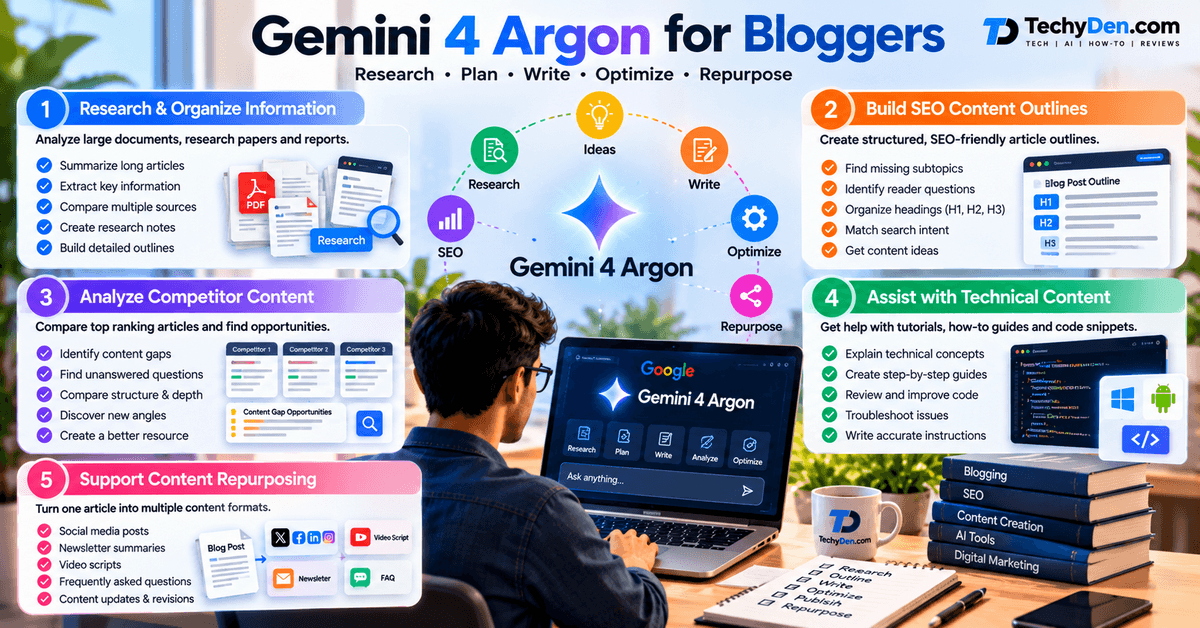
Gemini 4 Argon may be useful for bloggers who need to research complex topics, organize source material, analyze competitors, or create structured content workflows.
However, using a powerful AI model does not automatically produce content that ranks well in search engines. Accuracy, originality, search intent, first-hand experience, and editorial quality remain essential.
Here are several ways bloggers could use Argon.
1. Research and organize large amounts of information
You can use its large context window to analyze multiple reports, documentation pages, research papers, or other source materials.
For example, a technology blogger could provide official documentation for a software update and ask the model to extract new features, system requirements, known issues, and installation instructions.
The resulting research notes can help build a more complete article outline.
Always verify important facts against the original sources, especially release dates, version numbers, compatibility details, and pricing.
2. Build SEO content outlines
Argon can help organize research into a structured article outline.
A useful workflow is to provide your primary keyword, target audience, search intent, relevant source material, and competing article structures. Ask the model to identify missing subtopics, reader questions, and opportunities to explain the topic more clearly.
You should still validate keyword demand and competition with an SEO platform such as Semrush or Ahrefs. AI-generated keyword suggestions are not a substitute for actual search data.
To improve your AI-assisted brainstorming workflow, explore our collection of the best AI prompts for bloggers, featuring prompts for content planning, research, and writing tasks.
3. Analyze competitor content
For a competitive keyword, you can ask Argon to compare several articles and identify:
- Topics covered by multiple competitors.
- Important questions that remain unanswered.
- Differences in technical depth.
- Missing examples or practical instructions.
- Opportunities to improve the article’s structure.
The goal should be to create a genuinely more useful resource, not simply reproduce competing pages with different wording.
For a broader SEO workflow, see our guide to the best AI SEO tools for bloggers to explore tools that support keyword research, content optimization, and search performance analysis.
4. Assist with technical content
Argon may be useful when writing detailed tutorials about Windows, Android, AI software, APIs, or web development.
For example, you could ask it to explain a technical concept, organize troubleshooting steps, or review a code snippet.
Technical instructions should be tested before publication. Incorrect commands, outdated screenshots, and inaccurate compatibility claims can undermine reader trust.
5. Support content repurposing
After publishing a comprehensive article, you can use AI to create draft versions of:
- Social media posts.
- Newsletter summaries.
- Short video scripts.
- Frequently asked questions.
- Content updates and revision checklists.
Review each output for factual accuracy and platform suitability. Do not publish every generated variation without editing it.
If your primary goal is to create high-quality blog posts more efficiently, explore our roundup of the best AI writing tools for bloggers to compare writing assistants for research, drafting, editing, and content optimization.
Gemini 4 Argon vs ChatGPT vs Claude
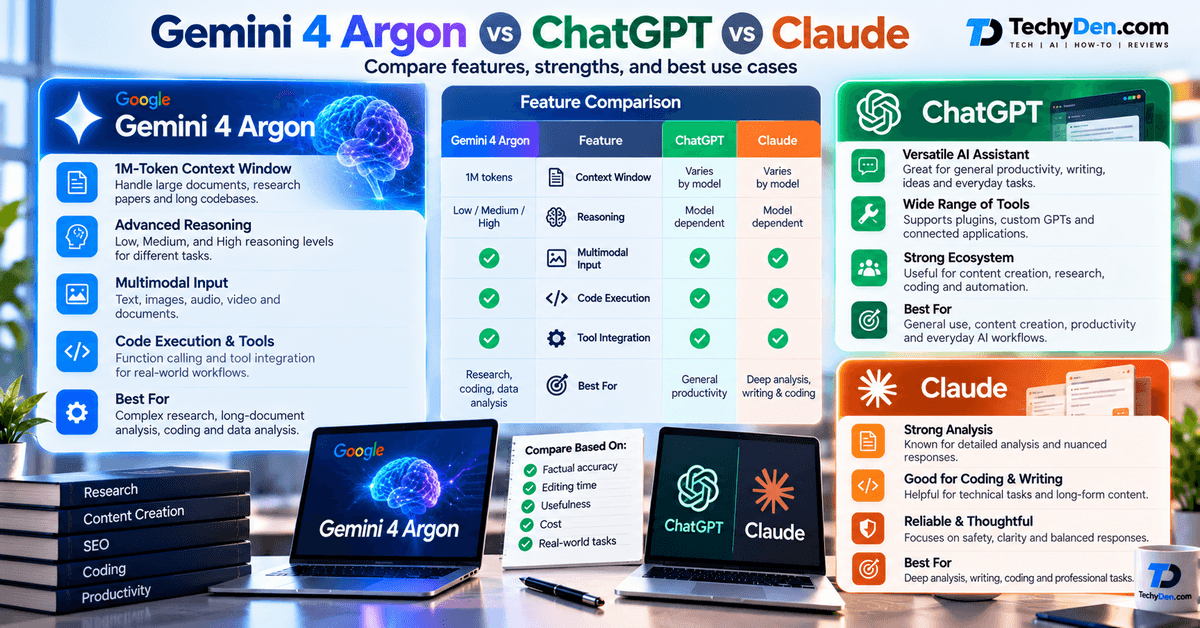
Choosing between Gemini, ChatGPT, and Claude depends on the type of work you perform, your preferred interface, and your budget.
| Feature | Gemini 4 Argon | ChatGPT | Claude |
|---|---|---|---|
| Complex reasoning | Strong on selected published benchmarks | Depends on the model and task | Depends on the model and task |
| Long-document analysis | Up to 1M-token context for Argon | Varies by model and plan | Varies by model and plan |
| Coding | Competitive, but not best on every benchmark | Model-dependent | Model-dependent |
| Google ecosystem | Natural fit for supported Google AI workflows | Depends on integrations | Depends on integrations |
| API pricing | Introductory pricing with a scheduled increase | Varies by model | Varies by model |
| Best evaluation method | Test your own workflows | Test your own workflows | Test your own workflows |
This table is a high-level comparison rather than a claim that one service wins every category. Features, limits, and prices change, so compare the specific models and plans available when you make a decision.
Gemini 4 Argon vs ChatGPT
Gemini 4 Argon is worth considering if your work involves long-context analysis, structured research, or Google-based AI workflows.
ChatGPT may be a better fit if its available tools, interface, connected applications, or preferred model suit your daily tasks.
For bloggers, compare both models using the same prompt, the same source material, and the same evaluation criteria. Measure factual accuracy, editing time, usefulness, and cost rather than judging only the writing style.
Gemini 4 Argon vs Claude
Argon has strong reported results in selected knowledge-work and long-context evaluations. However, independent testing indicates that the results depend on the task, including whether it involves extracting data, writing persuasive copy, or working with command-line tools.
Claude may be preferable for a particular coding or writing workflow, depending on the available model and the results of your own tests.
If you are choosing a paid AI tool, run a small comparison with representative tasks before committing to a subscription or API integration.
If you are deciding between leading AI assistants, our Claude AI vs ChatGPT comparison offers another useful starting point for evaluating competing models and their practical applications.
Pros and Cons of Gemini 4 Argon
Pros of Gemini 4 Argon
- Large context window: Useful for lengthy documents and complex research.
- Adjustable reasoning: Lets developers choose between lower and higher reasoning effort.
- Multimodal inputs: Supports multiple content types through compatible interfaces.
- Tool integration: Supports code execution and function calling.
- Competitive introductory API pricing: The initial token rates may be attractive for selected workloads.
- Professional workflow focus: Designed for complex, multi-step tasks rather than only simple chat.
Cons of Gemini 4 Argon
- No universal benchmark winner: Its performance varies across tasks and evaluation methods.
- Potentially higher output costs: Long reasoning sessions can consume more output tokens.
- Variable response times: Complex requests may take longer to process.
- Fact-checking remains necessary: A detailed response can still contain unsupported claims.
- Access depends on the product: Features and usage limits vary across subscriptions and APIs.
- Pricing increases after November: The published standard token rates double on December 1, 2026.
Is Gemini 4 Argon Worth Using?
Gemini 4 Argon is worth evaluating if you regularly handle large documents, complex technical questions, structured data, or multi-step professional projects.
For developers, it offers an interesting combination of long-context processing, reasoning controls, code execution, and tool integration.
For bloggers and content creators, its strongest potential use cases are research organization, technical documentation analysis, content planning, and structured workflows. It should be treated as a research and production assistant rather than an automatic replacement for editorial judgment.
If you primarily need short social posts, simple rewrites, or basic brainstorming, you may not need a model with this level of capability. A less expensive or more readily available model could be sufficient.
My recommendation is to test Argon on a small set of real tasks, compare its results with your current AI tool, and calculate the total cost before adopting it for regular use.
Frequently Asked Questions (FAQs) on Gemini 4 Argon Review 2026
What is Gemini 4 Argon?
Gemini 4 Argon is Google’s advanced reasoning model designed for complex knowledge work, long-document analysis, coding, data processing, and multi-step workflows.
When was Gemini 4 Argon released?
Google announced Argon in September 2026 and expanded its availability on October 13, 2026. Access depends on the supported product, subscription, or API.
What is the context window of Gemini 4 Argon?
Gemini 4 Argon supports a context window of 1,048,576 tokens. The limit is shared across the request’s input, reasoning, and output, subject to the selected API and its supported limits.
How much does Gemini 4 Argon cost?
Its introductory API price is $2 per million input tokens and $10 per million output tokens through November 30, 2026. The published standard prices from December 1 are $4 and $20 per million tokens, respectively.
Is Gemini 4 Argon better than ChatGPT?
Neither model is universally better. The right choice depends on the specific models being compared, the task, available tools, output accuracy, and total cost.
Can Gemini 4 Argon write blog posts?
Yes. It can assist with research, outlines, drafts, summaries, and technical explanations. Bloggers should fact-check the content, add original insights, and edit the final article before publication.
Is Gemini 4 Argon good for coding?
It performs competitively on several published coding benchmarks, but it does not lead every evaluation. Developers should test it on their actual programming language, codebase, and development workflow.
Does Gemini 4 Argon support images and video?
It accepts image and video inputs through supported interfaces and APIs. That does not mean the Argon model itself generates video output; generation capabilities may be provided by separate models and tools.
Can I use Gemini 4 Argon for free?
Google’s API documentation excludes Argon from the API Free tier. Check the current Gemini consumer plans and applicable access conditions for any subscription-based availability.
What is the biggest limitation of Gemini 4 Argon?
Its main limitation is that strong benchmark performance does not guarantee reliable results for every task. Cost, latency, factual accuracy, and task-specific performance should all be evaluated before using it in an important workfl
Final Verdict: Should You Try Gemini 4 Argon?
Gemini 4 Argon is a compelling AI model for users who need more than basic conversational assistance. Its large context window, adjustable reasoning, multimodal inputs, and support for complex workflows make it worth considering for research, coding, data analysis, and business automation.
However, it is not a universal replacement for other AI models. Its suitability depends on your workload, the quality of its output, access requirements, and the cost of running your prompts.
Our recommendation: Evaluate Gemini 4 Argon with a small set of real-world tasks before adopting it. For bloggers, start with source-based research and technical content planning, verify the results, and compare the time saved against your existing AI tools.