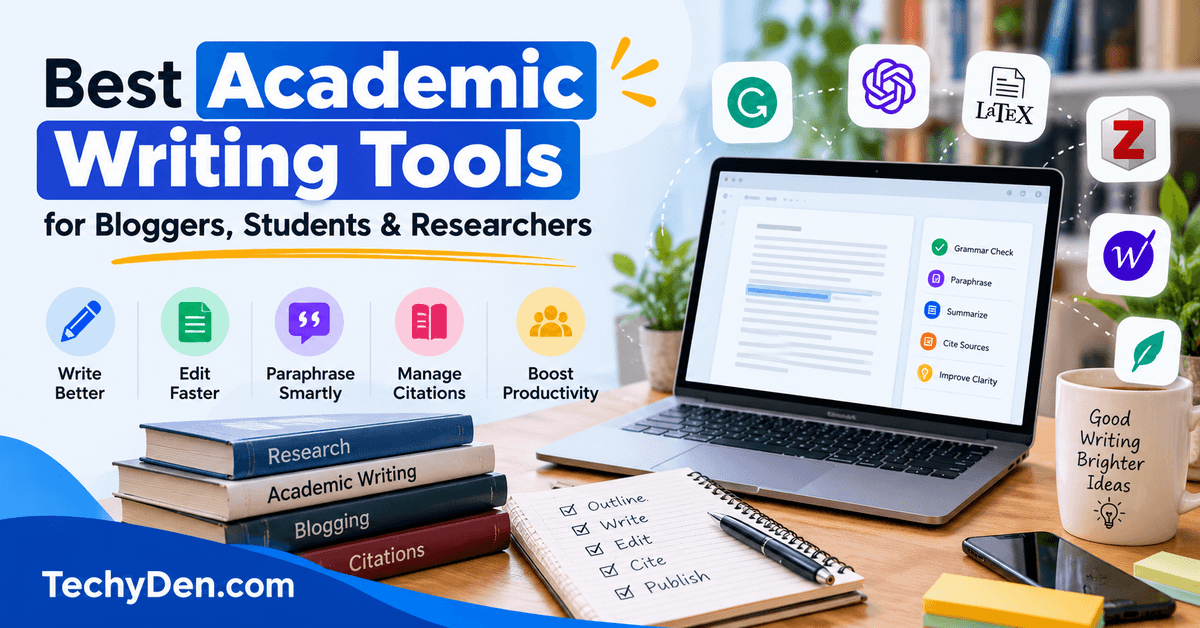
Academic writing can be intimidating and time-consuming, especially when you need to research a topic, organize information, write a structured draft, edit the content, and ensure that the final work is clear and accurate. For bloggers, researchers, students, educators, and content creators, these tasks can require hours of focused effort.
Fortunately, modern academic writing tools for bloggers can simplify many parts of the writing process.
AI-powered writing assistants, grammar checkers, paraphrasing tools, research platforms, citation tools, and productivity applications can help you improve your writing workflow and spend more time focusing on ideas and valuable information.
If you’re working on long-form articles, research-based blog posts, academic content, or other detailed writing projects, the right tools can help you work smarter rather than harder. These tools can assist with drafting, editing, paraphrasing, proofreading, organizing information, and improving the overall readability of your content.
Researchers and students can also use transcription tools to turn recorded interviews, lectures, and discussions into searchable text.
Students and bloggers who frequently write on mobile devices can also explore these writing apps for students and bloggers.
The Three Stages of the Writing Process
The writing process for this article is divided into three main stages:
- Writing and Editing a Draft: Create an initial draft, organize your ideas, improve sentence structure, and correct grammar and spelling errors.
- Rewording and Paraphrasing: Rewrite sentences and paragraphs to improve clarity, readability, originality, and overall flow while preserving the intended meaning.
- Organizing the Manuscript: Structure the final content logically, organize sections and references, improve consistency, and prepare the manuscript for publication or submission.
In this guide, we will explore some of the best academic writing tools for bloggers, including their key features, benefits, limitations, pricing, and practical use cases. Whether you are creating research-based blog content or managing detailed academic writing projects, these tools can help make the overall writing process more efficient.
What is academic writing?
Academic writing is writing that is done for academic purposes, such as writing for school or work. It can be anything from a research paper to a thesis. Academic writing can be challenging and requires a level of precision and accuracy that is not always required in other types of writing. Additionally, academic writing is often formatted in a way that is specific to the academic institution that you are writing for.
Modern academic writing software can also work alongside AI writing tools to help writers draft, edit, summarize, and refine research-based content.
Always keep in mind the purpose of your writing when you are drafting it, and make sure to adhere to the standard format and style guidelines of your specific institution. You also need to be aware of the conventions of your field and be sure to use the correct terms and citations when referencing sources.
- 10 Best Writing Apps for Android users
- Best Free Android Apps To Find Your Friends via GPS
- Best Windows 10 Apps: It Makes Your Life much Better
Finally, make sure to proofread your work multiple times to ensure that it is error-free and meets the standards of your academic institution.
What Are Academic Writing Tools?
Academic writing tools are software applications and AI-powered platforms designed to help students, researchers, educators, bloggers, and content creators plan, write, edit, organize, and improve research-based content. Modern academic writing software goes beyond basic grammar checking and can support different stages of the writing and research process, including literature discovery, drafting, paraphrasing, proofreading, citation management, reference organization, and manuscript preparation.
In 2026, academic writing tools increasingly use artificial intelligence to provide writing suggestions, improve sentence clarity, summarize research, organize information, and assist with academic language. However, different tools are designed for different purposes. For example, Grammarly is useful for grammar, spelling, clarity, and general writing improvement, while specialized platforms such as Paperpal, Writefull, and Trinka AI focus more heavily on academic and technical writing.
Research-focused tools such as Elicit, Consensus, Scite, and Semantic Scholar can help users discover academic papers, explore research findings, evaluate evidence, and organize information for literature reviews. Reference-management platforms can also help researchers organize sources and generate citations and bibliographies.
For bloggers, these tools can be particularly useful when creating research-based articles, educational content, scientific blog posts, reviews, and long-form guides. An effective academic writing workflow can combine research and literature-discovery tools with AI writing assistants, grammar checkers, paraphrasing tools, and citation managers.
What Can Academic Writing Tools Help With?
Academic writing tools can support many stages of the writing process, including:
- Research and literature discovery: Find relevant academic papers, studies, and research evidence.
- Writing and drafting: Generate ideas, outlines, summaries, and initial drafts.
- Grammar and proofreading: Identify grammar, spelling, punctuation, and sentence-structure problems.
- Academic language improvement: Make writing clearer, more precise, formal, and appropriate for an academic audience.
- Paraphrasing and rewriting: Improve sentence structure and readability while preserving the original meaning.
- Citation and reference management: Organize references and assist with citation formatting.
- Research summarization: Extract important findings and summarize lengthy research papers or documents.
- Collaboration: Help authors and research teams work together on documents, ideas, comments, and revisions.
- Manuscript preparation: Improve consistency and prepare documents for journals, academic submissions, or publication.
Researchers and content teams can also use collaboration tools for content teams to organize ideas, documents, and communication.
AI Academic Writing Tools vs. General AI Tools
One important distinction in 2026 is the difference between general-purpose AI assistants and specialized academic writing tools.
General AI assistants such as ChatGPT and Claude can be useful for brainstorming, outlining, explaining concepts, summarizing user-provided material, and improving drafts. However, AI-generated citations and factual claims should always be independently verified because general-purpose AI models can produce inaccurate or fabricated references.
Specialized academic tools are often designed around specific research tasks. For example, Elicit focuses on literature discovery and synthesis, Consensus provides evidence-based research answers, Scite helps evaluate citation context, and Paperpal focuses on academic writing, editing, and manuscript preparation.
What Is the Best Academic Writing Tool in 2026?
There is no single best academic writing tool for everyone. The right choice depends on whether you need help with research, writing, grammar, paraphrasing, citations, literature reviews, or manuscript editing.
For example:
- Paperpal: Best suited for academic writing, language improvement, manuscript preparation, and journal-readiness support.
- Grammarly: Useful for grammar, spelling, clarity, and general writing improvement.
- Elicit: Useful for literature reviews, research discovery, and extracting information from academic papers.
- Consensus: Useful for finding evidence-based answers from scientific literature.
- Scite: Useful for examining how research papers are cited and evaluating supporting or contrasting citation contexts.
- Writefull: Useful for improving academic language, particularly for researchers working with scholarly and technical writing.
- QuillBot: Useful for paraphrasing, rewriting, and improving the clarity of existing text.
The best approach is often to combine several tools rather than rely on one application for every stage of academic writing. A researcher or blogger might use one tool to discover reliable sources, another to organize references, another to improve academic language, and a separate tool to proofread the final manuscript.
Most importantly, AI writing tools should support your research and writing process rather than replace critical thinking, original analysis, or source verification. Always check important facts, citations, quotations, statistics, and references against reliable primary or scholarly sources before publishing or submitting your work.
The Best Writing Software for Researchers
1. Jasper AI (formerly Jarvis)
AI Writing and Content Creation Platform
Jasper AI is an AI-powered content creation platform designed primarily for marketers, content teams, and businesses that need to produce consistent, on-brand content at scale. For bloggers and researchers, it can also be useful for brainstorming, outlining, drafting, rewriting, and refining research-based content.
Unlike the older version of Jasper, which was widely positioned as an AI copywriting assistant with templates, the platform has evolved into a broader AI marketing system. Its current ecosystem includes Jasper IQ, Brand Voice, Knowledge Base, Audiences, Style Guide, Product IQ, Chat, Agents, and research-oriented workflows.
How Jasper Can Help With Academic and Research-Based Writing
Jasper can be useful during several stages of the writing process. You can use it to brainstorm article ideas, develop outlines, rewrite sections, improve readability, create introductions and conclusions, and adapt content for different audiences.
For bloggers publishing research-based or educational content, Jasper’s Knowledge Base can be particularly useful. It allows users to provide information such as documents, URLs, product information, white papers, content briefs, and other reference material that Jasper can use as context when generating content.
Jasper also provides Brand Voice, which can analyze examples of your writing and create a customized voice based on your tone, style, and characteristics. This can help bloggers and content teams maintain a consistent writing style across different articles and content formats.
Key Features of Jasper AI
- AI Content Generation: Create drafts, ideas, summaries, marketing content, and other written material using AI.
- Jasper Chat: Interact with Jasper conversationally, provide context, attach knowledge, and refine generated responses.
- Brand Voice: Teach Jasper your preferred tone and writing style using examples of your existing content.
- Knowledge Base: Store and reuse important information, documents, URLs, and other business or content-related knowledge.
- Audiences: Define target audiences so generated content can be tailored to specific reader groups.
- Style Guide: Apply predefined writing and formatting rules to help maintain consistency across content.
- Product IQ: Store product information, claims, specifications, pricing, and other approved product details for content generation.
- AI Agents: Use specialized AI workflows to help teams execute repeatable marketing and content tasks.
- Research Agent: Jasper’s platform includes research capabilities designed to turn research into briefs, summaries, and campaign ideas.
- Web Search in Chat: Jasper Chat can use web search for prompts that benefit from current information when the feature is enabled.
- Team Collaboration: Jasper is designed to support content teams that need shared context, brand guidelines, and repeatable workflows.
Pros of Jasper AI
- Strong focus on content creation and marketing workflows.
- Brand Voice helps maintain a consistent writing style.
- Knowledge Base allows you to provide additional context and reference material.
- Useful for bloggers who produce content regularly.
- Supports AI-assisted research, drafting, rewriting, and content optimization workflows.
- AI Agents can help automate repeatable content and marketing processes.
- Suitable for teams that need centralized brand and content guidelines.
Cons of Jasper AI
- Jasper is primarily designed around marketing and business content, so it may not be the best choice for every academic research task.
- Important academic facts, references, statistics, and citations still need to be independently verified.
- Some advanced features are designed for business and marketing teams rather than individual students.
- The current pricing structure can be more complex than the older credit-based model because some advanced capabilities use credits.
- Users may need to spend time configuring Brand Voice, Knowledge Base, audiences, and other context settings to get the best results.
Jasper AI Pricing
Jasper currently offers a Pro plan at $59 per month when billed annually, according to its September 2026 pricing documentation. Business plans use custom pricing. Jasper’s current pricing model also includes a platform fee and consumption-based credits for certain advanced features, while core features such as Chat, Agents, Studio, and IQ are included in business plans.
Because Jasper’s pricing and feature availability can change, check the current pricing page before making a purchase.
Is Jasper Good for Academic Writing?
Jasper can be useful for academic-style and research-based content, particularly when the task involves brainstorming, outlining, rewriting, editing, and organizing information. However, it should not be treated as a replacement for academic research or human judgment.
For researchers and bloggers, a practical workflow is to use dedicated research databases and literature-discovery tools to find and verify sources, then use Jasper to help organize ideas and improve the presentation of the content.
If you are writing a research-based blog post, for example, you could use Jasper to create an outline, provide your verified research material as context, develop a first draft, improve readability, and adapt the article for your target audience. You should then fact-check the final article and verify every important citation and research claim before publication.
Best for: Bloggers, marketers, content teams, businesses, and creators who need AI-assisted content production with strong brand-voice and knowledge-management features.
Not ideal for: Users looking exclusively for a specialized academic research database, citation manager, or literature-review platform.
Our Verdict
Jasper has evolved considerably from the older AI writing assistant known as Jarvis. Its current strength lies in combining AI content generation with brand context, knowledge management, audience targeting, style controls, research workflows, and AI agents.
For bloggers creating research-based content, Jasper can be a valuable part of the writing workflow, but it works best when combined with reliable research and citation tools. Use Jasper to assist with writing and content production—not to replace original research, source verification, or human editorial judgment.
2. DraftIn
AI-powered writing and publishing platform for bloggers and content teams
DraftIn is now an AI-powered content management and publishing platform designed for people who write. Instead of focusing only on distraction-free academic drafting, the current DraftIn combines a writing editor, AI assistance, collaboration, publishing workflows, SEO features, media management, and analytics in one platform.
Its built-in AI assistant, called Quill, works directly inside the editor. It can suggest titles, rewrite paragraphs, create tags, adjust tone, and help optimize content for SEO without requiring you to move between different applications.
For bloggers, DraftIn can be useful when you want to move from an initial idea to a finished article and publication without relying on several separate tools. It also supports structured content and API-based publishing, making it more suitable for professional publishing workflows than the older version of DraftIn.
Key Features of DraftIn
- AI writing assistant: Quill can help with titles, paragraph rewriting, tags, and other content-generation tasks.
- AI-powered editing: Work with the AI assistant directly inside the writing editor.
- SEO optimization: DraftIn can assist with metadata and SEO-related optimization while preparing content.
- Real-time collaboration: Multiple people can work on the same draft, with comments and per-author history.
- Version history: Author-specific history helps teams track changes and revisions.
- Publishing workflows: Content can move through drafting, review, approval, and scheduling stages.
- Media management: The platform supports media uploads, optimization, and CDN delivery.
- Content analytics: Writers and teams can monitor content performance, including readership and other engagement metrics.
- API publishing: DraftIn provides REST and GraphQL APIs for delivering content to websites, applications, and newsletters.
- Headless CMS: Content can be separated from the presentation layer, allowing teams to use their preferred website or application framework.
- Content modeling: Teams can structure content using customizable fields and relationships.
- Team workflows: DraftIn brings writing, review, collaboration, and publishing into a single workspace.
Pros of Draftin
- AI assistance is built directly into the writing editor.
- Useful for bloggers and content teams that need writing and publishing in one place.
- Supports real-time collaboration and author history.
- Includes built-in SEO and publishing workflows.
- Supports API-based content delivery.
- Free plan is available without requiring a credit card.
Cons of Draftin
- It is more of a content management and publishing platform than a dedicated academic research tool.
- It does not replace specialized academic databases, citation managers, or literature-review tools.
- Some advanced publishing and collaboration capabilities are more relevant to professional content teams than individual students.
- The platform may be more than you need if your primary requirement is simply a distraction-free academic writing editor.
DraftIn Pricing
DraftIn currently offers a Free plan with up to 3 blogs, 250 posts, 200 MB of media storage, one invited external user, and 5 AI requests per month. The Hobby plan is listed at R$40 per month, while the Pro plan is R$100 per month. Hobby and Pro include unlimited AI requests, with higher limits for collaborators, blogs, and storage.
Is DraftIn Good for Academic Writing?
DraftIn can be useful for bloggers, researchers, educators, and content teams who need to write, edit, organize, and publish content, but it should not be considered a complete academic research platform.
If you are writing a research paper, thesis, dissertation, or scholarly article, you may need to combine DraftIn with dedicated research and citation tools. For example, literature discovery, source verification, reference management, and citation checking are better handled by specialized academic tools.
For bloggers producing research-based articles, however, DraftIn can be useful because its AI editor, collaboration features, SEO capabilities, and publishing workflow bring many parts of the content process together.
Best For
- Bloggers and content creators
- Content teams
- Publishers
- Researchers who also publish online content
- Collaborative writing projects
- Websites that need an AI-assisted publishing workflow
Final Verdict
DraftIn has evolved considerably from the minimalist writing application described in older articles. The current platform is better understood as an AI-powered CMS and writing platform for bloggers and content teams. Its Quill AI assistant, collaboration tools, SEO features, publishing workflows, and API support make it more useful for modern content production than simply providing a distraction-free writing environment.
For academic writing, DraftIn is best used as a writing and publishing assistant rather than a complete academic research solution. If your priority is literature discovery, citations, references, or scholarly source verification, combine it with dedicated academic research tools.
3. LaTeX
Powerful academic writing and typesetting tool for research papers
LaTeX is one of the most widely used document preparation systems for scientific and technical writing. Unlike traditional word processors, LaTeX separates the content of a document from its formatting, making it particularly useful for research papers, theses, dissertations, technical reports, books, and documents containing complex mathematical formulas. LaTeX is free software distributed under the LaTeX Project Public License.
LaTeX is especially valuable when your academic writing includes mathematical equations, tables, figures, references, citations, cross-references, and long structured documents. It provides precise control over document formatting and can automatically handle elements such as bibliographies, numbering, references, and indexes.
For beginners, however, traditional LaTeX can have a learning curve because documents are often created using markup commands rather than the familiar interface of Microsoft Word or Google Docs. Fortunately, Overleaf makes LaTeX considerably easier to use by providing a browser-based environment with both a Visual Editor and Code Editor. You can create and edit LaTeX documents without installing software or learning LaTeX commands from the beginning.
Key Features of LaTeX and Overleaf
- Professional document formatting: LaTeX produces highly polished documents suitable for academic and scientific publishing.
- Mathematical equations: It is particularly powerful for complex mathematical formulas and technical notation.
- Tables and figures: LaTeX provides extensive control over tables, figures, captions, numbering, and placement.
- Citations and bibliographies: Academic references and bibliographies can be managed efficiently using LaTeX and supported integrations.
- Cross-referencing: Sections, figures, tables, equations, and citations can be referenced throughout long documents.
- Academic templates: Overleaf provides thousands of templates for research papers, journal articles, theses, reports, presentations, and other documents.
- Visual Editor: Overleaf allows beginners to work with LaTeX without writing code for every formatting task.
- Code Editor: Experienced users can directly edit LaTeX source code for greater control.
- Real-time collaboration: Multiple authors can work on shared documents, add comments, and collaborate online.
- Version history: Premium Overleaf plans provide project history and version-control features.
- Cloud-based writing: Overleaf allows you to work from a browser without installing a complete LaTeX environment.
- AI assistance: Overleaf AI now includes tools for writing and editing assistance, LaTeX code generation, equation and table generation, paraphrasing, and help with LaTeX errors.
Pros of LaTeX
- Completely free LaTeX software is available.
- Excellent for research papers, theses, dissertations, and technical documents.
- Particularly powerful for mathematical and scientific writing.
- Produces consistent and professional document formatting.
- Handles large and complex documents efficiently.
- Provides strong support for citations, bibliographies, figures, tables, and cross-references.
- Thousands of academic templates are available through Overleaf.
- Overleaf makes LaTeX accessible to beginners through its Visual Editor.
- Supports real-time collaboration for research teams.
- Overleaf can be used directly in a web browser without complicated local installation.
Cons of LaTeX
- Traditional LaTeX has a steeper learning curve than Microsoft Word or Google Docs.
- Understanding LaTeX commands and document structure takes time.
- Troubleshooting compilation errors can be difficult for beginners.
- Formatting highly customized documents may require learning additional packages or commands.
- Some students may find a markup-based workflow less intuitive than a conventional word processor.
- Overleaf’s advanced collaboration, AI, and productivity features are distributed across its paid plans.
LaTeX and Overleaf Pricing
LaTeX itself is free software, so you do not need to pay a license fee to use the LaTeX system.
If you prefer an online LaTeX editor, Overleaf provides a Free plan with unlimited projects and one collaborator per project. Paid individual plans add features such as increased collaboration limits, project history, advanced reference search, and additional AI capabilities. Current listed annual prices include Student at $98/year, Standard at $199/year, and Pro at $399/year.
Is LaTeX Good for Academic Writing?
Yes. LaTeX is one of the strongest choices for scientific, technical, and research-based academic writing, particularly when your document contains mathematical equations, complex references, tables, figures, or extensive cross-referencing.
For beginners, I recommend starting with Overleaf rather than installing and configuring a complete LaTeX environment locally. Its Visual Editor, templates, tutorials, and browser-based workflow make it much easier to learn LaTeX gradually.
Best For
- Researchers
- PhD students
- Master’s students
- Scientific writers
- Mathematicians
- Engineers
- Computer science researchers
- Authors of research papers and journal articles
- Thesis and dissertation writers
- Anyone working with complex mathematical or technical documents
Final Verdict
LaTeX remains one of the best academic writing tools for researchers and technical writers. Its biggest advantage is the level of control it provides over complex documents, equations, references, figures, tables, and formatting.
The learning curve is still higher than that of traditional word processors, but modern platforms such as Overleaf have made LaTeX much more accessible. With its Visual Editor, templates, collaboration features, citation support, and AI-assisted writing and LaTeX tools, Overleaf provides a practical starting point even for users who have never worked with LaTeX before.
For beginners: Start with Overleaf’s Visual Editor.
For advanced researchers: Use the LaTeX Code Editor for maximum control over your academic documents.
4. Hemingway Editor
free and powerful
My favorite writing program is Hemingway Editor, which I suggest as one of the most valuable tools.
Hemingway Editor is a simple online application that identifies and corrects errors in your writing. It’s based on the notion that dense, complicated phrases are difficult to comprehend. These lengthy, twisting lines are broken into pieces with pauses in between by the computer.
It makes it simple to observe where it might remove superfluous words or phrases. You may also use the free Hemingway Editor mobile app for iOS devices!
Students and researchers can combine their writing workflow with free PDF editing tools for managing research documents.
PROS
- It helps you identify difficulties in your work, such as passive voice and confusing sentence construction.
- It’s a free tool that also double-checks your grammar.
- You may download software and access it without using the internet.
- It assists in the search for alternatives to challenging phrases.
- It can have a significant impact on the clarity of your writing.
- It improves reading comprehension and comprehension.
- On iOS devices, it is accessible as a free mobile app.
- It’s fantastic for writing essays.
CONS
- Sometimes the reader’s attention is required when the options are presented.
- It is not possible to export to MS Word or PDF files.
- This fantastic utility does not have a browser plugin.
- It’s not the best tool for double-checking lengthy research or reports.
- To set it, you must first determine the appropriate reading level.
Best Re-Writing or Paraphrasing Software
1. QuillBot
Best overall AI paraphrasing and academic writing tool
QuillBot has evolved from a simple paraphrasing tool into a broader AI-powered writing platform. It now includes paraphrasing, grammar checking, summarization, citation generation, plagiarism checking, AI detection, translation, AI chat, and other writing features. This makes it particularly useful for students, researchers, bloggers, and content creators who need to rewrite, refine, and improve their writing.
QuillBot’s Paraphraser remains one of its main features. It can rewrite sentences and paragraphs while allowing users to choose different writing modes and adjust the level of vocabulary changes. Premium users get access to all available paraphrasing modes, custom modes, comparison between modes, and unlimited paraphrasing.
For academic writing, QuillBot can be particularly helpful when you need to improve clarity, restructure sentences, reduce unnecessary repetition, summarize source material, or create citations. However, paraphrasing should not be used to disguise copied material. Always check the original source and provide appropriate citations.
AI-powered AI writing assistants can help writers improve clarity, rewrite sentences, and streamline the editing process.
Key Features of QuillBot
- AI Paraphraser: Rewrite sentences and paragraphs while maintaining the intended meaning.
- Multiple writing modes: Choose different approaches for rewriting, with additional modes available in Premium.
- Custom Modes: Premium users can create customized rewriting styles.
- Grammar Checker: Identify and correct grammar, spelling, punctuation, and other writing issues.
- Summarizer: Condense long articles, papers, and other text into shorter summaries.
- Citation Generator: Generate citations for academic and other sources.
- Plagiarism Checker: Premium users can check up to 25,000 words per month for potential plagiarism.
- AI Detector: Analyze text for characteristics associated with AI-generated writing.
- AI Humanizer: Help rewrite AI-generated text to make it sound more natural.
- Translator: Translate text across multiple languages.
- QuillBot Flow: Save and work with documents within the QuillBot environment.
- Browser and productivity integrations: QuillBot offers extensions and integrations for browsers, Microsoft Word, mobile devices, and other writing workflows.
Pros of QuillBot
- Excellent paraphrasing capabilities.
- Multiple rewriting modes provide flexibility.
- Useful for students, researchers, bloggers, and professional writers.
- Includes grammar checking and summarization.
- Citation Generator is useful when preparing academic content.
- Premium includes a plagiarism checker.
- Works across browsers, Microsoft Word, mobile devices, and other platforms.
- Combines several writing tools in one platform.
Cons of QuillBot
- The free version has significant usage limitations.
- Advanced paraphrasing modes require Premium.
- AI-generated suggestions still need human review.
- Paraphrasing does not replace proper academic citation.
- Some features may have different limits depending on the platform or subscription.
QuillBot Pricing
QuillBot currently offers a Free plan with limited access to its writing tools. The Premium plan is listed at $19.95 per month, $13.31 per month when billed quarterly, or $8.33 per month when billed annually at $99.95. Pricing can vary by region and platform.
Is QuillBot Good for Academic Writing?
Yes. QuillBot is one of the more useful tools for academic writing, paraphrasing, proofreading, summarization, and citation support. It is particularly helpful when English is not your first language or when you need to improve the clarity and flow of an existing draft.
However, researchers should not rely on QuillBot to generate or verify research findings. Always check facts, references, quotations, and citations against the original academic sources.
Best For
- Students
- Researchers
- Academic writers
- Bloggers
- Content creators
- Non-native English writers
- Writers who frequently paraphrase or revise content
Final Verdict
QuillBot is no longer simply a paraphrasing tool. Its combination of paraphrasing, grammar checking, summarization, citation generation, plagiarism checking, AI detection, and other writing tools makes it a strong all-in-one writing assistant.
For academic writing, its biggest strengths are rewriting, editing, summarizing, and citation-related workflows. Use it as an assistant for improving your writing rather than as a replacement for original research and human judgment.
2. Wordtune
Convenient AI writing and rewriting assistant
Wordtune is an AI-powered writing assistant focused on rewriting, grammar improvement, summarization, clarity, vocabulary, and fluency. It is designed to help writers express their ideas more clearly without requiring them to completely rewrite sentences manually.
For academic writers and bloggers, Wordtune can be useful when a sentence sounds awkward, repetitive, too informal, or difficult to understand. You can use its rewriting suggestions to explore alternative ways of expressing the same idea while retaining the original context.
Wordtune also provides AI summarization and writing recommendations, making it useful when working with lengthy source material or when you need to make a draft more concise.
Key Features of Wordtune
- AI rewriting: Generate alternative versions of sentences and paragraphs.
- Grammar checking: Identify and correct common grammar problems.
- Spelling correction: Fix spelling errors while editing.
- AI suggestions: Receive alternative wording and writing recommendations.
- Summarization: Condense longer content into shorter versions.
- Vocabulary enhancement: Find alternative words and expressions.
- Clarity improvements: Make sentences easier to understand.
- Fluency improvements: Improve the natural flow of your writing.
- Context-aware rewriting: Suggestions are designed around the meaning of the original text.
- Browser-based workflow: Use Wordtune while working online.
- Academic discount: Eligible students and educators can receive a 30% discount on Advanced and Unlimited plans with appropriate academic verification.
Pros of Wordtune
- Simple approach to rewriting and editing.
- Useful for improving sentence clarity and fluency.
- Grammar and spelling tools are available on the free plan.
- Helpful for non-native English writers.
- AI summaries can save time when reviewing lengthy content.
- Paid plans provide substantially higher usage limits.
- Students and educators may qualify for a discount.
Cons of Wordtune
- The free plan has daily and monthly usage limits.
- Advanced AI features require a paid subscription.
- Rewriting suggestions should still be reviewed for accuracy and context.
- It is primarily an English writing assistant rather than a complete academic research platform.
- It does not replace dedicated citation management or academic literature databases.
Wordtune Pricing
Wordtune currently offers three individual plans:
- Basic: Free, with limited daily rewriting and AI suggestions and three AI summaries per month.
- Advanced: $6.99/month when billed annually, with higher usage limits and additional AI features.
- Unlimited: $9.99/month when billed annually, with unlimited rewrites, AI suggestions, summaries, grammar checks, vocabulary enhancements, clarity improvements, and fluency improvements.
Pricing may vary depending on region, promotions, and billing arrangements.
Is Wordtune Good for Academic Writing?
Wordtune can be useful for editing and improving academic writing, especially when you already have the ideas and information but want to make your sentences clearer, more concise, and more natural.
It is best used during the editing stage rather than as a replacement for research. Always verify that rewriting suggestions preserve the precise meaning of scientific or technical statements.
Best For
- Students
- Researchers
- Bloggers
- Academic writers
- Non-native English speakers
- Professionals who frequently rewrite and edit content
Final Verdict
Wordtune is a convenient choice when your primary requirement is rewriting and improving existing text. It is particularly useful for making academic sentences clearer and more fluent without completely changing the underlying idea.
Compared with QuillBot, Wordtune is more focused on straightforward writing improvement and rewriting, while QuillBot offers a broader collection of academic and AI writing tools.
3. SpinBot
Best free option for basic paraphrasing and writing improvement
SpinBot is a free online AI-powered paraphrasing and writing platform. Unlike the older version described in many articles, SpinBot now offers more than basic text spinning. Its website includes tools for paraphrasing, grammar checking, proofreading, sentence correction, summarization, essay checking, abstract generation, and other writing tasks.
Its main paraphrasing tool can process up to 10,000 characters or approximately 1,000 words at a time. Users can choose between basic and advanced paraphrasing options, and the tool can generate longer or shorter versions of text.
SpinBot is particularly attractive to students and bloggers who need a quick rewriting tool without paying for a subscription. However, the output should always be carefully reviewed because automatic paraphrasing can occasionally alter technical meaning or produce awkward wording.
Key Features of SpinBot
- AI paraphrasing: Rewrite essays, paragraphs, articles, and other text.
- Basic and advanced modes: Choose between different levels of rewriting.
- 10,000-character input: The paraphrasing tool supports up to 10,000 characters or approximately 1,000 words at a time.
- Grammar Checker: Identify and correct grammar problems.
- Proofreader: Find spelling, punctuation, sentence structure, and word-choice issues.
- Sentence Checker: Improve sentence clarity, structure, and readability.
- Summarizer: Condense long articles and documents into shorter summaries.
- Essay Checker: Review essays and papers for grammar, spelling, punctuation, structure, and readability.
- Abstract Generator: Generate an initial abstract from academic content.
- Punctuation Checker: Identify and correct common punctuation problems.
- Multilingual grammar support: Some grammar tools support English plus additional languages and English dialects.
Pros of SpinBot
- Free to use.
- No subscription is required for its core paraphrasing tool.
- Easy to use for quick rewriting.
- Supports relatively large text inputs for a free paraphrasing service.
- Includes several additional writing and proofreading tools.
- Useful for students, researchers, bloggers, and content creators.
- Does not require registration for the free paraphrasing experience.
Cons of SpinBot
- Paraphrasing quality can vary depending on the source text.
- Automatically rewritten academic content may require substantial editing.
- Users should carefully check technical terminology and scientific meaning.
- The free service is supported by advertising.
- It does not provide the same depth of academic research and citation functionality as specialized academic tools.
- Paraphrasing a source does not remove the need to cite the original work.
SpinBot Pricing
SpinBot’s core paraphrasing tool is currently free, and the company states that it does not require a Premium subscription for the service. Its website also provides several free grammar, proofreading, summarization, and academic writing tools.
Is SpinBot Good for Academic Writing?
SpinBot can be useful for basic paraphrasing, proofreading, sentence improvement, summarization, and early-stage academic editing.
However, I would not recommend using it to automatically rewrite large portions of a research paper and submitting the output without careful review. Academic writing requires precision, and changes to terminology or sentence structure can unintentionally change the meaning of a scientific statement.
Use SpinBot as a free editing and rewriting assistant, then manually review the final text and cite the original sources appropriately.
Best For
- Students on a budget
- Bloggers
- Beginners
- Researchers who need basic rewriting
- Non-native English writers
- Quick grammar and proofreading tasks
Final Verdict
SpinBot is a useful free academic writing and paraphrasing tool, particularly when you need quick assistance without signing up for an expensive subscription. Its current toolset goes beyond traditional article spinning and includes grammar checking, proofreading, summarization, essay checking, sentence correction, and abstract generation.
For serious academic work, however, SpinBot should be considered a supporting tool rather than a complete academic writing solution. For more advanced paraphrasing, editing, citation, and plagiarism-related features, QuillBot is the stronger overall choice.
Best Writing Organization Tools
1. Scrivener
Best for Academic Researchers
Scrivener is great for academics who need to manage a large volume of data. Writing for academic purposes is more challenging than writing for graduate school. You will just have to pay a small amount of money for this software. Many well-known scholars, on the other hand, use it in their research papers.
It also offers a smartphone app, which is convenient. If you want to roam around and study ideas or compose on your phone, Scrivener can sync with your device so that everything is in one place.
Scrivener is a simple-to-use tool that helps you organize your work. You can create chapters with subpages for all of your research. You can also include relevant photographs or text boxes. It’s an excellent approach to organize your information and thoughts, so you can write a more effective academic research paper.
Scrivener also comes with a free 30-day trial. As a result, if you use it three times per week, you may be eligible for a 10-week trial. You might be able to get a discount here.
PROS:
- Ease of use – It allows you to alter and organise your content and research paper afterwards without having to worry about the order.
- There are several guidelines available to help you through the research and writing process.
- You can try the free trial to write your content without any doubt.
- It transforms the collection of articles and documents in to a
- It can help you turn a collection of articles and materials into a dissertation and a highly promising content.
CONS:
- The document interface can be a little confusing for first-time users.
2. Authorea
Best for Alternative Publication and Exposure
Authorea is a fantastic resource for writers looking for a low-cost alternative to the typical academic publication process. You can use it to write and publish your research paper or thesis, but it also provides you with a lot of exposure.
Authorea is a one-stop-shop for
- Writing/uploading,
- disseminating, and
- publishing your research article in reputable journals.
Authorea is a terrific resource for young academics who want to publish their work.
Authorea has a large library of free content production templates, with over 1,000 to choose from. You also receive a built-in plagiarism checker, however publishing your article requires purchasing the premium version.
Authorea is also compatible with Scrivener. That’s true, if you need to upload a research paper or just an article, you won’t have to leave your writing tool.
Authorea allows you to post your work on their website for free, which is one of the best benefits. They can also assign you a DOI, making it easier for others to cite your original research article.
PROS:
- A one-stop shop for research creation, dissemination, and publication in prestigious journals.
- This is an excellent tool for young researchers who want to do academic work and publish their research paper without having to worry about document management or other administrative tasks.
- Scrivener and Authorea are both compatible.
CONS:
- It may be difficult to publish in reputable journals.
3. Reedsy
Best for Aspiring Best-Selling Authors
Reedsy is an online publishing platform that connects authors and publishers with experts who can assist them in the creation of attractive books. They provide sophisticated tools and free educational information to help people become better researchers and achieve academic achievement.
The Book Editor from Reedsy is a sophisticated digital tool for generating and editing eBooks, print books, journals, and articles. Unlimited revision history with email comments, automatic backups, dynamic word count, advanced character filtering, track changes, export to.docx or.txt files, and more are all included.
Reedsy’s eBook Editor has all the functionality of a professional word processor, so you can write your eBook with the same high-powered tools that best-selling writers use.
PROS
- Reedsy offers a number of professional services to help you create a beautiful book.
- They offer a multitude of free educational resources to help you improve your research and writing skills.
- The Reedsy Book Editor is a robust yet user-friendly manuscript drafting and editing tool.
CONS
- Reedsy is a bit costly when compared to other publishing houses.
- This is a more advanced tool for folks who have achieved some level of success or have a large amount of money.
How Do I Take My Writing Skills to the Next Level?
Improving your writing skills is an ongoing process. Whether you are writing academic papers, research articles, blog posts, essays, or professional content, the best approach is to write consistently, read critically, revise your work, and learn from useful feedback.
AI writing and editing tools can also help you identify grammar problems, improve clarity, experiment with different sentence structures, and make your writing more concise. However, these tools should support your writing process rather than replace your own ideas, research, and judgment.
Here are some practical ways to take your writing skills to the next level:
- Write regularly: The more you write, the easier it becomes to organize your thoughts and develop a consistent writing style. Set aside time each week to write, even if you are working on short pieces.
- Read high-quality writing: Read research papers, books, reputable articles, and well-written blogs in your field. Pay attention to how experienced writers structure introductions, explain ideas, transition between sections, and support their arguments.
- Edit your own work: Don’t consider the first draft your final version. Review your writing for unnecessary words, repetition, unclear sentences, weak transitions, grammar problems, and unsupported claims.
- Be critical of your writing: Read your work from the perspective of your target reader. Ask whether the main idea is clear, whether the information is logically organized, and whether each paragraph contributes something useful.
- Get constructive feedback: Ask teachers, colleagues, editors, classmates, or trusted readers to review your work. Specific feedback can reveal problems that are difficult to notice when you have written the content yourself.
- Use writing and editing tools: Tools such as Grammarly, QuillBot, Wordtune, and other academic writing tools can help identify grammar issues, improve readability, paraphrase sentences, and refine your drafts. Always review AI-generated suggestions before accepting them.
- Build a personal writing workflow: Develop a repeatable process such as research, outlining, first draft, revision, proofreading, fact-checking, and final formatting. A consistent workflow can make long-form writing much easier.
- Practice different writing styles: Don’t limit yourself to one type of writing. Try essays, research summaries, blog posts, explanations, reviews, tutorials, and opinion pieces. Different formats help you develop different writing skills.
- Strengthen your vocabulary naturally: Learn new words by reading and observing how they are used in context. Avoid replacing simple words with complicated vocabulary simply to make your writing sound more academic.
- Focus on clarity rather than complexity: Good academic and professional writing should communicate ideas clearly. A simple, precise sentence is often better than a complicated sentence that is difficult to understand.
- Study your previous work: Periodically compare your recent writing with older work. Look for improvements in structure, grammar, clarity, vocabulary, and organization. This can help you identify both progress and areas that still need attention.
- Finish what you start: Don’t let criticism, mistakes, or a poor first draft stop you from completing your work. Writing improves through drafting and revision. A completed draft gives you something concrete to evaluate and improve.
The most important lesson is to write, review, revise, and repeat. Academic writing tools and AI assistants can make this process faster, but your writing skills ultimately improve through regular practice, thoughtful editing, and learning from feedback.
Frequently Answered Questions (FAQs)
What are some key features to consider when choosing the best academic writing tool?
When selecting the best academic writing tool, consider features such as robust citation management, seamless integration with word processors, support for collaborative writing, plagiarism detection capabilities, and intuitive user interface for efficient workflow.
How does citation management enhance academic writing tools?
Citation management features in academic writing tools help researchers and writers easily organize, format, and insert citations and references in various styles such as APA, MLA, or Chicago. It saves time and ensures accuracy in academic papers and research documents.
Can you recommend a top academic writing tool known for its collaborative features?
One top academic writing tool known for its collaborative features is Google Docs. It allows multiple users to work on a document simultaneously, facilitating real-time collaboration, commenting, and revision tracking, which are crucial for academic group projects and peer review.
How do academic writing tools assist in maintaining academic integrity?
Academic writing tools assist in maintaining academic integrity by offering built-in plagiarism detection features that scan documents for similarities with existing sources on the internet and academic databases. This helps writers avoid unintentional plagiarism and ensures the originality of their work.
What role does a user-friendly interface play in academic writing tools?
A user-friendly interface in academic writing tools enhances productivity and efficiency by providing intuitive navigation and easy access to features like formatting, citation management, and document organization. Without having to deal with complicated software interfaces, writers can concentrate on creating content.
Final Thoughts
Choosing the right academic writing tools can make the writing process more organized, efficient, and manageable for students, researchers, educators, bloggers, and content creators. From researching and outlining ideas to drafting, editing, paraphrasing, proofreading, managing citations, and preparing the final manuscript, the right tools can reduce repetitive work and give you more time to focus on the quality of your ideas.
There is no single tool that is perfect for every type of academic writing. QuillBot and Wordtune can help improve and refine existing text, while LaTeX and Overleaf are excellent choices for technical papers, mathematical documents, theses, and research publications. Tools such as DraftIn can be useful for collaborative writing and publishing workflows, while other specialized research and citation tools can help with literature discovery and reference management.
AI has also changed the way academic and research-based content is created. Modern AI writing tools can help generate ideas, improve sentence structure, summarize information, and speed up editing. However, AI should remain an assistant rather than a replacement for original thinking, credible research, fact-checking, and human judgment.
When selecting an academic writing tool, consider your specific requirements, including:
- The type of content you write
- Research and literature-review needs
- Citation and reference management
- Grammar and proofreading capabilities
- Paraphrasing and summarization features
- Collaboration requirements
- Privacy and data-handling policies
- AI features and usage limits
- Compatibility with your existing workflow
- Pricing and available free features
Most importantly, don’t choose a tool simply because it has the largest number of features. Choose one that fits naturally into your workflow and solves a specific problem.
The best results usually come from combining several tools rather than depending on one platform for everything. You might use a research tool to discover reliable sources, a citation manager to organize references, an AI writing assistant to improve a draft, and a word processor or LaTeX editor to prepare the final manuscript.
Remember that academic writing tools are designed to support your writing, not replace your expertise. Always verify important facts, check citations against the original sources, maintain academic integrity, and review AI-generated or AI-edited content carefully before submitting or publishing it.
Whether you are writing a college assignment, research paper, thesis, dissertation, journal article, or research-based blog post, the right combination of tools can help you write more efficiently while maintaining quality and originality.
Start with the tools that address your biggest writing challenges, learn how they fit into your workflow, and gradually build your own academic writing toolkit. The goal is not to use the most tools—it is to write better, research more effectively, and spend more time developing valuable ideas.