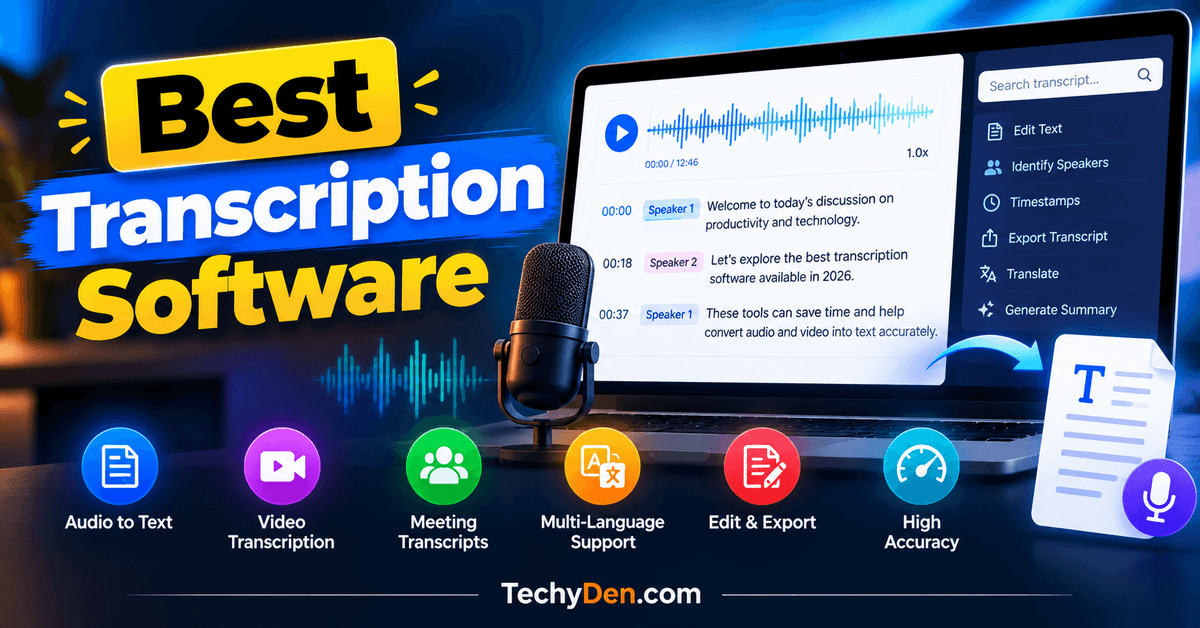
Transcription software makes it easier to convert spoken words from audio recordings, video files, interviews, meetings, lectures, and podcasts into written text. Instead of typing every word manually, you can use AI-powered tools to generate transcripts, identify speakers, add timestamps, and create subtitles.
The best transcription software depends on what you need to transcribe. Journalists may need accurate interview transcripts, businesses may want automatic meeting notes, and content creators may prefer software that converts speech into editable video content. Professional transcriptionists, meanwhile, may need precise playback controls and foot-pedal support.
Several tools now combine speech recognition with AI summaries, translation, collaboration, and editing features. However, accuracy varies depending on audio quality, accents, background noise, technical vocabulary, and the number of speakers.
In this guide, we compare eight of the best transcription software solutions in 2026, including their main features, advantages, limitations, pricing considerations, and ideal use cases.
Quick Overview: Best Transcription Software
| Software | Best For | Main Strength | Pricing Model |
|---|---|---|---|
| Rev | Human-verified transcription | AI and human transcription options | Free access, subscriptions, and per-minute services |
| Trint | Journalists and collaborative teams | Transcript editing and collaboration | Subscription plans |
| Descript | Podcasters and video creators | Edit audio and video through text | Free and paid plans |
| Transcribe | Manual and automatic transcription | Playback controls and transcription editor | Annual license plus optional transcription charges |
| Express Scribe | Professional transcriptionists | Playback shortcuts and foot-pedal support | Free and paid versions |
| InqScribe | Researchers and video transcription | Timecodes and manual transcription tools | Trial and paid license |
| Otter.ai | Meetings and interviews | Live transcription and AI meeting notes | Free and paid plans |
| Sonix | Multilingual audio and video | Transcription, translation, and subtitles | Pay-as-you-go and subscriptions |
Pricing and plan limits can change. Check the linked official websites before purchasing. The recommendations below are based on each product’s advertised capabilities and intended use cases, not a controlled accuracy benchmark.
Researchers and students can combine transcription software with the best academic writing tools to organize research notes, prepare drafts, and improve their writing workflow.
What Is Transcription Software?
Transcription software converts spoken language into written text. Depending on the tool, it may process live speech, prerecorded audio, video files, or voice recordings.
Traditional transcription software helps people listen to recordings and type the words manually. Modern AI transcription software uses automatic speech recognition (ASR) to generate text from speech.
Some tools combine both approaches, allowing users to generate an initial transcript automatically and then correct mistakes using an integrated editor.
For example, a journalist can upload an interview recording and obtain a draft transcript. A podcaster can convert an episode into text and use that transcript to edit the recording. A business can transcribe a meeting and generate a summary with action items.
Types of Transcription Software
- AI transcription software: Automatically converts speech into text. It is suitable for lectures, interviews, podcasts, and general audio or video recordings.
- Meeting transcription software: Captures live conversations in supported meeting platforms and may generate summaries, speaker labels, and action items.
- Human transcription services: Professional transcribers prepare or verify transcripts. These services are useful when accuracy, formatting, or specific professional requirements are important.
- Manual transcription software: Provides playback controls, keyboard shortcuts, timecodes, and other tools to help people transcribe recordings efficiently.
- Video transcription and captioning software: Converts video speech into text and may generate subtitles or captions in formats such as SRT and VTT.
8 Best Transcription Software Solutions in 2026
1. Rev
Best for Human-Verified Transcription
Best for: Journalists, researchers, legal professionals, and users who need human-reviewed transcripts.
Rev provides AI-powered transcription alongside human transcription services. This gives users the option to choose automated processing for speed or human transcription when the recording requires additional attention.
Rev is particularly relevant when a transcript will be used in a professional workflow and errors could cause problems. Its services include transcription, captions, subtitles, and an interactive editor.
The company also offers AI features for analyzing and working with transcripts.
Key Features
- AI transcription for supported audio and video.
- Human transcription services.
- Speaker identification and transcript editing.
- Captioning and subtitle services.
- Mobile recording and dictation options.
- AI-generated summaries and analysis.
- Export and sharing options.
- Services for professional and organizational workflows.
Pros
- Offers both automated and human transcription.
- Useful for interviews, research, and professional recordings.
- Provides additional captioning and subtitle services.
- Offers an interactive transcript editor.
- Includes options for organizations with more demanding workflows.
Cons
- Human transcription is more expensive than many automated alternatives.
- Human services may take longer than instant AI processing.
- Subscription features and service pricing vary.
- AI transcripts may still need correction.
Rev Pricing
Rev offers limited free access, subscription plans, and separately priced transcription services. Its official pricing page lists human transcription from $1.99 per audio minute, while AI transcription and captioning have separate pricing options.
The final cost depends on the service, subscription, and any applicable add-ons.
Check the official Rev pricing page for current rates.
Our verdict: Rev is a strong option when you want a choice between AI transcription and human-reviewed work. It is especially worth considering for important interviews, research projects, and professional transcripts where additional verification matters.
2. Trint
Best for Journalists and Collaborative Teams
Best for: Journalists, media organizations, researchers, and teams that work with recorded interviews.
Trint is an AI-powered transcription platform designed to help users turn audio and video into searchable, editable text. It focuses on the workflow surrounding transcription, including reviewing recordings, correcting transcripts, collaborating with colleagues, and preparing content for publication.
This makes it useful for people who regularly work with interviews, reports, documentaries, and other media projects.
Rather than simply producing a text file, Trint provides tools for editing and organizing transcript-based work.
Key Features
- AI transcription for supported languages.
- Searchable and editable transcripts.
- Collaboration tools for teams.
- Audio and video playback alongside text.
- Options for exporting transcripts.
- Translation features for supported workflows.
- Tools for reviewing recorded interviews.
- Organization-oriented workflows for media teams.
Pros
- Designed for interview and media workflows.
- Supports collaborative transcript review.
- Combines recording playback with text editing.
- Useful for organizing large amounts of recorded material.
- Can help teams turn interviews into publishable content.
Cons
- Subscription costs may be high for occasional users.
- Some features depend on the selected plan.
- Automated transcripts still need review.
- Users who only need basic speech-to-text may find the platform more extensive than necessary.
Trint Pricing
Trint offers subscription-based plans, with pricing and usage limits depending on the selected package. Because plan names, transcription allowances, and collaboration features can change, check the official pricing page before subscribing.
Visit Trint’s official website for current plan information.
Our verdict: Trint is worth considering if transcription is part of a larger editorial or collaboration workflow. It is particularly relevant to journalists and teams that need to review recordings together rather than simply download a transcript.
3. Descript
Best for Podcasters and Video Creators
Best for: YouTubers, podcasters, content creators, and video editors.
Descript combines transcription with audio and video editing. One of its defining features is text-based editing: users can edit a transcript to make corresponding changes to the recording.
This approach can simplify editing spoken content. Instead of working exclusively with a traditional timeline, you can review the generated transcript, remove unwanted sections, and make edits through text.
Descript also offers AI-powered production tools that can help creators improve audio, remove selected filler words, generate clips, and prepare content for publication.
Descript combines transcription with video editing, making it useful for creators who want to edit spoken content and prepare videos for publication.
Key Features
- Automatic transcription for supported languages.
- Text-based audio and video editing.
- Speaker detection and transcript editing.
- Screen recording and recording tools.
- Filler-word removal.
- AI-powered audio enhancement.
- Caption and subtitle generation.
- Collaboration and media export features.
Pros
- Combines transcription and editing in one workflow.
- Useful for podcast and video production.
- Text-based editing can make spoken content easier to edit.
- Includes AI tools for improving audio and preparing clips.
- Offers a free plan for trying its workflow.
Cons
- Advanced production features may require a paid subscription.
- Users may need time to learn the editing interface.
- Transcription allowances vary by plan.
- It may be excessive for users who only need a plain text transcript.
Descript Pricing
Descript offers a free plan and paid subscriptions. Its official pricing page lists transcription allowances that vary by plan, alongside audio and video editing capabilities.
The current plan structure and limits should be checked before subscribing.
Visit Descript’s official pricing page.
Our verdict: Descript is one of the most useful options for creators who need more than transcription. If you regularly edit YouTube videos, interviews, tutorials, or podcasts, combining text-based editing with audio and video tools may save time.
4. Transcribe
Best for Manual and Automatic Transcription
Best for: Researchers, students, journalists, and transcriptionists who want playback controls and an integrated editor.
Transcribe, available through Wreally, combines manual transcription tools with optional automatic speech recognition.
Its integrated media player and text editor help users listen to recordings and type corrections without constantly switching between applications. Playback controls, keyboard shortcuts, and text expansion can make repetitive transcription work easier.
It also supports automatic transcription for users who want to generate a draft rather than type everything from scratch.
Key Features
- Integrated audio player and text editor.
- Playback controls and looping.
- Keyboard shortcuts.
- Voice typing and dictation.
- Text expansion for frequently used phrases.
- Foot-pedal integration.
- Automatic transcription as an optional service.
- Timecodes, speaker identification, and subtitle options.
Pros
- Supports both manual and automatic workflows.
- Includes useful tools for people who type transcripts themselves.
- Foot-pedal support can improve professional transcription workflows.
- Provides an integrated player and editor.
- Offers an annual license for its manual transcription tools.
Cons
- Automatic transcription costs extra.
- It does not provide the same all-in-one production workflow as a full audio and video editor.
- Accuracy depends on the recording and selected transcription engine.
- Users may need to learn its playback shortcuts and editing workflow.
Transcribe Pricing
The official pricing page lists a self-transcription license at $20 per year. Automatic transcription is offered as an additional service, with its own usage charges.
Check Transcribe’s official pricing page for current rates and terms.
Our verdict: Transcribe is a useful choice if you want a manual transcription editor with optional AI assistance. It is particularly relevant to people who prefer to listen carefully and correct text themselves rather than rely entirely on automated output.
5. Express Scribe
Best for Professional Transcriptionists
Best for: Professional transcriptionists, administrative staff, researchers, and people who regularly transcribe dictation.
Express Scribe is transcription software from NCH Software. Unlike meeting assistants that automatically record and summarize conversations, Express Scribe focuses on helping users listen to recordings and type the content efficiently.
It includes playback controls, keyboard shortcuts, and support for compatible foot pedals. These features allow transcriptionists to control audio without repeatedly using a mouse.
Express Scribe can also work with speech-recognition tools to support a workflow in which software produces an initial draft and a person corrects it.
Key Features
- Variable-speed audio playback.
- Keyboard hotkeys for playback control.
- Compatible foot-pedal support.
- Audio and video playback.
- Support for numerous audio formats.
- File loading and management tools.
- Compatibility with external word processors.
- Free and paid versions.
Pros
- Well suited to manual transcription.
- Playback controls support repetitive listening tasks.
- Foot-pedal compatibility can improve efficiency.
- Offers a free version for basic use.
- Useful for dictation, interviews, lectures, and recorded statements.
Cons
- It is primarily a playback and transcription tool, not a complete AI meeting assistant.
- You may need a separate application or service for automatic transcription.
- Its interface may feel less modern than some newer cloud platforms.
- Professional features depend on the selected version.
Express Scribe Pricing
Express Scribe offers a free version and paid editions. Pricing varies by license, edition, and billing option.
Check the official Express Scribe website for current downloads and pricing.
Our verdict: Express Scribe remains relevant for people who transcribe recordings manually. If you need playback control, keyboard shortcuts, and foot-pedal support, it may be a better fit than a meeting-focused AI assistant.
6. InqScribe
Best for Timecoded Transcription
Best for: Video researchers, filmmakers, academics, and people who need timecoded transcripts.
InqScribe is designed for transcribing audio and video with precise time references. It provides an integrated media player, text editor, and tools for inserting timecodes while reviewing a recording.
Timecodes are particularly helpful when you need to connect a written transcript to a specific moment in a recording. Researchers can cite a passage, filmmakers can locate dialogue, and educators can organize material from recorded lectures.
InqScribe emphasizes manual transcription and media review rather than automated meeting summaries.
Key Features
- Integrated media playback and transcript editing.
- Timecode insertion.
- Customizable keyboard shortcuts.
- Text snippets for repeated phrases.
- Foot-pedal support.
- Playback-speed adjustment.
- Subtitle and transcript export options.
- Trial and paid licensing options.
Pros
- Useful for timecoded transcripts.
- Helps users connect text to specific moments in audio or video.
- Offers shortcuts for repetitive transcription work.
- Suitable for research and media workflows.
- A paid license may suit users who prefer a dedicated desktop tool.
Cons
- Less suitable for users who primarily want automatic speech recognition.
- Cloud collaboration is not its main focus.
- Users may need another tool for automated transcription.
- Licensing and platform availability should be checked before purchase.
InqScribe Pricing
InqScribe has offered trial and paid licensing options. Verify the current license price, supported operating systems, and any academic discounts on its official website before purchasing.
Visit InqScribe’s official website.
Our verdict: InqScribe is worth considering when timecodes and precise manual review are central to your work. It is more specialized than general-purpose AI transcription tools, but that focus can be useful for researchers and video professionals.
7. Otter.ai
Best for Meeting Transcription
Best for: Remote workers, students, managers, and teams that need searchable meeting notes.
Otter.ai is an AI meeting assistant designed to transcribe conversations and make meeting information easier to review.
It supports live transcription and integrates with supported meeting platforms, including Zoom, Microsoft Teams, and Google Meet. Depending on the plan and workflow, Otter can identify speakers, generate summaries, and extract action items from conversations.
This makes it useful for people who attend frequent meetings and want a searchable record of discussions.
Key Features
- Live transcription for supported meetings.
- Automatic meeting notes.
- Speaker identification.
- AI-generated summaries.
- Action-item extraction.
- Search across transcripts.
- Mobile applications.
- Integrations with supported meeting and productivity services.
Pros
- Useful for recurring meetings and interviews.
- Makes conversations searchable after the meeting.
- Reduces the need to type notes manually.
- Includes summaries and action-item features.
- Offers a free plan with limited usage.
Cons
- Free-plan limits restrict some workflows.
- Advanced features require a paid plan.
- Transcription quality depends on the audio and language.
- Users should review meeting-consent and recording requirements.
- It may not be the best option for precise human-verified transcripts.
Otter.ai Pricing
Otter.ai offers a free Basic plan and paid plans for individuals, teams, and organizations. The official pricing page lists monthly transcription limits, file-import restrictions, and additional features that differ by plan.
Check the latest details at Otter.ai’s official pricing page.
Our verdict: Otter.ai is a strong choice if you mainly need meeting transcription, searchable notes, and summaries. It is less specialized for manually transcribing media or editing videos than tools such as Express Scribe and Descript.
8. Sonix
Best for Multilingual Transcription and Subtitles
Best for: Content creators, journalists, researchers, and businesses working with multilingual audio or video.
Sonix is an automated transcription, translation, and subtitling platform. It converts supported audio and video files into editable transcripts and provides tools for reviewing, translating, and exporting the results.
The platform is useful for users who need more than plain text, particularly when working with interviews, presentations, podcasts, or videos intended for audiences in different languages.
Sonix also provides an in-browser editor and tools for speaker labels, timestamps, and subtitles.
Key Features
- Automated audio and video transcription.
- Transcription in supported languages.
- Translation tools.
- Speaker labels and timestamps.
- In-browser transcript editor.
- Subtitle and caption exports.
- AI-assisted transcript analysis.
- Collaboration and sharing options.
Pros
- Combines transcription, translation, and subtitles.
- Useful for multilingual content workflows.
- Includes a transcript editor.
- Supports speaker labels and timestamps.
- Offers pay-as-you-go and subscription options.
Cons
- Processing requires an internet connection.
- Costs can increase with frequent or lengthy recordings.
- Automated transcripts may need manual correction.
- Subscription allowances and collaboration features vary by plan.
Sonix Pricing
Sonix offers pay-as-you-go transcription and subscription plans. Its official pricing page currently lists a 30-minute free trial, a $10-per-hour pay-as-you-go option, and subscription plans with different included transcription and AI-analysis hours.
Additional usage and team seats may incur extra charges.
Check Sonix’s official pricing page for the latest plan details.
Our verdict: Sonix is worth considering when you need transcription alongside translation and subtitle creation. It is particularly useful for creators and organizations working with multilingual audio and video.
If you need to create tutorials or capture on-screen demonstrations before transcribing them, see our guide on how to record screen on Android.
Best Transcription Software by Use Case
The right choice depends on your workflow. Use this guide to narrow down the options.
| Your Requirement | Recommended Tool | Why |
|---|---|---|
| Human-verified transcripts | Rev | Offers human transcription services alongside AI |
| Interview and editorial collaboration | Trint | Designed for transcript review and teamwork |
| Podcast and video editing | Descript | Connects transcripts to media editing |
| Manual transcription with AI assistance | Transcribe | Combines a player, editor, and optional automatic transcription |
| Professional manual transcription | Express Scribe | Offers playback shortcuts and foot-pedal support |
| Timecoded research transcripts | InqScribe | Provides timecode-focused editing |
| Meeting notes and summaries | Otter.ai | Focuses on live transcription and meeting workflows |
| Multilingual transcription and subtitles | Sonix | Combines transcription, translation, and subtitle exports |
These recommendations reflect the tools’ intended use cases. The best option for you may change depending on your budget, languages, privacy requirements, and recording quality.
How to Choose the Best Transcription Software
Before purchasing a transcription tool, consider the following factors.
1. Transcription Accuracy
Accuracy is one of the most important considerations, but no tool performs equally well on every recording.
Clear speech with a good microphone is generally easier to transcribe than noisy recordings with overlapping speakers, strong accents, or specialized terminology.
If accuracy is important, test the tool with a representative sample of your own recordings. Check names, numbers, technical terms, punctuation, and speaker labels rather than relying only on a vendor’s advertised accuracy percentage.
2. Supported Languages
Check whether the software supports the languages and dialects you need.
If you work with multilingual interviews, lectures, or videos, also verify whether the platform supports automatic language detection, translation, and subtitle generation.
Language support alone does not guarantee equal accuracy across all languages.
3. Speaker Identification
Speaker identification, sometimes called speaker diarization, separates a recording into sections attributed to different speakers.
This is especially useful for interviews, meetings, panel discussions, and research recordings.
However, automated systems can mislabel speakers when voices sound similar or when participants interrupt one another. Review speaker labels before publishing or relying on a transcript.
4. Audio and Video File Support
Check whether the software accepts your recording formats and file sizes.
Some tools focus on audio uploads, while others support video files, live meetings, and direct integrations with recording platforms.
If you need subtitles, check whether the tool can export formats such as SRT or VTT.
5. Editing and Export Options
A transcript is more useful when you can correct mistakes and export the finished text into your preferred format.
Look for a searchable editor, timestamps, speaker labels, and export options such as TXT, DOCX, PDF, SRT, or VTT, depending on your workflow.
If you produce videos, consider whether the software also supports captions or text-based editing.
6. Pricing and Usage Limits
Transcription tools use different pricing models. Some charge by the minute or hour of audio, while others use subscriptions with monthly allowances.
Calculate the cost based on the amount of audio you actually process. A low monthly price may not be economical if the plan includes very few transcription minutes.
Also check whether file imports, AI summaries, extra users, translation, and additional storage are billed separately.
7. Privacy and Security
Recordings may contain personal conversations, confidential business information, research interviews, or sensitive professional material.
Before uploading a recording, review the provider’s privacy policy, data retention settings, access controls, encryption information, and any applicable compliance commitments.
If you are recording meetings, obtain any required consent and follow your organization’s policies.
For sensitive medical, legal, or business records, do not assume that a general-purpose transcription service meets your compliance requirements. Confirm the specific product, plan, contractual terms, and applicable regulations.
8. Integrations and Workflow
Choose software that fits the way you already work.
Meeting assistants may integrate with video-conferencing applications, while content-creation platforms may connect transcription to video editing. Manual transcription tools may work better with word processors and compatible foot pedals.
A good workflow should minimize repetitive work without making it difficult to verify the final transcript.
AI Transcription vs Human Transcription: Which Is Better?
AI and human transcription serve different purposes.
| Factor | AI Transcription | Human Transcription |
|---|---|---|
| Processing speed | Usually fast | Generally slower |
| Cost | Often lower | Usually higher |
| Editing required | Depends on audio quality and accuracy | Depends on the service and instructions |
| Complex terminology | May require correction | A qualified transcriber may handle context better |
| Large volumes | Often easier to scale | May require additional time and budget |
| Formatting requirements | Depends on the tool | Can be specified when ordering |
| Best suited for | Drafts, meetings, content workflows | High-stakes or specialized transcripts |
AI transcription is often a practical starting point for routine recordings. Human transcription or human verification may be preferable when the transcript must meet strict quality, formatting, or professional requirements.
Neither approach eliminates the need to verify important information.
How to Improve Transcription Accuracy
You can improve the results from many transcription tools by preparing your recordings carefully.
- Use a good microphone. Clear speech helps speech-recognition systems distinguish words more effectively.
- Reduce background noise. Record in a quiet environment and minimize interruptions when possible.
- Avoid overlapping speech. Ask participants to speak one at a time when recording interviews or meetings.
- Provide context where supported. Custom vocabulary, names, and technical terms can help some tools handle specialized language.
- Check speaker labels. Review speaker changes and timestamps rather than assuming the software has identified every speaker correctly.
- Proofread important transcripts. Verify names, dates, figures, quotations, and technical details against the original recording.
- Protect confidential recordings. Choose a service whose data handling and security arrangements match the sensitivity of your material.
Frequently Asked Questions About Transcription Software
What is the best transcription software in 2026?
The best option depends on your needs. Rev is worth considering for human-verified transcripts, Descript for audio and video editing, Otter.ai for meeting notes, and Sonix for multilingual transcription and subtitles. Compare features, limits, and costs before deciding.
What is the best free transcription software?
Several tools offer free access or limited free plans. Otter.ai provides a free plan with usage limits, while Descript offers limited transcription as part of its free plan. Express Scribe also offers a free version focused on manual transcription. Check the current restrictions before choosing.
Is AI transcription accurate?
AI transcription can produce useful results, especially when the recording is clear. However, accuracy depends on accents, background noise, overlapping speech, language, and technical vocabulary. Always review important transcripts, particularly when they will be used for publication, research, or professional decisions.
Which transcription software is best for meetings?
Otter.ai is a useful option for meeting transcription because it focuses on live transcripts, meeting summaries, speaker identification, and action items. Before recording a meeting, check the platform’s compatibility and follow applicable consent and recording policies.
Which transcription software is best for YouTube videos?
Descript is a good option for creators who want to transcribe and edit videos using text. Sonix is worth considering if you also need subtitles or multilingual workflows. Check whether your chosen plan includes the required transcription hours and export formats.
Can transcription software identify different speakers?
Many tools offer speaker identification or diarization. This feature attempts to separate a recording into sections for different speakers. It can be useful for interviews and meetings, but speaker labels may require correction when voices overlap or sound similar.
Is human transcription better than AI transcription?
Human transcription may be preferable for recordings requiring detailed review, specialized terminology, or specific formatting. AI transcription is usually faster and can be more economical for routine work. The best choice depends on the recording, required accuracy, turnaround time, and budget.
Can transcription software convert audio to Word documents?
Many transcription platforms provide downloadable text or document formats, although export options differ. Check whether the tool supports DOCX or another format that works with your word processor. You may need to adjust formatting after exporting.
Which transcription software supports multiple languages?
Sonix and Trint are worth investigating for multilingual workflows, while Descript and other tools support selected languages depending on the current plan. Verify the exact languages supported and test your target language before committing to a subscription.
Is transcription software safe for confidential recordings?
Security depends on the provider, product, settings, and subscription plan. Review data retention, access controls, encryption, and applicable compliance terms before uploading confidential audio. For sensitive professional information, confirm that the specific service meets your organization’s requirements.
Final Verdict: Which Transcription Software Should You Choose?
The best transcription software is the one that fits your recording workflow, accuracy requirements, and budget.
Rev is worth considering when human verification matters. Trint suits editorial teams that collaborate on interviews. Descript is a strong choice for podcasters and video creators, while Transcribe, Express Scribe, and InqScribe offer useful workflows for manual transcription and detailed review.
Otter.ai is particularly relevant to meeting notes and live transcription, while Sonix combines transcription with translation and subtitle tools.
Before paying for a subscription, try the available free plan or trial with a representative recording. Compare the output, review the export options, and calculate the total cost for your expected usage.
Our recommendation: Start with the tool that matches your primary use case rather than choosing based on a headline accuracy claim. Test it with your own audio, verify important passages, and review its privacy terms before uploading sensitive recordings.